Key Takeaways
- VeryAI raised $10 million in a seed round led by Polychain Capital to launch its Proof of Reality platform on Solana and fight AI-generated fake accounts.
- The company’s palm-scan system can tell real humans apart from bots, deepfakes, and fake identities while keeping personal data safe.
- Palm scans are turned into encrypted biometric signatures, so identities can be verified without storing sensitive raw data.
VeryAI, a rising startup in identity verification, has just raised $10 million in a seed round led by Polychain Capital, with backing from the Berggruen Institute, Anagram, and other early investors. The funding will support the rollout of its Proof of Reality platform on the Solana blockchain, designed to tackle one of the internet’s fastest-growing problems: AI-driven fake accounts.
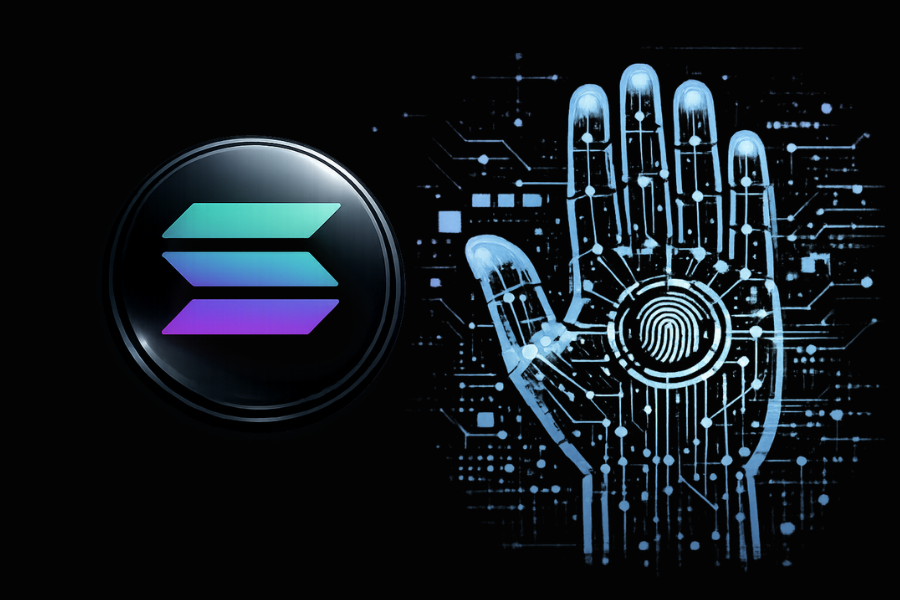
Key to VeryAI’s technology is a palm-scan verification system that can tell real humans apart from bots, deepfakes, and synthetic identities. As fraud becomes more advanced across crypto platforms, fintech apps, social media, and governance systems, VeryAI aims to help users and businesses verify who’s real. This funding is a big step toward making that happen across Solana and other blockchain platforms.
The Challenge: AI‑Generated Accounts and Identity Fraud
Recent advances in artificial intelligence have made it easier than ever to create highly convincing fake accounts, automated bots, and deepfake media that imitate real human behavior online. These AI-generated identities can interact with platforms, post content, vote, or even participate in token airdrops, often without raising suspicion.
Traditional verification methods, including passwords, CAPTCHAs, two-factor authentication, and even facial recognition, are finding it harder than ever to keep up. Advanced AI tools can mimic human traits and behaviors, bypassing these legacy systems and leaving platforms vulnerable to fraud, manipulation, and abuse at scale.
As a result, online services across crypto exchanges, fintech platforms, social networks, and governance systems are racing to implement more advanced identity verification solutions. The goal is to ensure that users are genuine humans, not synthetic personas or automated programs designed to exploit or manipulate digital ecosystems.
What VeryAI Is Building: Palm Biometrics + Blockchain
VeryAI combines biometrics with blockchain technology to create a privacy-focused proof-of-humanity system that works across platforms.
Palm-Scan Verification
Instead of using facial scans, which can be faked or collected without permission, VeryAI captures images of a user’s palm with a smartphone camera. Palm patterns are unique and less exposed than faces, making them a reliable way to confirm someone is a real person while lowering the risk of misuse.
These palm scans are converted into encrypted biometric signatures rather than stored as raw images. This means the system can verify identity without keeping sensitive personal data, using irreversible features that prove a user is human while protecting privacy.
Zero-Knowledge Proofs and On-Chain Attestations
To protect user privacy, VeryAI uses zero-knowledge proofs, a cryptographic method that lets users prove they are real humans without revealing their palm data. This allows people to verify themselves once and use that proof across different platforms without having to share their personal information again.
Identity confirmations are also recorded on the Solana blockchain, allowing decentralized platforms to verify a user’s human status in a secure, tamper-proof way. Using Solana provides a fast, low-cost system for storing and verifying these proof-of-humanity signals.
How Platforms Can Use It
VeryAI’s verification system is more than just a tool for checking customer identities. It is a building block that platforms can use to make sure only real people can use their services.
Examples of how it can be used include:
- Crypto exchanges and DeFi platforms: Stop fake or automated accounts from trading, staking, or voting. This helps keep markets fair and reduces the chance of manipulation.
- Token airdrops: Make sure rewards go to real people rather than automated wallets or accounts created by scripts. This ensures that giveaways and rewards reach genuine users.
- DAOs and governance systems: Enable fair voting, where each verified person receives only one vote. This helps prevent groups of fake accounts from controlling decisions.
- Social and Web3 apps: Reduce spam, scams, and fake accounts, including deepfakes. This creates safer and more trustworthy interactions for users.
By offering a “proof of humanity” layer, VeryAI helps platforms build trust, security, and fairness. This is especially important for decentralized systems, where anonymous or AI-generated accounts have often led to fraud, unfair control, and manipulation.
Funding and Future Roadmap
After raising $10 million in a seed round led by Polychain Capital, VeryAI plans to speed up the development and use of its Proof of Reality platform. The funding will help the company grow its engineering team, connect its system with more blockchain protocols and Web3 platforms, and research better ways to detect fraud and verify users.
Support from well-known figures in the ecosystem, including Solana’s co-founder, shows strong confidence in VeryAI’s approach. It reflects a growing belief that identity verification and proof-of-humanity systems will be an important part of the future of decentralized applications, helping crypto exchanges, DeFi platforms, governance systems, and social networks stay secure from AI-generated fraud and fake accounts.
Final Thoughts
VeryAI’s $10 million seed funding is a big step toward solving one of the internet’s fastest-growing problems: ensuring users are real. By combining palm-scan biometrics, zero-knowledge proofs, and blockchain attestations on Solana, the startup is building a system that lets platforms confirm humans while keeping personal data private, helping stop bots, fake accounts, and AI-driven fraud. Backed by Polychain Capital, Solana’s co-founder, and other investors, VeryAI is set to grow its platform, connect with more services, and improve fraud detection across the Web3 world. As decentralized apps continue to expand, systems like VeryAI’s proof-of-humanity will become essential for building trust, security, and fairness in the digital space.
Frequently Asked Questions
What is VeryAI?
VeryAI is a startup focused on identity verification. It builds tools that help platforms confirm real human users and prevent fake accounts and AI-driven fraud.
How much funding did VeryAI raise and who led the round?
VeryAI raised $10 million in a seed round led by Polychain Capital, with participation from the Berggruen Institute, Anagram, and other early investors.
What is the Proof of Reality platform?
Proof of Reality is VeryAI’s main platform, built on Solana, which combines palm-scan biometrics, blockchain, and cryptography to verify real humans online.
How does the palm-scan system work?
Users take a photo of their palm using a smartphone. Palm patterns are unique and less publicly exposed than faces, making them a secure way to confirm identity.
How does blockchain fit in?
Identity confirmations are recorded on the Solana blockchain, giving platforms a secure, tamper-proof, and low-cost way to verify proof-of-humanity signals.