Key Takeaways
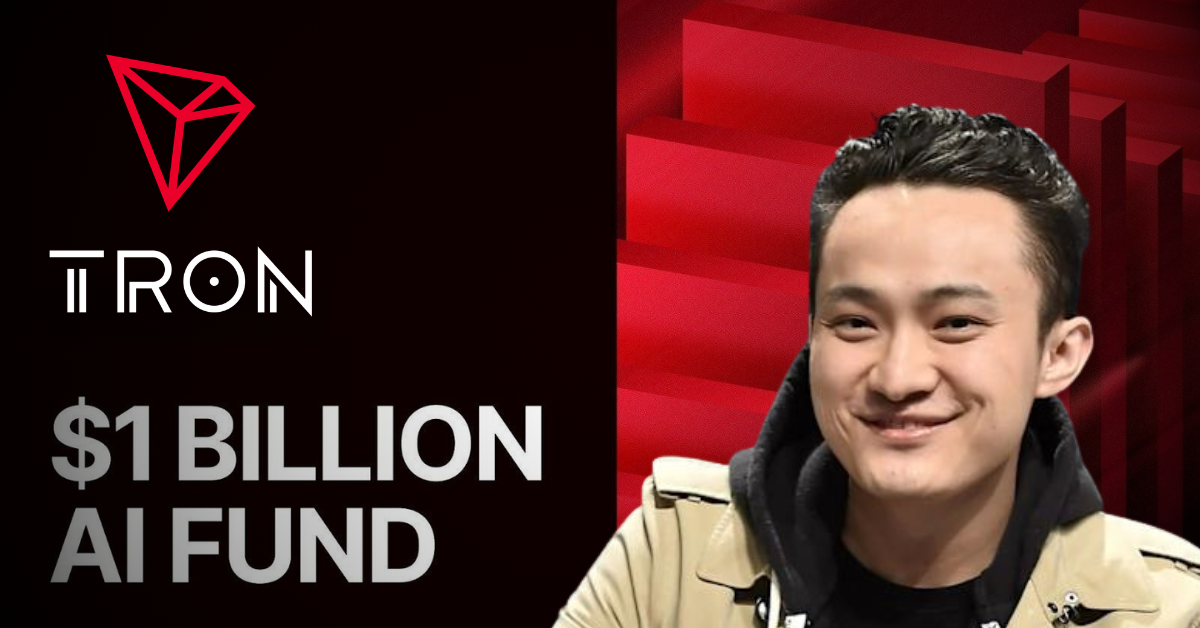
- TRON DAO has increased its AI fund tenfold, moving from $100 million to a staggering $1 billion to fuel the agentic economy.
- The fund prioritizes four pillars: agent identity, stablecoin payment rails, tokenized real-world assets (RWA), and developer tools.
- Tron positions itself as the high-speed, low-cost alternative to Ethereum for high-frequency machine-to-machine commerce.
In a bold move to dominate the “machine economy,” TRON DAO has officially scaled its dedicated AI fund to $1 billion. This massive injection of capital is specifically designed to support the rise of autonomous agents—software entities capable of executing financial transactions without human intervention. By targeting early-stage startups building the backbone of this new economy, Tron aims to become the primary layer for AI-driven commerce.
TRON DAO scales AI fund to $1B for the agentic economy
The expanded fund is not just about general AI; it is a surgical strike on the infrastructure required for agents to thrive. TRON DAO has identified four critical areas for investment: sophisticated identity systems for AI agents, stablecoin-based rails for instant payments, the tokenization of real-world assets, and robust developer tooling.
This strategy leans heavily into the thesis that stablecoins are the “natural” currency for AI. As these agents begin to manage assets and pay for services autonomously, the need for a scalable, low-friction settlement layer becomes paramount.
Tron scaling to support AI agents, Justin Sun says
Tron founder Justin Sun has been vocal about why his network is uniquely suited for this evolution. With over 370 million user accounts and a circulating supply of USDt exceeding $85 billion, the network already possesses the liquidity agents need. Sun points to the technical advantages of Tron, specifically its average confirmation time of roughly three seconds.
When compared to the twelve seconds typically seen on Ethereum, Tron’s speed makes it a superior candidate for the high-frequency, micro-transactions that define agentic behavior. To further lower the barrier for creators, the ecosystem recently introduced the AINFT framework, a toolkit specifically designed for deploying autonomous agents on-chain.
Final Thoughts
As the race between Solana, Base, and Ethereum intensifies, TRON’s $1 billion bet signals that the future of crypto isn’t just for humans—it’s for the millions of AI agents soon to be navigating the digital economy.
Frequently Asked Questions
What is an “agentic economy”?
It refers to a digital ecosystem where autonomous AI agents perform tasks and financial transactions independently.
Why does Tron use stablecoins for AI?
Stablecoins provide a stable, programmable medium of exchange that allows AI agents to predict costs and settle payments instantly.
What is the AINFT framework?
It is a developer toolkit on the Tron network used to build and deploy autonomous AI agents.