Decentralized, privacy-focused cryptocurrency Zcash (ZEC) surged to its highest level since 2018 over the weekend, briefly touching $855, as Grayscale filed its fifth amended registration statement with the Securities and Exchange Commission (SEC) to convert its existing Zcash Trust into a US exchange-traded fund (ETF).
What Grayscale Filed
Grayscale’s amendment would rename the trust The Zcash ETF and list it on NYSE Arca under the ticker ZCSH.
The filing sets an annual sponsor fee of 2.5%, with Bank of New York Mellon serving as transfer agent and Coinbase Custody Trust Company as custodian.
The registration remains preliminary, as securities can’t yet be sold under it, and the SEC has neither approved nor disapproved the filing. If it clears, this would be the first US ETF to directly track a privacy-focused digital asset.
Grayscale has already launched more than a dozen crypto ETFs, including products tracking Bitcoin, Ethereum, Dogecoin, and XRP, and its Zcash Trust itself has been running since 2017 with more than $260 million in assets under management.
Bloomberg Intelligence ETF analyst James Seyffart said Grayscale was “getting closer and closer to converting this thing into an ETF.”
The sponsor fee accrues daily and is paid in ZEC, gradually reducing the tokens each share represents over time.
For up to 12 months after the ETF becomes effective, Grayscale intends to direct all fees it collects toward trust marketing and initiatives supporting Zcash development, marketing, and education.
That plan is voluntary and revocable, and it doesn’t reduce the 2.5% fee itself; Grayscale is simply choosing to reinvest what it collects for a limited period rather than keep it.
The DCG Ownership Question
A subsidiary of Grayscale’s parent company, Digital Currency Group, is separately in nonbinding discussions to potentially contribute about 200,000 ZEC to the fund.
Under a June 30 snapshot, when the trust had 4,829,300 shares outstanding, each representing roughly 0.0805 ZEC, that contribution would create approximately 2.485 million new shares, or roughly 34% of the enlarged total, assuming no other creations, redemptions, or changes to the exchange ratio.
The same quarterly report classified 757,202 shares as related-party holdings, which, added to the potential DCG contribution, would put collective related-party ownership near 44.3%, still below a majority, though that figure treats those shares as one group rather than attributing them to a single holder and represents only a snapshot in time.
The filing itself warns that Digital Currency Group could end up owning a majority of the fund through DCG International Investments and other affiliates, which could let the group control the trust’s limited shareholder votes and create conflicts with other investors, though explicitly conditional, since Grayscale’s discussions with DCG International remain nonbinding and the affiliate could ultimately acquire more shares, fewer shares, or none at all.
For investors weighing whether to hold this ETF once it launches, that concentration risk is worth tracking separately from the fund’s price performance, since a single large holder with outsized voting power is a different kind of risk than the usual market volatility associated with a new crypto product.
Why the ETF Structure Matters for Tracking Zcash’s Actual Price
The core problem this conversion aims to fix is a long-running gap between the trust’s share price and the actual value of the ZEC it holds.
From October 18, 2021 through June 30, 2026, the trust recorded a maximum premium of 240% and a maximum discount of 55% to its net asset value, with an average premium of 53% and an average discount of 19% over that stretch, and its shares closed below net asset value on 700 separate days. As of August 20, just before the proposed ETF structure would take effect, that discount stood at 1%.
An ETF structure allows authorized participants to create or redeem large share baskets whenever the market price drifts from the underlying ZEC value, an arbitrage mechanism designed to keep the two prices much closer together than the trust structure has managed.
That said, perfect tracking is not guaranteed as cash-order constraints, a shortage of liquidity providers, suspended creations or redemptions, and limited liquidity in the ZEC market itself could all disrupt that arbitrage process, and concentrated ownership could further complicate active trading if large holders sell, or are simply perceived as likely to sell.
The Price Move Itself Is Heavily Derivatives-Driven
ZEC gained more than 22% over 24 hours to around $819 by early afternoon in New York on Saturday, extending a weekly gain of more than 30% and pushing its market cap to roughly $13.8 billion, the 12th-largest cryptocurrency by market value.
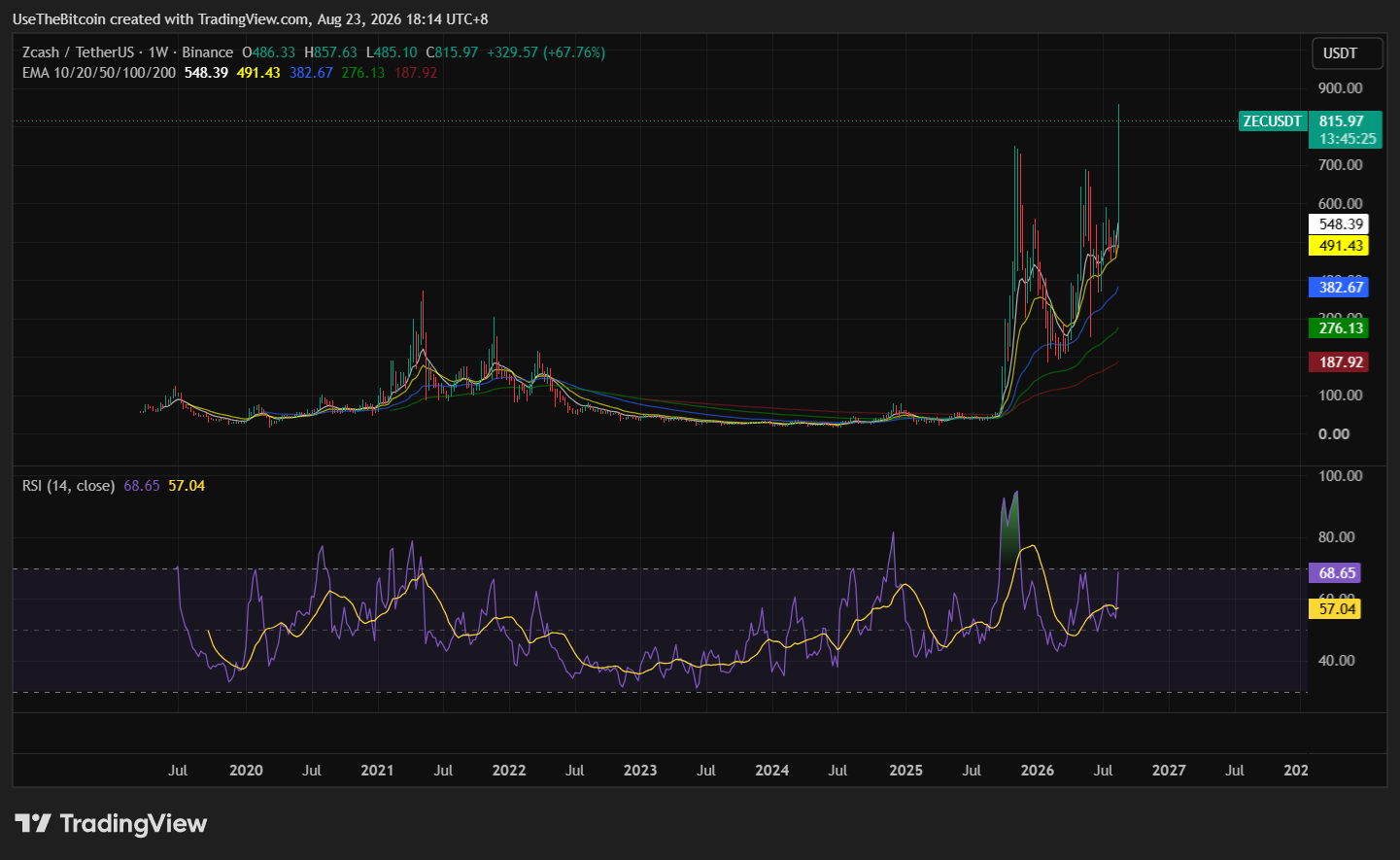
Moreover, ZEC futures volume reached about $9.54 billion over 24 hours, compared with only around $1.06 billion in spot trading volume, with open interest near $1.8 billion, equal to about 13% of the token’s entire market cap. That imbalance means this rally is currently being driven far more by leveraged derivatives positioning than by direct spot buying.
This rally also represents a sharp recovery from a serious setback as ZEC fell from around $630 to $250 in June after developers disclosed a counterfeiting vulnerability affecting the Orchard shielded pool, later patched through the NU6.2 network upgrade.
At Saturday’s peak, ZEC had more than tripled off that June low, though it remains roughly 75% below its all-time high above $3,190.
What Comes Next
The SEC has not set a public timeline for ruling on Grayscale’s amended filing, and the fund’s fifth amendment doesn’t guarantee approval.
Whether DCG’s discussions around the 200,000 ZEC contribution firm up into a binding commitment, and at what final size, will meaningfully shape both the ownership concentration questions raised in the filing and how much the fund’s launch might affect ZEC’s circulating supply.
What this means for you: this is still a proposed, unapproved conversion rather than a live ETF, and the current price surge reflects a mix of the filing news, a broader privacy-coin rally, and heavy derivatives activity rather than confirmed regulatory approval, so treat the current price action as running ahead of the actual regulatory process rather than a reaction to a done deal.