This article contains affiliate links. If you sign up or buy through them, UseTheBitcoin may earn a commission at no extra cost to you. It does not change what we write. Disclosure Policy
Sending money to the Philippines with crypto takes four moves: the worker abroad buys a dollar stablecoin such as USDT or USDC on an exchange licensed where they live, sends it over a blockchain network to the family’s account on an app licensed by the Bangko Sentral ng Pilipinas (BSP), and the family sells it for pesos and moves them to a bank account, GCash or Maya. Once the coins are sent, the pesos can usually be paid out within the hour, weekends included.
Crypto can beat a remittance app when the sender buys stablecoins cheaply, uses a low-fee network and sends a few hundred dollars or more at a time. It loses on small amounts, where flat network fees weigh more, and against the zero-fee transfers Remitly and Western Union advertised from the US to the Philippines in October 2026. It also fits badly in Saudi Arabia, where the authorities have said since 2018 that no one is licensed to deal in virtual currencies. Our guide to what crypto remittance is covers the basics.
Can you still use Binance to send money to the Philippines?
Not on the Philippine side. As of October 2026 Binance holds no BSP license, so your family should receive and cash out through a licensed local app, and Binance P2P is not a licensed option for them.
The Securities and Exchange Commission (SEC) warned the public in November 2023 that Binance was not authorized to offer securities in the country. In March 2024 the National Telecommunications Commission ordered internet providers to block its website, and in April 2024 the SEC asked Google and Apple to remove its apps from their Philippine stores.
Binance is returning through a local partner, BlockShoals Technologies, which the SEC cleared in April 2026 to test Binance products in its sandbox. In June 2026 the SEC said the first 90 days were for technical work only and that public onboarding needed further approval, and the BSP said neither company held a license as a virtual asset service provider (VASP). A Philippine Binance website was reachable again by late July 2026, but peso deposits had not opened, and BlockShoals’ press page announced no public launch through 30 October 2026. Our Coins.ph vs Binance Pay comparison covers the two payment apps.
Which Philippine apps can receive crypto and pay out pesos?
Coins.ph, PDAX, Maya and GCash’s GCrypto are the practical choices. The BSP’s list of virtual asset service providers dated 15 July 2026 names six active non-bank providers, including Betur Inc. (which runs Coins.ph), Maya Philippines and PDAX, plus two banks, GoTyme and UnionBank. GCash is not on the list; its help center says GCrypto is powered by PDAX. New names are unlikely soon, because the BSP extended its freeze on new VASP licenses from 1 September 2025. More on each app: how to buy and sell crypto in the Philippines.
Networks and fees below come from each provider’s own pages, checked on 30 October 2026.
| App | BSP status | USDT networks | USDC networks | Getting pesos out |
|---|---|---|---|---|
| Coins.ph | Licensed VASP (Betur Inc.) | Tron, Ethereum, BNB Smart Chain, Solana, TON, Polygon, Arbitrum and others | Ethereum, Base, Solana, BNB Smart Chain, Arbitrum and others; not Tron | InstaPay PHP 5, PESONet free; no deposit fee for USDT or USDC |
| PDAX | Licensed VASP | Tron, Ethereum, Solana, TON, Polygon, Celo, Kaia | Ethereum, Base, Solana, Polygon, Arbitrum, Stellar, Worldchain | Fee and minimum vary by bank or e-wallet; shown in the app |
| GCash GCrypto | Runs on PDAX | Tron, Ethereum, TON, Avalanche, Celo, Kaia | Ethereum, Base, Solana, Avalanche | Free to receive and to move to the GCash wallet; GCash to a bank by InstaPay PHP 10 |
| Maya | Licensed VASP (Maya Philippines) | Chosen in the app when you tap Receive | Chosen in the app | Sell into the Maya Wallet, then transfer; check the app for fees |
One warning about Coins.ph: in late September 2026 the BSP partially suspended DCPay Philippines, the company behind its peso wallet, from receiving InstaPay and PESONet transfers. On 30 October 2026 the Coins.ph status page still showed cash-ins under maintenance but cash-outs to banks, GCash and Maya working, and crypto deposits were not part of the order. Families who rely on Coins.ph should keep a second app verified.
Limits depend on verification. In October 2026 PDAX listed verified (Level 2) accounts at up to PHP 1,000,000 a day and PHP 2,000,000 a month, and fully verified GCash users could move up to PHP 100,000 a month from GCrypto to the GCash wallet, or PHP 500,000 with GCash Plus.
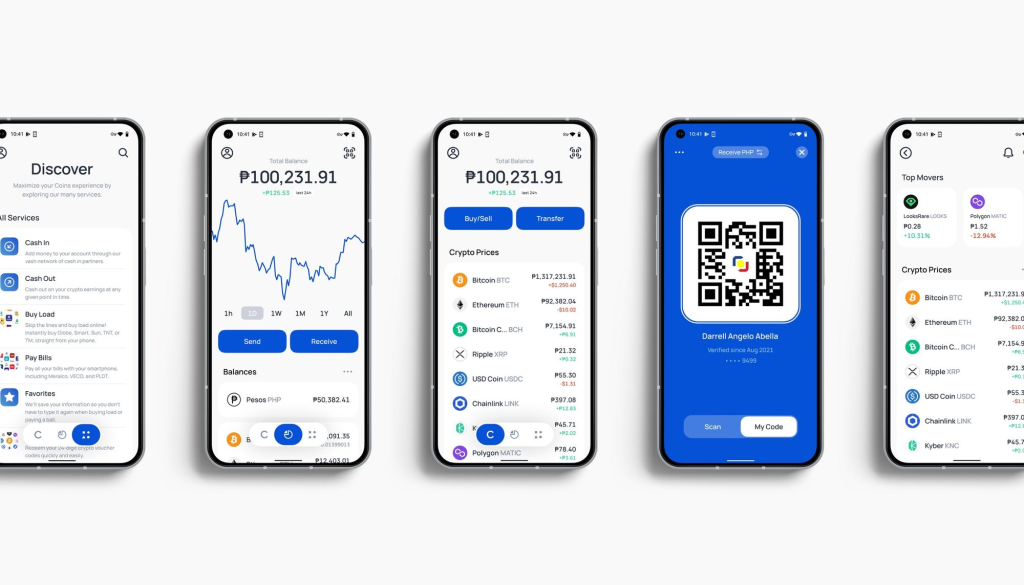
Image: Coins.ph
How do the pesos get to a bank or e-wallet?
The recipient sells the stablecoin for pesos in the app, then sends the pesos out by InstaPay or PESONet or to an e-wallet. InstaPay pays in real time, around the clock, up to PHP 50,000 per transfer; PESONet arrives the same banking day if sent before the bank’s cut-off, according to BPI’s guide as of October 2026.
As of October 2026, Coins.ph charges PHP 5 per InstaPay cash-out, nothing for PESONet, and PHP 105 for cash pickup at a remittance center on amounts up to PHP 10,000 (1.6% above that). GCrypto moves pesos to the GCash wallet free, and GCash has charged PHP 10 per InstaPay transfer to a bank since 4 July 2026. PDAX shows its fee for each bank or e-wallet on the cash-out screen. Other routes are in our guide to converting crypto to cash.
Under BSP Circular 1108, a single payout above PHP 500,000 needs extra due diligence and can only go by check, direct credit to a deposit account or an electronic account-to-account transfer.
How do you send crypto to the Philippines, step by step?
Set up the receiving side first, then send a small test before the full amount.
- The recipient opens and fully verifies an account on a BSP-licensed app such as Coins.ph, PDAX, Maya or GCrypto.
- The recipient picks the stablecoin, taps Receive or Deposit, chooses a network from the table above and shares the address, plus the destination tag if one is shown.
- The sender buys the same stablecoin on an exchange licensed in their country and withdraws it to that address on the same network.
- The sender sends a small amount first, waits until it shows in the recipient’s app, then sends the rest.
- The recipient sells the stablecoin for pesos and cashes out by InstaPay, PESONet or to an e-wallet.
Which stablecoin and network should you use?
Use a coin and network that both the sending exchange and the receiving app list. USDT on Tron, Ethereum or TON and USDC on Ethereum, Base or Solana work with Coins.ph, PDAX and GCrypto alike. Our USDC explainer covers that coin in more detail.
Withdrawal fees differ by network. On Coins.ph’s fee table in October 2026, sending USDT out cost 5 USDT on Ethereum, 3.5 on Tron, 0.3 on Solana and 0.01 on TON, and your exchange abroad has its own table. Because the fee is flat, 3.5 USDT is 1.75% of a $200 transfer but 0.35% of $1,000.
What mistakes cost people money?
Sending on a network the receiving app does not list is the costliest mistake, because PDAX and Coins.ph both warn that such coins may never be credited. Two traps from the table: USDT on BNB Smart Chain reaches Coins.ph but not PDAX or GCrypto, and Coins.ph does not accept USDC on Tron.
XRP and XLM also need a destination tag, sometimes called a memo, and PDAX lists a missing tag as a cause of stuck deposits. For transfers of PHP 50,000 or more, the travel rule in Circular 1108 makes platforms exchange the names and account details of sender and recipient, so expect questions. Completed crypto sends cannot be reversed or refunded.
Which countries can you send from?
You can send from the US, the UAE, Hong Kong and Singapore through exchanges licensed there; Saudi Arabia is the exception. In 2025 overseas Filipinos sent a record US$35.63 billion through banks, 39.7% of it from the US, according to BSP data reported in February 2026.
- In the United States, check that the exchange appears in FinCEN’s MSB Registrant Search and holds any license your state requires.
- In the UAE, check Dubai’s VARA public register, which separates full licenses from in-principle approvals that may not operate yet. Binance‘s Dubai company, Binance FZE, was listed in October 2026 with an active license issued in April 2024.
- In Saudi Arabia, the central bank and a government committee warned in 2018 that no one in the kingdom is licensed to deal in virtual currencies, and the US Library of Congress found no Saudi crypto law as of December 2024. A licensed remittance company is the safer route.
- In Hong Kong, the SFC tells investors to use only platforms on its licensed list, which named 13 platforms on 16 October 2026. Check that yours lets retail customers buy and withdraw the stablecoin you plan to send.
- In Singapore, firms offering digital payment token services need an MAS license under the Payment Services Act; search the firm’s name in MAS’s Financial Institutions Directory.
Is crypto cheaper or faster than Remitly or Western Union?
Crypto is sometimes cheaper but rarely simpler. When the World Bank priced a US$200 transfer from the US to the Philippines in August 2025, the total cost (fee plus exchange-rate margin) ran from 0.58% to 17.5% by provider and product. Its survey put Remitly’s products at 3.25% to 8.44% and Western Union’s at 3.46% to 5.06%.
Headline fees can mislead. In October 2026 Remitly advertised zero fees on US transfers to Philippine bank accounts and mobile wallets, and Western Union offered $0 fees on bank and wallet transfers until 15 December while stating on the same page that it makes money from the exchange rate. Compare the pesos received.
A crypto transfer stacks four costs: buying the stablecoin abroad, the network withdrawal fee, selling it for pesos (0.1% to 0.15% on Coins.ph’s spot market for accounts trading under PHP 500,000 a month) and the cash-out fee. Speed is close: Coins.ph puts crypto deposits at a few minutes to an hour, and Remitly advertises instant delivery when you pay by card. Remittance apps also need no crypto account at either end and offer cash pickup.
What are the risks and rules?
Scams, unlicensed P2P trades and transfers you cannot reverse are the main risks, and ID checks and the BSP’s travel rule are the main rules.
Scams aimed at overseas workers
Fake crypto investment platforms target OFWs and their families. In April 2024 the Department of Migrant Workers warned them about Trade 13.0 Serax, a crypto trading platform the SEC said was not registered, and named the signs: fake news headlines, unverified celebrity endorsements and returns that look too good to be true.
The US Federal Trade Commission adds general rules: only scammers demand payment in crypto, an online contact offering investment tips is a red flag, and no real job asks you to buy crypto for a “client”. Never share a password, one-time PIN or seed phrase. See seven crypto scams to watch for and wallet security mistakes to avoid.
P2P risks
Selling crypto directly to a stranger for a bank or GCash transfer leaves no licensed platform in the middle. The BSP urged the public in August 2025 not to deal with unregistered or offshore providers, and Binance P2P falls in that group in the Philippines. A stranger’s pesos may also come from a scam victim. Under the Anti-Financial Account Scamming Act of 2024 (Republic Act 12010), lending, selling or renting out an account to move money you know comes from a scam carries six to eight years in prison and a fine of PHP 100,000 to PHP 500,000.
ID checks, reporting and tax
Expect ID checks on both ends. Circular 1108 requires licensed platforms to verify their customers: PDAX’s unverified Level 1 accounts cannot cash out or withdraw crypto, and GCrypto needs a fully verified GCash account. Use only your own verified accounts. For tax on any gain from crypto held before selling, ask the Bureau of Internal Revenue or a tax adviser.
More remittance guides
These guides cover the other parts of a transfer, from choosing a service to keeping the money safe.
- 7 best crypto remittance platforms, with their fees
- The cheapest ways to send crypto internationally
- Cheapest crypto to transfer, by coin and network
- Coins.ph fees explained
- How to convert crypto to GCash
- Crypto wallets used by overseas workers
- How to spot and avoid crypto remittance scams
Frequently asked questions
Is it legal to receive crypto from abroad in the Philippines?
Yes, through a provider licensed by the BSP, which supervises virtual asset service providers under Circular 1108 of 2021. Coins.ph, PDAX and Maya are licensed; GCrypto runs on PDAX.
Can my family cash out crypto straight to GCash?
Yes. GCrypto moves pesos to the GCash wallet without a fee, within GCash’s monthly limit, and Coins.ph sends pesos to GCash by InstaPay for PHP 5 (October 2026 fees).
Should I send USDT or USDC?
Either works if the recipient’s app accepts that coin on your network. As of October 2026, Coins.ph, PDAX and GCrypto all accept USDT on Tron, Ethereum or TON and USDC on Ethereum, Base or Solana.
How long does a crypto transfer to the Philippines take?
Usually under an hour once the coins are sent. Coins.ph says deposits take a few minutes to an hour depending on the network, and InstaPay cash-outs land in real time.
What happens if I send on the wrong network?
The coins may be lost for good. Contact the platform’s support at once with the transaction ID, but PDAX and Coins.ph both warn that coins sent on a network they do not support may never be credited.
More crypto guides: Guides hub · What is cryptocurrency · What is a seed phrase · 7 crypto scams to avoid