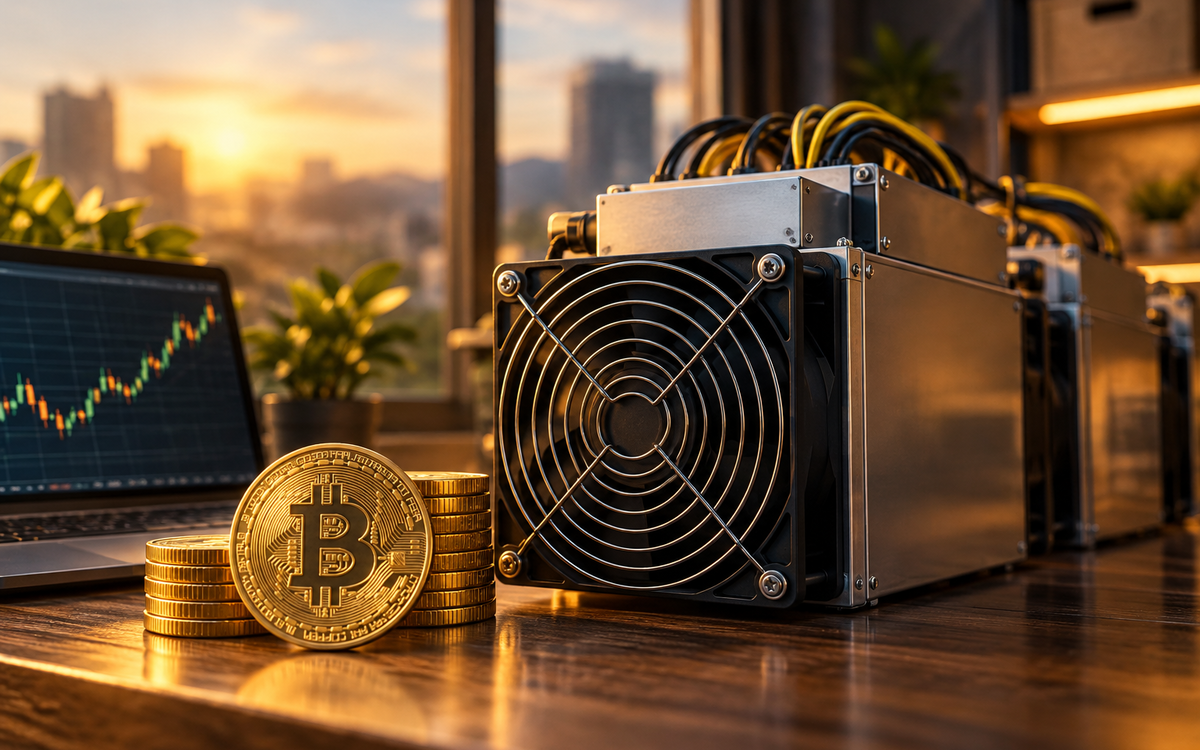
Bitcoin home mining in 2026 depends on several factors, but electricity costs and hardware efficiency are two of the biggest. Electricity rates of roughly $0.07 to $0.09 per kilowatt-hour or less can give home miners more room to cover operating costs, while current-generation hardware can produce more Bitcoin from the same amount of power.
By comparison, most US households pay around $0.16 to $0.20 per kilowatt-hour. Understanding how these costs interact with mining difficulty, hashprice, hardware efficiency, and other expenses is key to assessing whether home mining can work in 2026.
What Is Bitcoin Home Mining?
Bitcoin home mining means running an ASIC (Application-Specific Integrated Circuit, a chip built only to mine Bitcoin) at home to validate transactions and compete for the right to add the next block to the blockchain.
Anyone building or buying a mining rig is entering that same race. Whoever finds a valid block first earns the block subsidy, currently 3.125 BTC, plus that block’s transaction fees. Everyone else who worked on it, including every other home miner and mining pool running at the same time, gets nothing for that round.
Difficulty resets roughly every two weeks to keep blocks arriving close to every ten minutes. As more hashrate joins the network, your share of the network’s total hashrate shrinks, so your chance of finding the next block drops, even if your own hardware never changes.
How Does the Math Actually Work?
Two numbers decide whether a home miner makes or loses money: hashprice and your electricity rate.
Hashprice is what the network pays per day for each unit of computing power. On September 7, 2026, it sat at roughly $39.63 per petahash per second per day, with Bitcoin near $79,700 and difficulty at 127.45 trillion, according to Cryptolexicon’s report. The number shifts daily with price and difficulty, so treat any calculation as a snapshot.
From hashprice, you can work out a machine’s break-even electricity rate using its efficiency in joules per terahash (J/TH), where lower is better. A September 2026 report via openPR worked this out using the formula directly: break-even dollars per kWh equals hashprice divided by 24 times the machine’s J/TH rating.
At a hashprice of $40.54 per petahash per day, a 9.50 J/TH machine breaks even at $0.1778 per kWh. Below that rate, the machine profits. Above it, it doesn’t.
Break-Even Rates by Hardware Generation
A July 2026 Bitcoin-mining profitability snapshot shows how ASIC efficiency affects the electricity rate a machine can tolerate. At an estimated hashprice of roughly $29 per PH/s per day, newer, more efficient hardware could remain viable at higher electricity prices than older machines.
| Hardware | Cooling / generation | Efficiency | Electricity-only break-even rate |
| Antminer S19 XP | Older air-cooled generation | 21.5 J/TH | ~$0.055/kWh |
| Antminer S21 XP | Current air-cooled generation | 13.5 J/TH | ~$0.088/kWh |
| Antminer S23 Hydro | Current liquid-cooled generation | 9.5 J/TH | ~$0.124/kWh |
Table 1: Bitcoin ASIC Break-Even Electricity Rates (July 2026)
Estimates based on a $29 per PH/s per day hashprice; electricity-only, excluding pool fees, hosting, cooling, downtime, repairs, taxes, depreciation, and financing. Actual rates shift with Bitcoin’s price, fee revenue, and difficulty.
Lower J/TH means less electricity per unit of hashrate, so the S23 Hydro tolerates roughly 12.4¢/kWh, the S21 XP about 8.8¢/kWh, and the S19 XP about 5.5¢/kWh before costs eat their revenue.
The U.S. Energy Information Administration expects the average U.S. household electricity price to be 18.2¢ per kWh in 2026, higher than every break-even price in the table. At that rate, the mining machines listed would spend more on electricity than they earn from mining, based on the July estimates. To make money at home, miners generally need much cheaper electricity.
Why Difficulty and Hashprice Keep Changing
Difficulty peaked at an all-time high of 155.97 trillion in late October 2025, then fell as much as 19.3% by late August 2026 as some large mining companies redirected capacity toward AI hosting contracts instead, according to a September 2026 hashrate analysis from Shattered.io.
A lower difficulty helps anyone still mining: the same hardware earns more Bitcoin per unit of work. FutureBit’s September 16, 2026 tracker put the drawdown at 18.3% below the October 2025 peak, meaning identical hashrate now earns about 22.4% more expected Bitcoin than it did at the top.
That swing cuts both ways. Network hashrate has also been climbing back toward the 1 zettahash mark, and difficulty adjusts upward to match it every two weeks. Anyone running the numbers on a Tuesday should expect them to look different by the following retarget.
How Most Miners Actually Participate
Given how thin the margins are for most home setups, mining pools and cloud mining remain the two paths most people looking to participate in mining actually use.
Mining Pools
Joining a mining pool combines your hashrate with that of other miners. When the pool earns block rewards, it pays participants according to its payout rules and deducts a fee, often around 1% to 4%, depending on the pool and payout method. Pooling replaces the highly unpredictable payoff of solo mining with smaller, more regular payouts. That is why the vast majority of Bitcoin mining activity is coordinated through pools rather than done solo.
Cloud Mining
Cloud mining lets you rent hashrate from someone else’s data center instead of buying and hosting your own machine, which avoids the electricity and hardware problem directly. It introduces a different one: you are trusting a contract and a counterparty, and the space has a documented history of platforms overselling capacity or misrepresenting returns. Read the contract terms, confirm the operator’s track record, and treat any guaranteed-return promise as a warning sign rather than a selling point.
Common Mistakes Home Miners Make
Most of the losses home miners report trace back to a handful of avoidable decisions, not bad luck.
- Buying hardware based on the sticker price of Bitcoin, not the math. A rising Bitcoin price does not rescue a bad electricity rate. Run the break-even formula (hashprice divided by 24 times the machine’s J/TH rating) before ordering anything, using current numbers, not numbers from a headline you read three months ago.
- Ignoring uptime and repair turnaround. A host advertising a slightly cheaper rate but slower repairs and lower uptime can cost more per Bitcoin mined than a slightly pricier host with reliable service.
- Treating older ASICs as free money because they were cheap to buy. Machines above roughly 20 J/TH are effectively a liability at most current electricity rates and hashprice levels, regardless of how little you paid for the unit itself.
- Forgetting that mining income falls when Bitcoin’s price falls. Electricity bills do not move with the market. A 30% price drop cuts your dollar-denominated revenue by roughly 30% while your power cost stays exactly the same, which is the asymmetry that pushes marginal miners offline first.
Where to Go From Here
Before you put money into hardware, it’s worth rounding out the crypto basics this decision touches on, from how block rewards are actually won to ways to store Bitcoin safely once you’ve earned it. A hardware wallet is the standard next step for anyone accumulating mining proceeds rather than leaving them on an exchange.
This article is for informational purposes only and does not constitute financial advice. Do your own research before making any investment decisions, including any decision to purchase mining hardware.
Frequently Asked Questions
Still deciding whether a rig makes sense for your situation? These are the questions that come up most often.
Is Bitcoin home mining profitable at US residential electricity rates?
For most US households paying $0.16 to $0.20 per kilowatt-hour, no. Current break-even rates for even the newest air-cooled ASICs sit closer to $0.07 to $0.09 per kilowatt-hour, according to Startmining’s July 2026 breakdown, well below the national residential average.
What electricity rate do I need for home mining to pay off?
It depends on your hardware’s efficiency. A current-generation Antminer S21 XP (13.5 J/TH) needs roughly $0.07 to $0.09 per kilowatt-hour to break even, while an older S19 XP (around 17.5 J/TH) needs closer to $0.055 to $0.07, based on OneMiners’ August 28, 2026 calculations. Anyone above $0.10 per kilowatt-hour should expect thin or negative margins on most hardware currently sold.
Is joining a mining pool better than mining alone at home?
For almost anyone without industrial-scale hashrate, yes. Pools convert an unpredictable, potentially years-long wait for a solo block into small, steady, near-daily payouts, at the cost of a pool fee of roughly 1% to 4%.
Does a falling Bitcoin price make home mining less profitable even if difficulty stays flat?
Yes. Mining revenue is paid in Bitcoin, and its dollar value moves with the market, but electricity costs are fixed in dollars. A price drop cuts dollar revenue directly while costs stay the same, squeezing or eliminating margin.
Has mining difficulty gotten easier or harder in 2026?
Both, at different points. Difficulty fell as much as 19.3% from its October 2025 peak by late August 2026, partly because some public miners redirected power capacity to AI hosting contracts. It has also moved back upward as network hashrate climbed toward 1 zettahash, so the trend is not one-directional.