Key Takeaways
- Satoshi Nakamoto is estimated to hold approximately 1.1 million BTC, although the attribution relies on early mining patterns rather than confirmed wallet ownership.
- The Patoshi Pattern links roughly 22,000 early Bitcoin blocks through unusual mining behavior, but independent researchers disagree on the total.
- Most coins attributed to Satoshi remain unspent, raising questions about their accessibility, potential market impact and future quantum-computing risks.
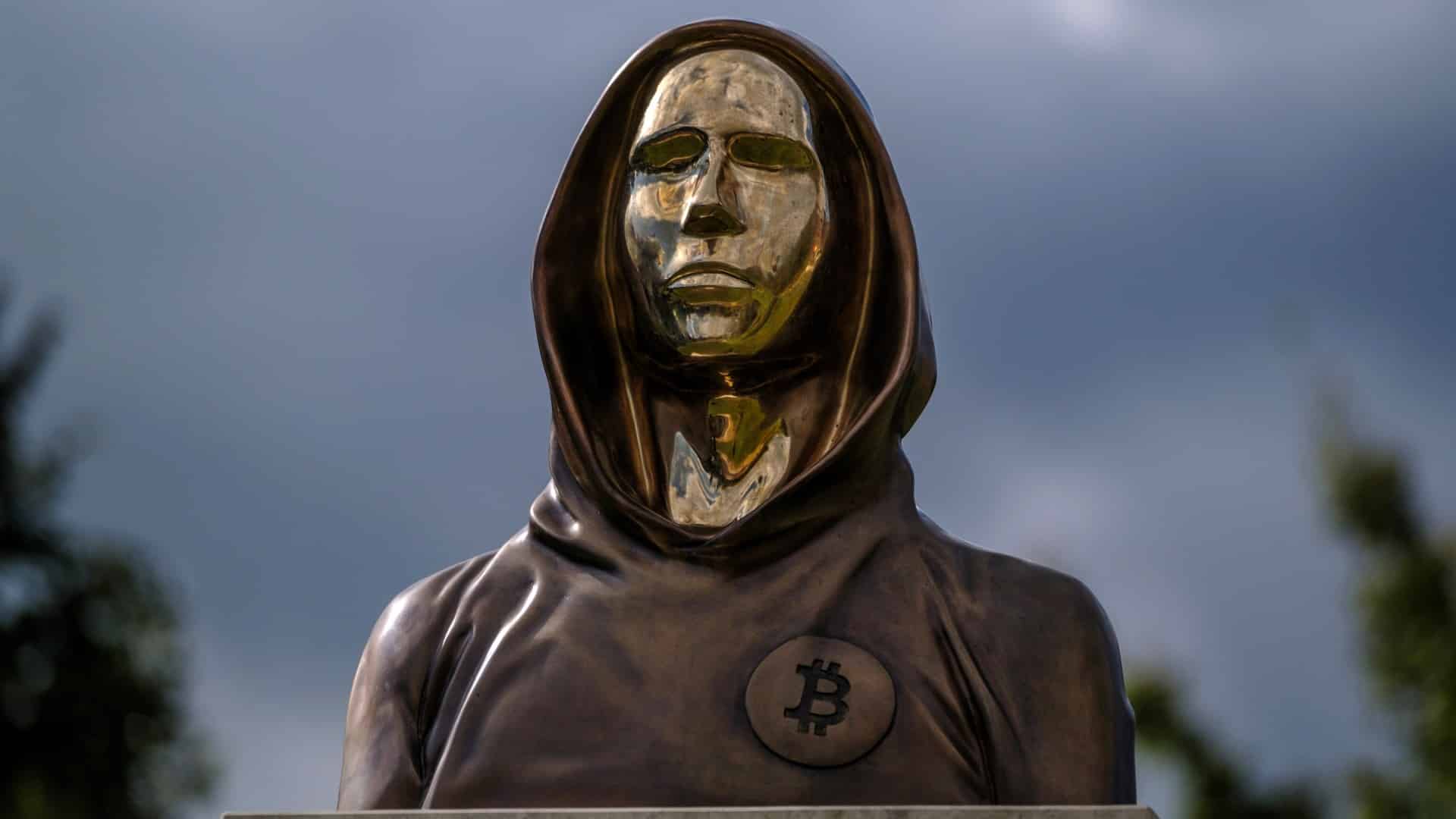
Satoshi Nakamoto is widely believed to own around 1.1 million Bitcoin (BTC), making the cryptocurrency’s anonymous creator one of its largest holders.
The estimate comes from blockchain research. By examining unusual patterns in Bitcoin’s earliest mining activity, researchers identified thousands of blocks that appear to have been produced by a single miner, nicknamed Patoshi.
That miner is widely suspected to be Satoshi, but no one has proven the connection. The coins are spread across thousands of early mining outputs, and most have remained untouched since Bitcoin’s launch.
The 1.1 Million BTC Question
The most widely cited estimate of Satoshi Nakamoto’s holdings is approximately 1.1 million BTC.
In February 2025, blockchain intelligence platform Arkham attributed roughly 22,000 early Bitcoin addresses to Satoshi, reporting a combined balance of 1,096,354 BTC.
These addresses were identified using the Patoshi Pattern, a mining fingerprint Sergio Demian Lerner first investigated in 2013.
However, another major investigation by BitMEX Research in 2018 concluded that the dominant early miner may have accumulated closer to 600,000 to 700,000 BTC.
Both studies identify evidence of concentrated mining during Bitcoin’s first year. They disagree on how many blocks can reliably be attributed to one miner and whether Satoshi was that miner.
Satoshi’s Estimated Holdings Versus Total Capped Supply of 21 Million
Bitcoin’s maximum supply is capped at 21 million BTC. If Satoshi controls about 1.1 million coins, that’s about 5.2% of all Bitcoin that can ever exist.
| Bitcoin Supply Metric | Amount |
| Maximum Bitcoin supply | 21,000,000 BTC |
| Widely cited Satoshi estimate | 1,100,000 BTC |
| Arkham’s attributed balance, February 2025 | 1,096,354 BTC |
| Share of maximum supply | Approximately 5.2% |
| Alternative BitMEX estimate | 600,000 – 700,000 BTC |
| Original block mining reward | 50 BTC |
Table 1. Satoshi Nakamoto’s Estimated Bitcoin Holdings Versus Maximum Supply
The distinction between estimated holdings and confirmed ownership is important, because the blockchain records which outputs were created and whether they have been spent, but it does not automatically reveal the identity of the miner who earned them.
The 1.1 million BTC figure is therefore best understood as a widely used forensic estimate, not a verified personal balance.
Where Are the Coins Stored? (The Earliest Coinbase Outputs)
Satoshi’s suspected Bitcoin holdings are not stored in a single wallet holding 1.1 million BTC.
Instead, the estimate is associated with thousands of early block rewards created between 2009 and 2010.
When miners successfully add a block to Bitcoin, they receive newly created BTC through a special transaction known as the coinbase transaction (this has nothing to do with the Coinbase crypto exchange).
During Bitcoin’s earliest years, the block subsidy was 50 BTC.
Many of these early rewards were paid to pay-to-public-key (P2PK) outputs, an older Bitcoin transaction format that locks coins directly to a public key.
Some blockchain explorers display address-like representations of these outputs, but they should not be confused with a single modern wallet holding all the coins.
One particularly famous example is Bitcoin’s genesis block (Block 0), mined on January 3, 2009.
The genesis block contains an original 50 BTC reward, but Bitcoin’s current rules make that output unspendable because it was never added to the network’s spendable-output set. Later payments sent to the commonly displayed genesis address are separate outputs and do not change that restriction.
Have Any of Satoshi’s Original Bitcoins Ever Moved?
Most Bitcoin associated with the Patoshi Pattern has never been spent, and that is one of the strongest reasons the estimate keeps attracting attention.
Unlike active crypto whales, the presumed owner has left an enormous amount of BTC dormant.
However, an important distinction exists between the broad Patoshi cluster and Bitcoin addresses independently associated with Satoshi’s early activity.
Arkham’s research includes addresses connected to historically documented transactions attributed to Satoshi. Its records indicate that some coins linked to his early activity were spent, with the last such transaction recorded in July 2010.
Nevertheless, the vast majority of the approximately 1.1 million BTC attributed through the Patoshi Pattern remains unspent.
Occasional incoming transactions also create confusion. For example, in February 2026, an unidentified sender transferred 2.5 BTC to Bitcoin’s genesis address. This was an incoming payment from someone else, not evidence that Satoshi had returned or moved his original coins.
What Is the Patoshi Pattern?
The Patoshi Pattern is a distinctive mining signature found in some of Bitcoin’s earliest blocks.
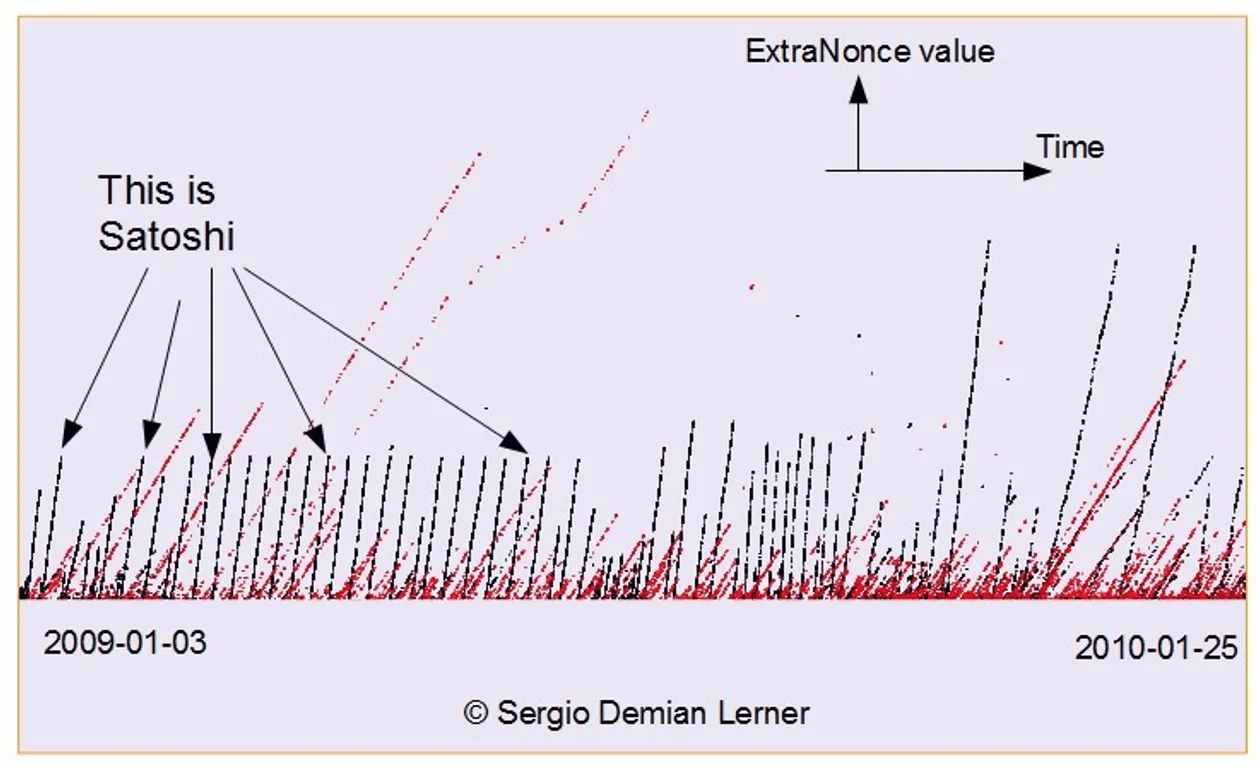
It was named by researcher Sergio Demian Lerner, who identified evidence that one miner was producing a disproportionately large share of blocks during Bitcoin’s early development.
Instead of examining wallet names or exchange records, Lerner studied technical information preserved inside the blockchain.
The patterns suggested that a particular miner used different software or mining behavior than other participants.
Sergio Demian Lerner’s Research Explained
In April 2013, Lerner published research examining unusual behavior in Bitcoin’s early mining records.
He noticed that blocks attributed to one apparent miner followed a consistent pattern that differed from the rest of the network.
His research evolved over several years, culminating in a detailed 2019 explanation, The Return of the Deniers and the Revenge of Patoshi.
The later analysis combined multiple indicators, including ExtraNonce behavior, nonce distributions and block timestamps, to identify approximately 22,000 blocks attributed to a single mining entity.
Since early blocks generated 50 BTC each, that translates into roughly 1.1 million BTC in original mining rewards.
The research provides compelling evidence of a dominant miner, but it cannot conclusively identify the person controlling the mining hardware.
Flaws in Early Mining on Nonce and ExtraNonce Signatures
The Patoshi Pattern became visible partly because early Bitcoin mining software exposed information that could link blocks together.
Mining involves changing values until a block header produces a hash satisfying Bitcoin’s difficulty target.
Two values are particularly important:
- Nonce: A 32-bit field inside the block header that miners repeatedly change while searching for a valid hash.
- ExtraNonce: An additional value in the coinbase transaction that lets miners expand their search space.
In early Bitcoin software, the ExtraNonce behaved like a running counter. Because it was not always reset between blocks, researchers could compare how its value changed over time.
Lerner found that the suspected Patoshi miner’s ExtraNonce increased along an unusually steep, consistent trajectory.
He also identified a distinctive restriction in the lowest byte of the nonce values associated with Patoshi blocks. Instead of being distributed across the full possible range, these values were concentrated in two intervals: 0 to 9 and 19 to 58.
Those signatures provided separate ways to identify blocks that may have been produced by the same mining setup.
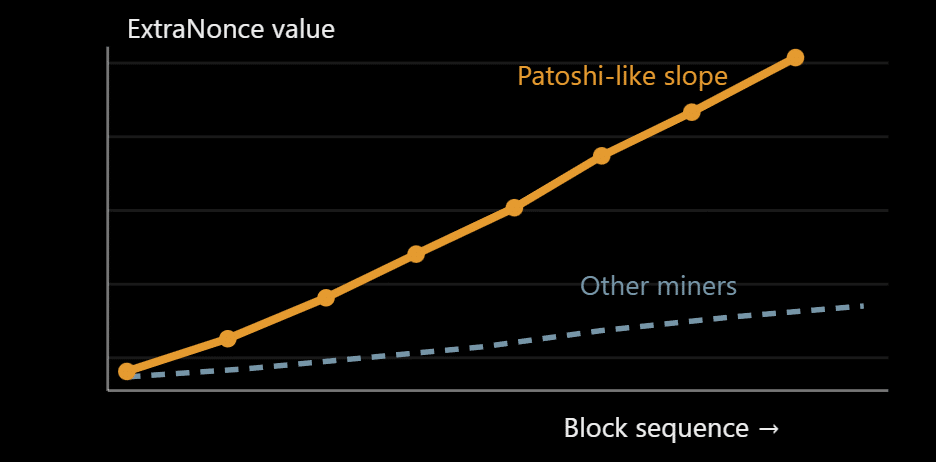
Figure 1. How the Patoshi mining fingerprint works. Illustrative diagram only, not a reproduction of actual blockchain data. The unusually steep ExtraNonce trend helped researchers distinguish the suspected Patoshi miner.
The pattern is stronger than a simple count of blocks mined, but its interpretation still depends on assumptions about how early mining software operated.
Mapping Block 0 to Block 50,000 to Identify a Single Miner
Lerner’s research focused heavily on Bitcoin’s earliest blocks, particularly the first 50,000.
That range spans from Bitcoin’s genesis block in January 2009 to April 2010, when the network was still relatively small.
The analysis identified approximately 22,000 blocks associated with the Patoshi mining fingerprint, representing roughly 44% of the first 50,000 blocks.
A later classification also identified the signature continuing beyond that initial range, with the characteristic activity largely disappearing around block 54,000 in May 2010.
| Research | Main Finding |
| Lerner, 2013 | Identified unusual ExtraNonce patterns suggesting a dominant early miner |
| Lerner, 2019 | Strengthened the case using nonce restrictions and timestamps; estimated approximately 1.1M BTC |
| BitMEX Research, 2018 | Found evidence of a dominant miner but estimated a lower 600K – 700K BTC |
| Arkham, 2025 | Attributed approximately 1.096M BTC across roughly 22,000 addresses |
| Peer-reviewed research, 2021 | Independently examined unusual early mining signatures |
Table 2. Major Research Findings on the Patoshi Pattern
A 2021 paper published in PLOS ONE further examined mining anomalies across Bitcoin’s blockchain.
That research supported the existence of unusual early mining signatures but also showed why attributing an entire collection of blocks to one named individual requires caution.
Why Did Satoshi Nakamoto Mine So Much Bitcoin?
Bitcoin launched in January 2009 with almost no established mining community, no crypto exchanges and little economic incentive for outsiders to participate.
Someone needed to keep producing blocks while the network attracted its first users.
The Patoshi Pattern suggests that one miner played an unusually large role during this period. Whether that was Satoshi, and precisely why the miner accumulated so many coins, remains uncertain.
Bootstrapping Network Hashrate to Prevent 51% Attacks
Bitcoin depends on miners to process transactions and secure its blockchain through proof of work.
In the network’s earliest days, relatively few people had downloaded the software or started mining.
A miner contributing substantial computing power could help ensure blocks kept arriving and the network maintained a growing transaction history.
There is also a security argument. A 51% attack becomes possible when an attacker controls a majority of the network’s effective mining power, potentially allowing them to reorganize recent blocks or double-spend their own transactions.
A large, honest miner could make such an attack more expensive for outsiders during Bitcoin’s early development.
However, a dominant miner is not automatically good for decentralization. That same concentration of computing power creates risk if the miner behaves maliciously.
The theory that Satoshi mined extensively to protect Bitcoin is plausible, but it remains an interpretation of the early mining evidence rather than a documented explanation from Satoshi.
The Dominant Miner Theory Versus Altruistic Genesis Proof
There are two common explanations for the Patoshi miner’s activity.
The first is straightforward: someone recognized Bitcoin’s potential early, mined aggressively and accumulated coins while competition was limited.
The second is that Satoshi deliberately maintained enough mining capacity to help the network survive its earliest months.
Under the second interpretation, the large balance was an unintended consequence of securing a network that had few other participants.
The fact that most Patoshi-associated coins remained unspent is consistent with someone who did not mine primarily for immediate profit. However, dormancy alone cannot establish motivation.
A miner might also have lost access to the coins, chosen to preserve them or accumulated them for reasons unrelated to Bitcoin’s security.
Lerner’s research establishes evidence of unusual mining activity, not the miner’s intentions.
Why Satoshi Progressively Lowered Mining Intensity Before Vanishing
The Patoshi mining fingerprint became less prominent as Bitcoin’s early network developed.
Lerner identified changes and pauses in the suspected miner’s activity, with the characteristic pattern largely disappearing around May 2010.
One explanation is that Satoshi gradually reduced mining activity as other miners joined, allowing the network to become less dependent on its creator.
This would be consistent with Bitcoin’s broader goal of operating without a central authority.
However, the evidence does not show that Satoshi intentionally adjusted mining power to promote decentralization. Changes in hardware, software, personal circumstances or mining profitability could also explain the pattern.
There is also a timeline distinction worth preserving, as the Patoshi Pattern largely disappeared in 2010, while Satoshi continued communicating with Bitcoin developers afterward. His final known private correspondence about moving on from the project came in April 2011.
The end of the mining pattern and Satoshi’s departure from development were therefore separate events.
What Happens If Satoshi Nakamoto Sells or Moves Coins?
A confirmed transaction from one of the large, long-dormant Patoshi clusters would likely become a major Bitcoin market event.
Because the estimated balance represents more than 5% of Bitcoin’s maximum supply, investors have long treated these coins as a potential source of selling pressure.
However, the market impact would depend on how much BTC moved, where it went and whether the transaction represented an actual sale.
Market Shock Versus Permanent “Lost Coins” Assumption
Some investors treat Satoshi’s suspected holdings as effectively removed from circulation.
The reasoning is simple: if coins have remained untouched for more than 15 years, they may never return to the market.
But there is no proof that all the associated private keys have been destroyed or lost.
A transaction from the Patoshi cluster would challenge the assumption that those coins are permanently inactive.
Several scenarios could produce different market reactions:
| Possible Event | Potential Market Implication |
| Small transfer between old addresses | Could trigger speculation without proving a sale |
| Transfer to a known exchange deposit address | Could raise concerns about potential selling |
| Large direct sale | Could create substantial sell-side pressure |
| Transfer to new custody addresses | Could indicate asset management or a security-related move |
| Continued inactivity | Leaves the existing dormant-supply assumption largely unchanged |
Table 3. Potential Market Implications of Satoshi-Linked Bitcoin Activity
A large transfer does not necessarily mean the coins have been sold. Bitcoin transactions reveal movements between outputs, but they do not always disclose their economic purpose.
Similarly, even a major sale doesn’t automatically mean 1.1 million BTC enter exchange order books at once.
The owner could sell gradually, use over-the-counter transactions or move only a small portion of the holdings.
The Philosophical Threat to Bitcoin’s Founderless Identity
Bitcoin’s creator disappeared from public development, leaving the network to operate without a recognized founder directing its future, and that absence has become an important part of Bitcoin’s identity.
If someone convincingly demonstrated control over a large portion of the suspected Satoshi holdings, it could renew questions about the creator’s identity, motives and possible influence.
The reaction might extend beyond price movements.
Some users could see Satoshi’s return as significant historical news, while others might worry that Bitcoin was once again becoming associated with a single influential figure.
Still, controlling a large Bitcoin balance does not mean owning the blockchain.
Bitcoin would continue operating under the consensus rules enforced by participating nodes, regardless of whether Satoshi returned.
Are Satoshi Nakamoto’s Keys at Risk From Quantum Computing?
Quantum computing introduces a different long-term concern.
Many early Bitcoin mining rewards were paid to P2PK outputs, which expose the public key directly on the blockchain.
Bitcoin’s digital signatures rely on mathematical problems that conventional computers find extremely difficult to solve.
A sufficiently powerful, fault-tolerant quantum computer running Shor’s algorithm could theoretically derive a private key from an exposed public key.
That makes some early Bitcoin outputs potentially vulnerable to a future quantum attack, even if their owners never attempt to spend them.
Bitcoin Improvement Proposal BIP 360 discusses these risks and proposes an output format designed to better protect against attacks targeting exposed public keys.
As of October 2026, no publicly established demonstration shows a quantum computer capable of recovering Bitcoin private keys at the scale required for such an attack.
The timing remains uncertain, but the problem has already prompted discussions about future Bitcoin upgrades.
Another difficult question is what should happen to older coins if quantum attacks eventually become practical.
Coins whose owners can move them could potentially migrate to more secure output types after suitable changes are adopted. Long-dormant coins controlled by unknown or unavailable owners present a harder problem.
Any proposed restriction on those coins would also raise serious questions about property rights, fungibility and Bitcoin’s existing consensus rules.
Satoshi Nakamoto Versus The World’s Largest Whales
If the 1.1 million BTC estimate is correct, Satoshi remains one of Bitcoin’s largest individual holders.
However, comparing that balance with modern institutions requires understanding the difference between personal ownership, corporate treasury assets, exchange custody and investment funds holding BTC for their investors.
Satoshi Nakamoto Versus BlackRock, MicroStrategy, and Sovereign Treasuries
The largest modern Bitcoin holders include publicly traded companies, exchange-traded funds (ETFs), custodians and governments.
Strategy, formerly known as MicroStrategy, has built one of the world’s largest corporate Bitcoin treasuries. According to its October 5, 2026 disclosure, Strategy held 848,000 BTC as of October 4.
BlackRock’s iShares Bitcoin Trust (IBIT) is another major holder. As of October 8, its reported net assets were approximately $65.69 billion.
Unlike Strategy’s corporate treasury, however, IBIT holds Bitcoin to provide fund shareholders with exposure. Those holdings should not be interpreted as Bitcoin personally owned by BlackRock’s executives.
Governments also control significant Bitcoin balances, often accumulated through criminal investigations, seizures and forfeitures.
The United States established a Strategic Bitcoin Reserve in March 2025, with government-held forfeited Bitcoin forming part of the reserve under its governing order.
| Holder or Entity | Reported Bitcoin Exposure | Ownership Context |
| Satoshi Nakamoto | Approximately 1.1M BTC estimated | Unconfirmed individual attribution based on early mining |
| Strategy (formerly MicroStrategy) | 848,000 BTC as of October 4, 2026 | Corporate treasury |
| BlackRock’s IBIT | Approximately $65.69B in net assets as of October 8, 2026 | Fund assets held for investors |
| US Strategic Bitcoin Reserve | Holdings vary with government inventory and forfeitures | Government-controlled reserve |
| Other sovereign holders | Holdings vary by jurisdiction | Government reserves, seizures or other holdings |
Table 4. Satoshi Nakamoto Compared With Major Bitcoin Holders
The comparison shows why Satoshi’s estimated balance remains exceptional.
Strategy’s disclosed 848,000 BTC represents roughly 4% of Bitcoin’s maximum supply, while the commonly cited Patoshi estimate represents about 5.2%.
Still, these figures measure different forms of control.
Satoshi’s estimated coins are associated with early mining, Strategy’s assets belong to a public company, and ETF holdings represent assets administered for shareholders.
Government Bitcoin figures can also change as authorities obtain, transfer or dispose of assets. Public wallet trackers may not capture every account or establish the government’s complete beneficial ownership.
Can Satoshi Nakamoto Influence Network Governance?
Holding 1.1 million BTC would give Satoshi considerable economic influence, but it would not provide special voting rights over Bitcoin’s protocol.
Bitcoin does not use a token-weighted governance system where holding more coins automatically gives someone more votes.
Consensus rules are enforced by Bitcoin nodes, which independently validate transactions and blocks.
Changing those rules requires network participants to adopt compatible software and reach sufficient practical consensus.
The Bitcoin developer documentation explains that full nodes independently validate blocks according to their chosen consensus rules.
Satoshi could potentially influence market sentiment, publish proposals or persuade other participants to support changes.
But even Bitcoin’s creator could not unilaterally change the 21 million supply limit, seize another user’s coins or force every node to accept new rules.
Economic ownership and network governance are fundamentally different.
Final Thoughts
Satoshi Nakamoto is widely estimated to hold about 1.1 million BTC, but that figure is forensic attribution, and not confirmed ownership. The Patoshi Pattern provides compelling evidence of a dominant early miner, while independent research shows that the exact number of coins is still open to debate.
For readers studying Bitcoin’s early history, the strongest evidence comes from the original mining records and the differences between Lerner’s and BitMEX Research’s findings. The main unresolved questions are whether Satoshi controlled the entire cluster and whether its private keys still exist.
To explore the protocol beyond its earliest miners, see our guide to earning Bitcoin without buying it.
Frequently Asked Questions
Need a refresher? Here are the questions most readers ask about Satoshi Nakamoto’s Bitcoin holdings and the Patoshi Pattern.
Can the Bitcoin Network Vote to Burn or Freeze Satoshi’s Coins?
Bitcoin has no built-in majority-vote mechanism that lets coin holders decide to burn or freeze another person’s BTC.
Changing the rules to make selected outputs unspendable would require a controversial consensus change supported by participating network users.
Under Bitcoin’s existing rules, miners or holders cannot simply vote to confiscate Satoshi’s suspected coins.
Did Satoshi Nakamoto Destroy the Private Keys?
No verified evidence shows that Satoshi destroyed the private keys controlling the coins attributed to the Patoshi Pattern.
Their inactivity could mean the keys were lost, intentionally abandoned or deliberately kept unused.
The blockchain can show that an output hasn’t been spent, but it cannot establish whether anyone still holds the corresponding private key.
How Do Wallet Watchers Track Satoshi’s Public Addresses?
Blockchain analysts use block explorers and forensic clustering methods to identify outputs associated with Bitcoin’s earliest mining activity.
The Patoshi Pattern lets researchers group thousands of early block rewards by technical signatures, while platforms such as Arkham provide tools to monitor attributed addresses.
These tools can show incoming and outgoing transactions, but their labels still depend on assumptions about who controlled the original mining activity.
A transaction involving a suspected Satoshi address does not, by itself, prove that Satoshi initiated it.