Crypto freelance platforms are sites where you find paid work and can be paid in cryptocurrency. In our November 24, 2026 check, five were worth using: LaborX and CryptoTask (marketplaces that hold crypto in escrow), Superteam Earn (Solana bounties paid in USDC or SOL), Web3.Career (a crypto job board) and Fiverr (a general marketplace whose blockchain gigs pay out in fiat). Invoicing in a stablecoin such as USDC keeps the agreed amount steady.
Which crypto freelance platforms are worth using in 2026?
On this list, LaborX and CryptoTask are the two marketplaces that pay in crypto and hold the client’s money in escrow, so the payment is locked before you start work. Superteam Earn suits short bounty work, Web3.Career has the most job listings of the five, and Fiverr has a large blockchain category but pays out in fiat only.
| Platform | Type | How you are paid | Fee for freelancers | Escrow | Best for |
|---|---|---|---|---|---|
| LaborX | Marketplace (jobs and gigs) | ETH, WBTC, USDC, USDT, DAI and other tokens on Ethereum or BNB Chain | 10% per completed job or gig | Yes, funds locked when the contract is signed | Crypto-paid work with payment protection |
| CryptoTask | Marketplace | Bitcoin, Tezos, or USDT, USDC and DAI on Ethereum, BNB Chain or Polygon | 0% basic use, 3% with escrow | Yes, smart contract escrow | Lowest fees, also non-crypto skills |
| Superteam Earn | Bounties and projects from Solana teams | USDC, SOL and other tokens | No talent fee listed in its FAQ | Not described; the sponsor pays the winner | Building a portfolio from scratch |
| Web3.Career | Job board | Set by each employer; 2,556 roles tagged “pay in crypto” | None listed for job seekers | No | Contract and full-time crypto roles |
| Fiverr | General gig marketplace | PayPal, Payoneer or bank transfer; no crypto | 20% (you keep 80%) | Client pays at checkout; earnings clear 14 days after completion | Selling fixed-price blockchain gigs |
How we checked: on November 24, 2026 we read each platform’s own pages for the coins it pays in, its fees, its escrow terms and the dates of its newest listings. These figures change often. We did not complete paid jobs on these sites for this update.
The 5 crypto freelance platforms in detail
Each platform below is described with what it pays in, what it costs you, where it falls short and who it suits, using figures from its own site on November 24, 2026.
1. LaborX
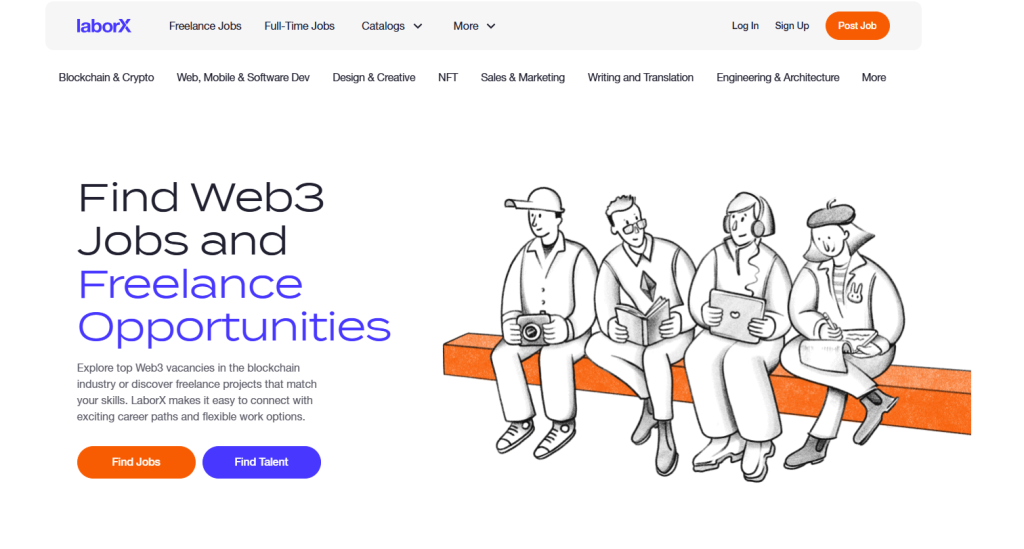
LaborX is a freelance marketplace for crypto and Web3 work where clients post jobs and freelancers also sell fixed-price gigs. Its homepage listed 1,139 jobs and 332,580 gigs on November 24, 2026, and its newest vacancies were dated November 19 and 20, 2026.
Payments run on Ethereum or BNB Chain. On Ethereum you can be paid in ETH, WBTC, TIME, USDC, USDT, DAI or AUDT; on BNB Chain in BNB, BTCB, TIME, BUSD, USDT, USDC or DAI. LaborX locks the client’s funds when the contract is signed and releases them automatically once the work is completed and accepted.
Freelancers pay a 10% platform fee on each completed job or gig, and clients pay 0%. Premium members can get up to half of that fee back as TIME, LaborX’s own token, whose value moves with the market. It suits freelancers who want the largest pool of crypto-paid jobs with escrow and accept a higher fee for it.
2. CryptoTask

CryptoTask is a freelance marketplace that connects clients and freelancers directly and settles jobs through smart contract escrow. Its about page lists more than 20,000 professionals and 35,000 platform users, and its newest task listings were dated November 14 and 17, 2026 when we checked.
CryptoTask charges 0% for basic use and 3% when a job runs through escrow. Clients can pay in Bitcoin, Tezos, or USDT, USDC and DAI on Ethereum, BNB Chain or Polygon, among other coins. Rates are posted in dollars or euros, so you can agree a fixed amount and settle in a stablecoin.
CryptoTask has far fewer listings than LaborX, many tasks are not crypto-specific (translation, telesales, simple websites), and budgets are often small. It suits freelancers who want the lowest fee and do not need a large client pool.
3. Superteam Earn
Superteam Earn is a work board where Solana ecosystem projects post paid bounties and freelance projects. Its bounty page says winners are paid in USDC, SOL and other tokens, and its homepage showed more than 273,000 people signed up on November 24, 2026.
A bounty is a competition: everyone who enters does the work, and only the best submissions get paid. A project works like a normal gig, where the sponsor picks one applicant. On listings sponsored by Superteam or Solana, winners pass identity checks (KYC) and fill in a payment form, and the FAQ says to expect the reward within 7 days of sending the form. External sponsors usually pay the wallet linked to your Earn account.
Bounties mean unpaid work when you do not win, and every sponsor is a Solana ecosystem project. Superteam Earn works best for people early in a crypto career who need public proof of work to win their first paid clients.
4. Web3.Career

Web3.Career is a crypto job board: it lists roles from blockchain companies, and you apply to each employer. On November 24, 2026 it listed 42,562 jobs at 7,399 projects. Its “pay in crypto” filter returned 2,556 roles, and its freelance filter returned 59.
Those numbers show that most listings on crypto job boards are full-time or contract roles, with only a small share tagged freelance. Web3.Career does not hold money in escrow, so the currency, network and milestones are whatever you agree with the employer. For more boards with listing counts, see our ranking of the top Web3 and crypto job boards.
5. Fiverr
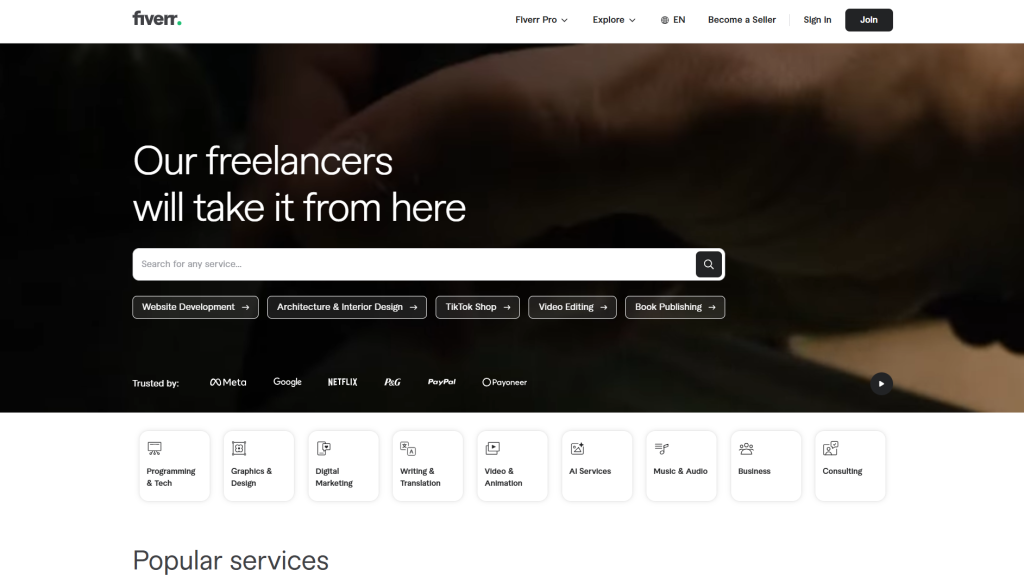
Fiverr is a general freelance marketplace with a Blockchain Development and Solutions category that covers dApps, protocol development, security audits and chain analysis. That category showed more than 1,500 gigs on November 24, 2026. Fiverr does not pay in crypto: its help center says “We don’t accept cryptocurrency,” and freelancers withdraw to PayPal, a Payoneer account or a bank transfer via Payoneer.
Freelancers receive 80% of each order, and earnings clear 14 days after the order is completed (shorter for Top Rated and Pro sellers). Fiverr also bans gigs that involve buying or selling crypto, trading or mining. It suits a freelance blockchain developer who wants buyer volume and is happy to be paid in fiat. If you are building that skill set, our guide to the most in-demand blockchain skills shows what clients hire for.
Which platforms did we remove, and why?
We removed Gitcoin, Remote3 and CryptoJobs.com from the summer 2026 version of this list because, on November 24, 2026, none of them offered a working stream of freelance jobs paid in crypto.
- Gitcoin no longer runs freelance bounties. Its support FAQ says the bounties and hackathons program was taken over by Buidlbox, and Buidlbox’s own site now says it is part of HackQuest. Gitcoin describes itself as a directory and reference library for funding, and its grant rounds fund whole projects rather than one-off tasks.
- Remote3’s newest jobs in its RSS feed were dated August 24, 2026, and its job category pages were still headed “new in Sep 2025.”
- CryptoJobs.com showed 182 active jobs, the newest posted about five months earlier, and none labeled freelance.
How do you get paid in crypto as a freelancer?
To get paid in crypto, agree the price in a fiat amount, pick a stablecoin and a network with your client, give them a wallet address on that network, and send an invoice that names all three. Ask for a small test payment the first time, then record the value on the day the money arrives.
- Agree the price in dollars or euros, for example $1,500 for the project, and the coin you will accept.
- Agree the network. Circle says USDC is natively supported on 38 blockchain networks (as of September 16, 2026), so “USDC” alone does not tell the client where to send it.
- Share an address from a wallet you control that supports that coin on that network.
- Send an invoice with the amount, coin, network, address and due date.
- Ask for a small test transfer on the first payment and confirm it arrived.
- Record the date, amount, dollar or euro value and transaction ID for your tax records.
- Move what you need for bills to your bank through an exchange.
A Stripe survey of more than 2,300 independent workers in 20 countries, published August 19, 2026, found that 57% would accept stablecoin payouts if platforms offered them, and 18% of workers in emerging markets already receive them. The workers cited the fees and slow settlement of traditional cross-border transfers.
Stablecoins or bitcoin: what should you invoice in?
Invoice in a stablecoin if you want to know what you will be paid. Circle says USDC is redeemable 1:1 for US dollars and EURC 1:1 for euros, so the invoice amount keeps its value while you wait to be paid. A bitcoin or ETH payment can be worth more or less by the time it lands, and again when you sell it.
If a client insists on paying in bitcoin, fix the fiat amount on the invoice and state which price source and time set the conversion. Our USDT vs USDC comparison explains how the two largest dollar stablecoins differ.
What equipment and accounts does a crypto freelancer need?
A crypto freelancer needs five things before the first payment: a wallet, separate storage for savings, a way to cash out, strong account security and a record-keeping system.
- A self-custody wallet app that supports the networks your clients use. Remote’s help center points contractors paid in USDC on Base or Polygon to MetaMask and other Ethereum-compatible wallets. Compare options in our list of the best cryptocurrency wallets.
- A hardware wallet for money you do not plan to spend soon, kept separate from the hot wallet you share with clients.
- An account at an exchange that supports your bank currency, so you can convert stablecoins and withdraw.
- Two-factor authentication on every account, using an authenticator app or a security key rather than SMS.
- A spreadsheet or crypto tax software that logs each payment as it arrives.
How do you invoice a client in crypto?
A crypto invoice is a normal invoice with three extra lines: the coin, the network and your wallet address. Keep the usual details (your name, the client, an invoice number, the work, the fiat amount and the due date). If the coin is not a stablecoin, add the exchange rate rule. Any invoicing tool works, and crypto invoicing services such as Request Finance issue invoices that clients can pay in crypto or fiat.
Can a contractor payroll service pay you in stablecoins?
Yes. If a client pays you through a contractor payroll service, you may be able to take your pay in USDC or another stablecoin without the client touching crypto. We confirmed these options on November 24, 2026.
| Service | How you receive crypto | Cost to you | Limits |
|---|---|---|---|
| Remote | USDC through Stripe Connect to your own wallet on Base, Aptos or Polygon | Not stated in its help article | The company must be billed in USD and you must live in a supported country |
| Deel | Withdraw your Deel balance through Coinbase or BVNK (USDC or USDT); Deel’s own DLUSD wallet since June 2026 | Set per withdrawal method in Deel’s contractor guide | DLUSD started in Argentina; availability varies by country |
| Bitwage | Clients pay your Bitwage account by ACH or wire; you choose stablecoins, crypto or local currency | Free plan: 2% on stablecoins, $15 on Ethereum-based stablecoin deposits, $20 per incoming wire | The $15.99 a month Premium plan removes the stablecoin flat fees |
How do you move crypto pay to your bank account?
To cash out, send the stablecoin to an exchange that supports your bank’s currency, sell it for fiat and withdraw to your bank. Before you send, check that the exchange accepts that coin on that exact network. Kraken’s support page warns that deposits on an unsupported network may not be credited and that recovery is not guaranteed, with recovery fees of $200 or $500 for some error types. Our guide on how to convert crypto to cash covers the options by country.
How is crypto freelance income taxed?
In the US and many other countries, crypto you receive for work is taxed as income at its market value on the day you receive it. Selling or converting it later is a separate event that can create a gain or loss, so keep a record of both.
In the US, the IRS says independent contractors report digital asset payments on Schedule C, and you must keep records of the US dollar value of every digital asset received as payment. Brokers report sales on Form 1099-DA for transactions from January 1, 2025. In the EU, the DAC8 directive has applied since January 1, 2026. Crypto service providers collect data on EU residents’ transactions for tax authorities, and the first exchanges between countries are due by September 30, 2027.
For each payment, log the date, the coin and amount, the fiat value at receipt, the client and the transaction ID, and keep exchange statements for each sale. Crypto tax software can import wallet and exchange data. This is general information, not tax advice; a tax professional in your country can tell you how your income is classified.
How do freelancers in Europe get paid in crypto?
Freelancers in the EU can invoice in USDC or in a euro stablecoin such as EURC, which Circle says complies with MiCA (the EU crypto-asset regulation) and is redeemable 1:1 for euros. To cash out, use a provider authorized under MiCA.
MiCA has applied in full since December 30, 2024, and ESMA says the transition period for crypto firms that were already operating ended by July 1, 2026 at the latest. ESMA publishes an interim register of authorized crypto-asset service providers, so you can check an exchange before you use it. Under DAC8, those providers also report your transactions to your tax authority, which makes accurate records more important.
Tips for crypto freelancers: mistakes to avoid
The most expensive mistakes in crypto freelancing involve payment terms more than the choice of platform. Watch for these four.
- Keep payment inside escrow. A client who asks to pay you directly to skip LaborX or CryptoTask fees also removes your dispute protection.
- Treat job boards differently from marketplaces. On Web3.Career there is no escrow, so ask for milestones with the first one paid upfront.
- Never connect your wallet, sign a transaction or install software as part of a “test task.” Use a separate wallet for client payments.
- Start with one small paid contract on a new platform to learn its payout time, fees and dispute process before you take bigger work.
Risks and limits of being paid in crypto
Crypto pay adds risks a bank transfer does not have. A payment sent to the wrong address or network usually cannot be reversed. A stablecoin also depends on its issuer, and escrow only protects work done on the platform that holds it.
- A stablecoin is not a bank deposit. USDC and EURC are backed by Circle’s reserves, so you rely on Circle and on the exchange you cash out through.
- Token rewards change value. LaborX fee rebates in TIME and Superteam payouts in SOL can be worth less when you sell them.
- Tax can apply at two points: on the income when you receive it, and on any gain when you later sell or convert.
Crypto pay is a poor fit if you need steady fiat income for rent and your clients are outside crypto, or if your country restricts crypto use. In that case a regular marketplace that pays by bank or PayPal is simpler, and you can still convert part of your income later.
Frequently Asked Questions
Which freelance platforms pay in crypto?
LaborX and CryptoTask pay freelancers in crypto through escrow, including stablecoins such as USDC, USDT and DAI. Superteam Earn pays bounty and project winners in USDC, SOL and other tokens. On job boards such as Web3.Career, the employer decides, and 2,556 listings were tagged “pay in crypto” on November 24, 2026.
How do I get paid in crypto as a freelancer?
Agree a fiat price, then choose a stablecoin and network with your client. Send an invoice with the amount, coin, network and your wallet address, and ask for a small test payment first. Record the value on the day you receive it, and cash out through an exchange that supports that network.
What crypto wallet should a freelancer use?
Use a self-custody wallet that supports the networks your clients pay on, such as an Ethereum-compatible wallet for USDC on Base or Polygon. Keep a separate hardware wallet for savings, turn on two-factor authentication everywhere, and never share your recovery phrase or sign transactions for a “test task.”
Does Fiverr pay in crypto?
No. Fiverr’s help center says it does not accept cryptocurrency, and freelancers withdraw earnings to PayPal, a Payoneer account or a bank transfer via Payoneer. Fiverr keeps 20% of each order and holds earnings for 14 days after completion. You can convert part of your payout to crypto yourself afterward.
Is crypto freelance income taxable?
In the US and many other countries, yes. Crypto received for work is usually income at its market value on the day you get it, and selling it later can create a separate gain or loss. US contractors report it on Schedule C. EU exchanges report users’ transactions under DAC8 from 2026.
Can freelancers in Europe receive stablecoins?
Yes. EU freelancers can invoice in EURC, which Circle says is MiCA-compliant and redeemable 1:1 for euros, or in USDC. Cash out through an exchange listed in ESMA’s register of authorized crypto-asset service providers, and keep records, because those providers report transactions to tax authorities under DAC8.
More crypto guides: Guides hub · What is cryptocurrency · What is a seed phrase · 7 crypto scams to avoid