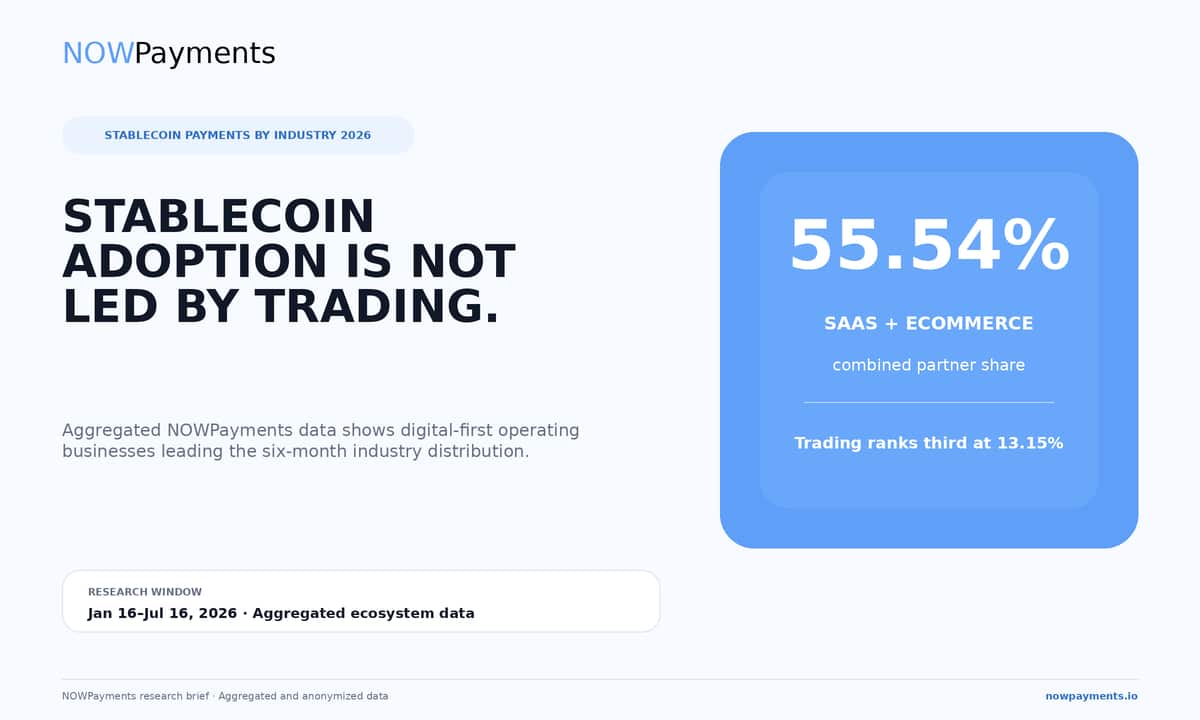
Crypto payments can reduce costs by replacing card-network charges and some cross-border intermediaries with a blockchain transaction or lower-cost processor. The saving is not automatic. Network, processing, conversion, withdrawal, accounting, security, and compliance costs may remain.
The useful comparison is the total amount the business keeps after the payment is received, converted, reconciled, and transferred where it will be used.
Why the Headline Card Rate Understates the True Cost
A card payment passes through several organizations, including the merchant’s processor or acquiring bank, the card network, and the cardholder’s issuing bank. The merchant normally sees these costs combined into a percentage of the sale plus a fixed amount.
Pricing differs by provider, country, card type, channel, and volume, so there is no single rate that applies everywhere.
The visible charge is only part of the cost. A business may also face dispute fees, fraud losses, refund costs, delayed funds, and extra international charges. Fixed fees take a larger share of low-value purchases. Conversely, a low-cost domestic bank transfer may still beat crypto after conversion and operational expenses.
Where Crypto Cuts Costs in the Payment Chain
Crypto can shorten the payment chain. A customer can transfer an asset directly to a business-controlled wallet, or a crypto payment processor can create the invoice, monitor the blockchain, and settle the proceeds to crypto or fiat currency, a process explained step by step in a guide on how to start accepting crypto payments in a business.
A direct wallet payment avoids card interchange and acquiring fees. The sender usually pays the blockchain fee, although the merchant may later pay to move funds. A hosted processor can handle pricing, invoicing, payment detection, refunds, and fiat conversion.
Crypto can be useful for cross-border sales because a blockchain does not add an international-card surcharge based on the parties’ locations, a point covered in more depth in an explainer on why businesses use Bitcoin for international transactions. Yet the customer may pay to acquire the asset, while the merchant may pay to convert and withdraw it.
Costs That Crypto Payments Do Not Eliminate
Every supported blockchain has its own fee model. Bitcoin fees change with demand for block space and the transaction’s data size. Ethereum uses a gas fee that depends on the computational work a transaction requires and the network’s demand at that moment. Congestion can make a normally affordable route expensive.
Layer 2 networks can reduce onchain costs, but customers must use the correct network and the merchant may pay to consolidate balances later. Conversion is another expense: processor charges, trading spreads, withdrawals, custody, and foreign exchange can erase a low checkout fee. A volatile asset can also move in price before conversion.
Comparing the Main Payment Routes Side by Side
| Payment Route | Main Cost Components | Settlement and Reversibility | Operational Burden |
| Online card payment | Percentage fee, fixed fee, possible international and FX charges, dispute costs | Processor settlement; cardholder disputes may reverse a payment | Familiar checkout, processor handles most infrastructure |
| Bank payment | Transfer or debit fee, possible return and FX costs | Timing and return rules depend on the banking rail | Usually simple domestically; cross-border support varies |
| Hosted crypto processor | Processor fee, possible spread, conversion and payout charges | Blockchain payment plus processor settlement terms | Processor handles invoices and monitoring; account approval may apply |
| Direct crypto wallet | Network fee, conversion, custody, accounting, and later transfer costs | Confirmed blockchain transfers are generally not unilaterally reversible | Business manages wallets, pricing, confirmation rules, refunds, and records |
| Stablecoin payment | Network fee plus possible processor, conversion, and redemption costs | Blockchain settlement; value still depends on issuer and market confidence | Lower price volatility, but network and issuer selection remain important |
Table 1. Cost and Operational Differences Between Payment Routes
Direct wallets may have the lowest explicit fee but place the greatest responsibility on the merchant. A processor can cost more while reducing engineering, pricing, and reconciliation work.
Why Stablecoins Often Fit Business Payments Better
Stablecoins are designed to track a reference asset, usually a national currency. They can reduce the short-term price exposure associated with Bitcoin or Ether. However, a stablecoin is not a bank deposit. Its value depends on the issuer, reserves or collateral, redemption arrangements, liquidity, and regulation. The same token can also circulate on networks with different fees and risks.
Some processors price stablecoin payments below their standard card rate once fiat conversion, wallet and anti-money-laundering screening, fraud prevention, and gas sponsorship are bundled in, though results will differ by provider and business.
How Order Size Changes Which Rail Wins
The cheapest rail can change with the purchase amount. A card’s fixed component has a large effect on a small sale. On a $10 transaction, a hypothetical card rate combining a percentage fee with a flat per-transaction charge can consume roughly 6% of the sale.
On a $1,000 transaction, that same fee structure shrinks to around 3% of the total, since the flat portion matters far less at scale.
A blockchain fee usually does not rise in direct proportion to the amount, which can benefit larger invoices. For a small purchase, even a modest network fee may be expensive as a percentage. Businesses should model normal order sizes and include failed invoices, support time, refunds, and customer adoption.
Calculating the Real Processing Cost
The effective cost of a payment method adds together several components: processing fees, network fees, conversion spread, FX and withdrawal costs, fraud or dispute losses, and operating and compliance costs.
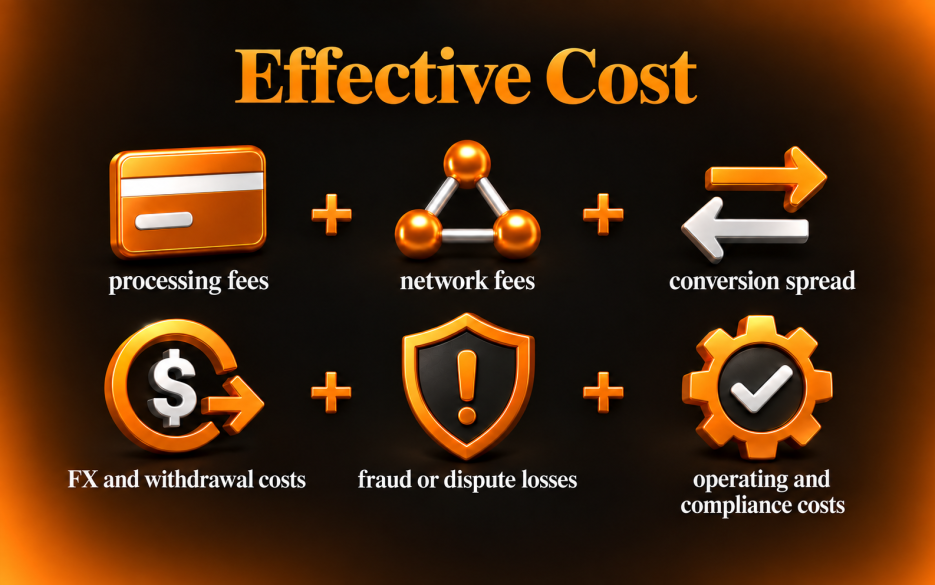
Divide that amount by completed sales revenue to obtain an effective percentage. Use completed sales rather than attempted payments, because a cheap option that causes customers to abandon checkout may reduce revenue even when each successful transaction costs less.
Measure a representative period because network fees, asset prices, and support cases vary. A merchant that converts every payment needs the conversion and payout rate; one that retains crypto must measure price and custody risk. The displayed price is not necessarily the amount reaching a bank account, a gap covered when converting crypto to cash.
Chargebacks, Refunds, and Customer Protection
Confirmed blockchain transfers generally cannot be reversed by a card issuer. This removes the conventional chargeback mechanism and can reduce exposure to friendly fraud. It does not eliminate fraud or the merchant’s responsibility to resolve legitimate complaints.
Customers can use the wrong asset or network, pay an expired invoice, or send the wrong amount. Consumer law or merchant policy may still require a refund, which is normally a new transaction. Terms should explain confirmation, exchange rates, invoice expiry, and refund valuation.
Accounting, Tax, and Compliance Costs
Crypto receipts require records of the invoice, asset, network, transaction identifier, time received, exchange rate, fees, refunds, and fiat proceeds.
Tax rules differ by jurisdiction. In the United States, the IRS says businesses should record the fair market value of digital assets received as payment and treats crypto received for goods or services as business income.
A later sale or conversion may create a separate gain or loss. Other countries use their own classification and reporting rules.
The Financial Action Task Force says virtual-asset service providers should use customer due diligence, recordkeeping, and suspicious-transaction reporting. A merchant’s duties depend on its activities and location, but screening, licensing, and privacy can create real costs.
When Crypto May Not Save Money
Crypto may not save money when customers must acquire it solely to pay, the merchant needs an expensive off-ramp, the network is congested, or a cheap domestic bank rail already works. Low volume may not justify integration, training, accounting, and security costs. Supporting too many assets also fragments balances.
Before launch, compare card, bank, and crypto routes using the same order values and settlement currency. Confirm fees, limits, networks, conversion, refunds, custody, and regulatory status with the provider.
Wallet security is part of the cost because one loss can erase months of savings. Access controls, approvals, backups, and phishing defenses should be documented.
The Real Savings Depend on a Full Cost Comparison, Not the Checkout Fee Alone
Crypto payments can reduce fees when they replace costly card or cross-border routes and the network, processor, and conversion method are economical. The decision should be based on total cost, including conversion, withdrawals, refunds, security, accounting, compliance, and customer experience. A controlled comparison with existing methods is the clearest way to identify a genuine saving.
Frequently Asked Questions
These questions cover the practical details businesses ask most often when weighing crypto payments against their existing card and bank processing setup.
Are crypto payments always cheaper than credit cards?
No. Network fees, processing, conversion, withdrawals, accounting, and compliance may reduce or eliminate the saving.
Do crypto payments have chargebacks?
They generally lack card-network chargebacks, but merchants may still owe refunds under contracts, platform rules, or consumer law.
Are stablecoin payments free?
No. Network, processor, conversion, settlement, and withdrawal fees may apply.
Does a business have to hold cryptocurrency?
Not necessarily. Some processors convert crypto and settle fiat, subject to fees, account requirements, and local availability.
Which cryptocurrency network has the lowest fees?
There is no permanent answer. Demand and transaction type change fees, while reliability, liquidity, security, and off-ramp support also matter.
Can accepting crypto create a tax obligation?
Yes. Receipt, holding, and disposal can create reporting and tax consequences under local rules.
This article is for educational purposes and is not financial, legal, tax, or accounting advice. Crypto payments involve market, custody, operational, counterparty, regulatory, and technology risks. Businesses should confirm current fees and obtain advice appropriate to their jurisdiction and activities.