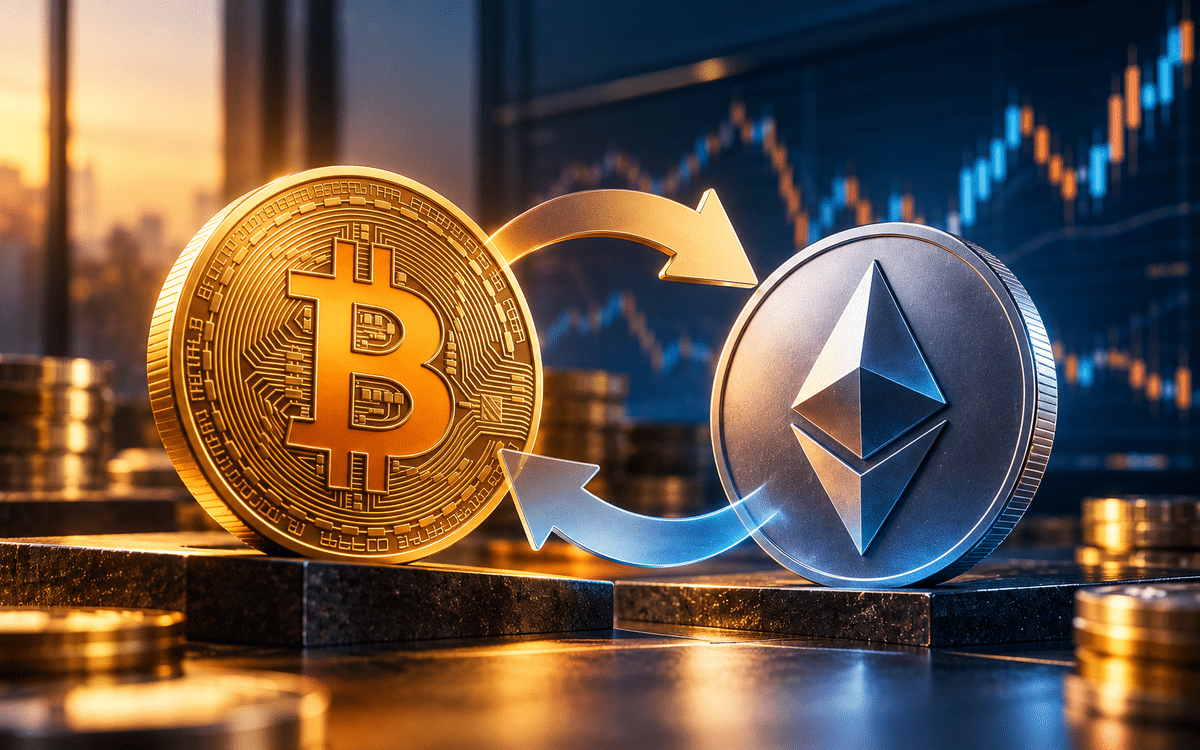
Cryptocurrency swapping is the direct exchange of one crypto asset for another, without converting either side to dollars, euros, or any other fiat currency first. If you already hold Ethereum and want Solana instead, a swap moves you from one to the other in a single step, instead of selling ETH for cash and then buying SOL separately.
For someone new to crypto, this distinction matters because it removes a layer most people assume is required. You do not need a bank account link, a cash-out step, or a second transaction to change what you hold. You just need a platform that supports both assets, and how that platform handles the trade behind the scenes is where the details start to matter.
How Does Crypto Swapping Work?
Every swap runs through one of two kinds of platforms. The result looks the same on screen, but the mechanics behind it are as different as trading currency at a kiosk versus trading it directly with another traveler.
Swapping on a Centralized Exchange (CEX)
On a centralized exchange, such as Coinbase or Binance, you are trading against the platform’s own reserves or its order book. According to Coinbase’s own exchange documentation, orders are matched on a price-time priority basis, meaning the best available price gets filled first, and ties go to whichever order arrived earlier. The exchange matches your request with existing liquidity, charges a fee for the service, and credits your account with the new asset almost immediately.
You never touch a smart contract directly. The exchange handles custody, pricing, and settlement on your behalf, which makes the process simple but means you are trusting that platform to hold your funds securely and process the trade as promised.
Swapping on a Decentralized Exchange (DEX)
On a decentralized exchange, such as Uniswap or PancakeSwap, there is no company standing between you and the trade. Instead, your swap draws from a liquidity pool, a shared pot of two assets that other users have deposited in exchange for a share of the trading fees.
A smart contract calculates the exchange rate automatically based on how much of each asset is in the pool at that moment. According to Uniswap’s own protocol documentation, most of these pools rely on a constant product formula, where the price shifts as the ratio of the two assets in the pool changes with each trade.
You keep control of your funds in your own wallet throughout, but you are exposed to slippage, meaning the price can shift slightly between when you submit the swap and when it settles, especially in a pool with thin liquidity.
Why Does Crypto Swapping Matter for Someone New to Bitcoin?
If you bought your first Bitcoin and later want exposure to a different project, the obvious instinct is to sell the Bitcoin for cash and buy the new coin separately. That approach works, but it usually means paying a fee to convert to fiat and another fee to convert back, plus a delay while funds clear. A swap lets you go from Bitcoin to the other asset in one action, cutting out the cash step and often the fees that come with it.
This is one reason swapping has become a standard entry point for people building a portfolio beyond a single coin. Before choosing where to do that, it helps to understand what separates one platform from another. Knowing the basics of crypto, including how wallets and exchanges work, can make crypto swapping easier to understand.
How to get started with crypto swapping
The steps are largely the same whether you use a CEX or a DEX, though a DEX adds a wallet-connection step at the start.
- Choose your platform. Pick a CEX if you want a simple interface and are comfortable holding funds on the exchange, or a DEX if you want to keep custody of your assets in your own wallet.
- Connect or log in. On a CEX, sign in to your account. On a DEX, connect a self-custody wallet such as MetaMask or Phantom.
- Select the trading pair. Choose the asset you are swapping from and the asset you want to receive.
- Enter the amount and review the quote. The platform shows the exchange rate, the estimated fee, and, on a DEX, the slippage tolerance you are willing to accept.
- Confirm the swap. On a CEX, this settles instantly in your account. On a DEX, you approve the transaction in your wallet and wait for it to confirm on-chain.
- Check your balance. The new asset should appear in your exchange account or your wallet within a few seconds to a few minutes, depending on network congestion.
CEX vs. DEX: Which Should You Use?
The right choice between the two often comes down to what matters most to the person making the trade: convenience or control.
| Feature | Centralized exchange (CEX) | Decentralized exchange (DEX) |
| Who holds your funds | The exchange typically holds funds in your account until you withdraw. | You generally trade from a wallet whose keys you control. |
| Speed | Trade execution is often near-instant within the exchange. | Depends on the blockchain and transaction conditions. |
| Fee structure | Trading fees. Other fees may apply. | Network and pool fees. Route or interface fees may also apply. |
| Coin selection | Limited to supported listings. | Tokens with compatible pools. Availability and liquidity vary. |
| Slippage risk | Often lower for liquid markets. Varies by pair and order size. | Can be higher in thin pools or for large trades. Varies by pool and trade size. |
| Identity verification | Often required, depending on platform and jurisdiction. | Usually not required by the protocol. Related services may have their own requirements. |
Table 1. CEX vs. DEX at a glance
This comparison is a starting point, not a verdict. A CEX may suit someone who values a familiar interface and fast internal trade execution. A DEX may suit someone who wants to trade from a self-custody wallet. Actual fees, liquidity, speed, and access depend on the platform, token, and network, and some users choose between both for different trades.
Common mistakes to avoid
Most swap mishaps trace back to a handful of avoidable slip-ups, not bad luck.
- Ignoring the slippage setting. A DEX lets you set how much price movement you will tolerate before a swap fails or executes at a worse rate. Leaving this too loose on a volatile or low-liquidity pair can mean receiving noticeably less than expected.
- Forgetting network fees. A swap that looks free or cheap on the surface can still cost real money in gas, the fee paid to the underlying blockchain to process the transaction, particularly on networks that get congested during busy periods. Check the estimated fee before confirming, not after.
- Skipping the contract address check. On a DEX, anyone can list a token with a name that copies a legitimate project. Verify the contract address against the official project source before swapping into an unfamiliar token, not just the ticker symbol shown in the interface.
- Chasing low-liquidity pairs for a better rate. A pool with little liquidity can show an attractive price and then deliver a worse one once slippage is factored in. Larger, more established pools tend to give a more predictable result.
- Assuming a swap and a trade are interchangeable. A swap is built for moving between assets you already hold. If you are trying to enter or exit a position using cash, cost-average into an asset over time, or use tools like limit orders, standard exchange trading is usually the better fit.
Choosing Where to Swap Next
Picking between a CEX and a DEX is only the first decision. Within each category, platforms differ on how deep their liquidity runs, what they actually charge once network and pool fees are added up, and how their security track record holds up over time. Anyone still deciding which specific platform fits their situation can turn to this breakdown of the factors that matter most when picking a crypto swap, which walks through liquidity, fees, and security side by side before committing funds.
Frequently asked questions
Still working through the basics? Here are the questions beginners ask most often about crypto-to-crypto swaps.
Is swapping crypto the same as trading crypto?
Not quite. Swapping is a direct exchange between two crypto assets you already hold, with no fiat step involved. Trading typically happens through an exchange’s order book and can involve buying with cash, selling for cash, or using tools like limit orders and margin that a simple swap does not offer.
Do I need a wallet to swap crypto?
You need a wallet to swap on a decentralized exchange, since the DEX interacts directly with your wallet through a smart contract. On a centralized exchange, your funds sit in your exchange account instead, so a separate wallet is not required unless you plan to withdraw afterward.
Why did I receive less crypto than the quoted price?
This is usually slippage, the gap between the price shown when you submitted the swap and the price at the moment it settled. It happens more often on decentralized exchanges with lower liquidity, and it can be reduced by tightening your slippage tolerance or choosing a pool with more available liquidity.
Are crypto swaps taxable?
In most jurisdictions, swapping one cryptocurrency for another is treated as a taxable event, similar to selling one asset and buying another, even though no cash changes hands. Rules vary by country, so it is worth checking local guidance or speaking with a tax professional before swapping in significant amounts.
Can I swap any two cryptocurrencies?
Only if a platform supports both assets. A CEX limits you to the coins it lists, while a DEX limits you to tokens that have an active liquidity pool on that network. If no pool or listing exists for a pair, you may need to route through a more commonly held asset, such as ETH or USDT, as an intermediate step.