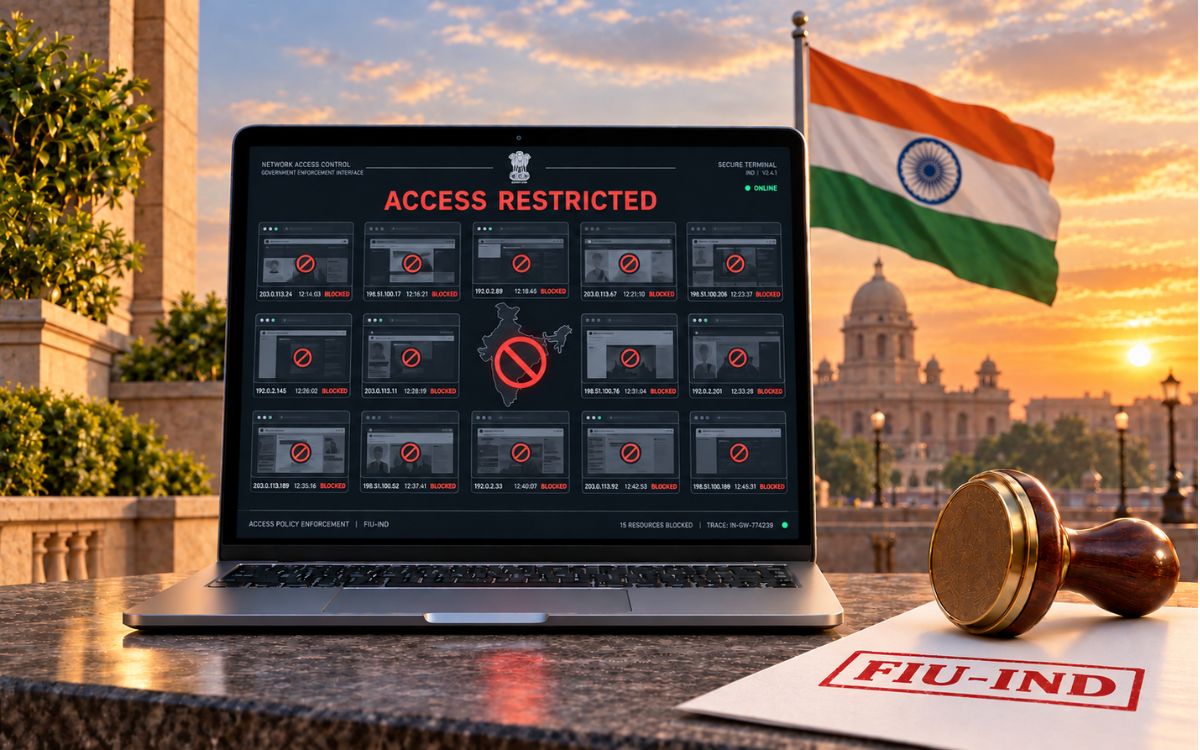
India’s Financial Intelligence Unit has issued non-compliance notices to 15 virtual digital asset service providers and initiated action to remove their websites and applications from public access in the country.
FIU-IND said the named platforms had been serving Indian users without registering as reporting entities or meeting requirements under the Prevention of Money Laundering Act, or PMLA.
The 15 Platforms Named by FIU-IND
The Ministry of Finance announced the enforcement action on September 9. The notices cover Weex, BloFin, Rezorex, Bitunix, DigiFinex, Toobit, XT.com, LATOKEN, WOO X, Pionex, ChangeNOW, SimpleSwap, FixedFloat, WhiteBIT, and Guardarian.
FIU-IND issued the non-compliance notices under Section 13 of the PMLA. Its director also initiated notices seeking the takedown of the providers’ applications and website addresses from public access in India, a move that would affect anyone in the country currently using these platforms to buy, sell, or hold crypto, similar to the enforcement patterns already reshaping how Indian users approach buying and selling cryptocurrencies in India.
| Compliance Requirement | Who It Covers | FIU-IND’s Announced Response |
| Registration as a reporting entity | Onshore and offshore providers serving India | Non-compliance notices |
| Transaction reporting | Providers handling covered VDA activity | Required under the PMLA |
| Record keeping | Registered virtual-asset service providers | Required under the PMLA |
| AML compliance | Exchanges, transfer services, and custody providers | Ongoing monitoring obligations |
| Unregistered operations | The 15 named providers | Website and application takedown action |
Table 1. Requirements Behind FIU-IND’s Enforcement Action
India’s Ministry of Finance also summarized the action through its official X account:
Why Offshore Platforms Must Follow Indian AML Rules
India’s registration requirement is based on the services a company provides rather than the location of its headquarters.
A platform may therefore fall under the PMLA when it serves users in India and facilitates exchanges between crypto and fiat currency, transfers virtual assets, safeguards assets, or provides instruments that allow users to control them, a compliance burden that layers on top of the tax obligations already covered in a guide on navigating UPI transfers and the 1% TDS on USDT in India.
Registration with FIU-IND does not amount to full approval of a platform or its products. It primarily places the provider within India’s anti-money laundering, reporting, and record-keeping framework.
The action also does not constitute a nationwide prohibition on holding cryptocurrency. It targets specific service providers accused by FIU-IND of operating without satisfying the applicable compliance requirements.
What the Website and App Takedowns Could Affect
Removing a provider’s website or application from public access could interrupt account access, trading, deposits, and withdrawals for users in India. The government announcement did not specify when each restriction would take effect or whether the platforms received a deadline to register before blocking begins, leaving affected users without a clear timeline to plan around.
The named companies may seek registration and address the alleged deficiencies, but the release did not disclose whether any had responded to the notices. Users with active balances on these platforms have little visibility into how quickly access could be cut off, or whether existing funds would remain retrievable once a takedown takes effect, a gap in disclosure that leaves the practical impact largely uncertain for now.
What Happens Next for the Named Platforms
The next development will be whether the 15 providers complete FIU-IND registration or challenge the findings. The timing and scope of the access restrictions will also show whether India applies the measures across websites, application stores, and other distribution channels.
What this means for you: If any funds sit on one of the 15 named platforms, treat the takedown notices as a signal to review account access and consider withdrawing assets while access remains available, since neither the timeline for blocking nor the platforms’ response to the notices has been disclosed.
Crypto products and NFTs remain high-risk in India, and registration under anti-money laundering rules does not guarantee protection against market losses, platform failures, or withdrawal problems.