

Picture a construction worker in Dubai who wants to send $200 home to his family in Manila.
Through his bank, the transfer takes three to five business days, and by the time it lands, a chunk of it has disappeared into wire fees, correspondent bank charges, and a marked-up exchange rate.
He’s not imagining it. Traditional international transfers routinely cost 5% to 10% of the amount sent, and that’s before factoring in the wait.
This is the exact gap crypto remittance was built to close. Instead of routing money through a chain of banks that each take a cut, crypto remittance moves value directly, in minutes rather than days, often for a fraction of the traditional cost.
What Crypto Remittance Means
Crypto remittance is the practice of sending money across borders using cryptocurrency instead of traditional banking rails, such as SWIFT wires or dedicated money transfer services, which have handled most international transfers for decades.
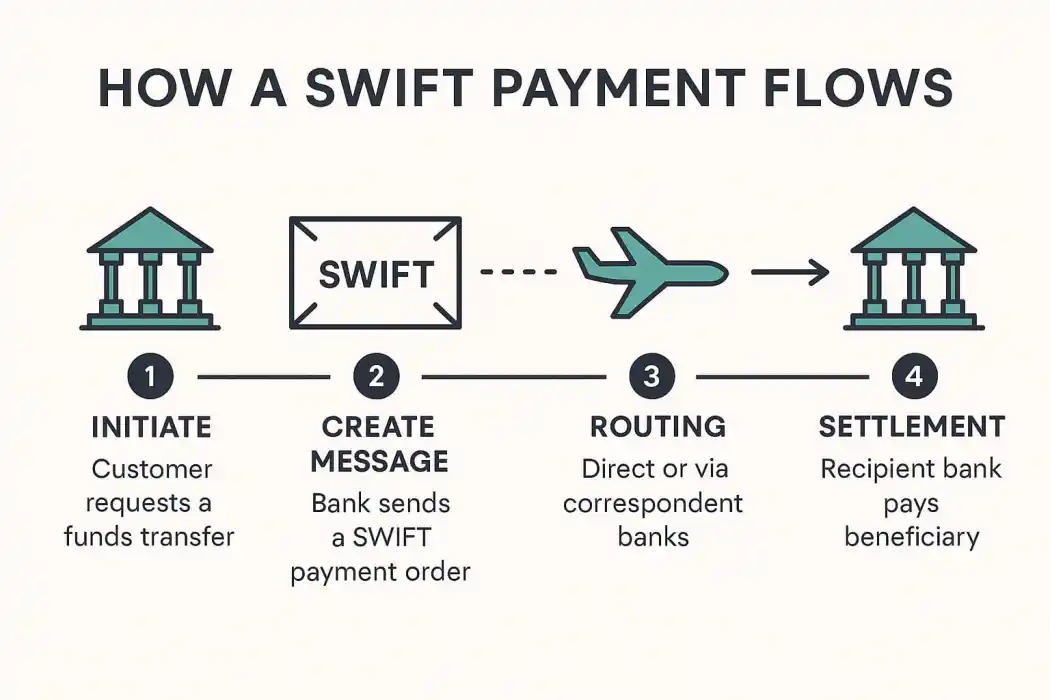
Traditional remittance depends on a chain of intermediary banks and payment processors, each one adding both a fee and a delay. Crypto remittance skips that chain almost entirely.
In practice, the sender buys crypto, most often a stablecoin, and sends it directly to the recipient’s digital wallet. The recipient then converts it into their local currency, whether pesos, rupees, or dollars, through a local exchange, a peer-to-peer platform, or a mobile wallet service.
The money moves peer-to-peer rather than bank-to-bank, which is the core reason crypto remittances can undercut traditional transfer costs so dramatically.
The Three Pieces That Make Crypto Remittance Work
Crypto remittance is not just “sending Bitcoin instead of dollars.” It depends on three specific pieces working together, and understanding each one explains both why it works and where it can go wrong.
Stablecoins Keep the Value Steady
While Bitcoin or Ethereum can technically move across borders too, most real-world crypto remittances today run on stablecoins like USDC or USDT, which are pegged roughly 1-to-1 to a currency like the US dollar.
That peg matters enormously here. A sender needs to know that $100 sent will still be worth close to $100 by the time the recipient cashes out minutes later, and a volatile asset like Bitcoin can’t reliably promise that over even a short window.
Low-Cost Blockchains Keep Fees From Eating the Savings
The network a transfer runs on determines most of its cost. Older networks like Ethereum’s base layer can carry high fees during busy periods, which would defeat the purpose of using crypto remittance to save money in the first place.
Modern remittance activity has shifted toward faster, cheaper networks like XRP, Stellar, Solana, and Tron, where network fees often run just a few cents, making even small transfers worthwhile.
Local Off-Ramps Turn Crypto Back Into Spendable Cash
None of this helps a recipient unless they can convert the crypto into local currency they can spend. That requires functioning local infrastructure, typically one of a few types.
| Off-Ramp Method | Example Providers | Typical Fee | Settlement Time |
| Local exchanges | CoinDCX (India), PDAX (Philippines) | Low, a platform commission | Instant conversion, fast bank withdrawal |
| P2P marketplaces | Binance P2P, OKX P2P, Bitget P2P | None charged directly, built into the exchange rate | 10 to 30 minutes |
| Mobile wallets | GCash (Philippines) | Low, a fixed transfer fee | Instant |
What a Crypto Remittance Transfer Looks Like
Walking through an actual transfer makes the mechanics clearer. The sender starts by buying a stablecoin, usually USDC or USDT, through an exchange or app in their own country.
They then send that stablecoin directly to the recipient’s wallet address, a transfer that settles on the blockchain in seconds to a few minutes depending on the network used.
From there, the recipient has choices. They can hold the stablecoin if they do not need the funds immediately, move it to a local exchange to convert it into their home currency, or use a peer-to-peer platform to sell it directly to another individual at a negotiated rate.
Once converted, the money typically lands in a local bank account or mobile wallet, just like any other domestic deposit.
The entire process, from the sender’s initial purchase to the recipient’s cash-in-hand conversion, often completes within the same day, and frequently within the hour, compared to the multi-day timeline of a traditional wire.
That speed difference is the main practical reason crypto remittance has gained traction among people who send money home regularly, rather than for one-time transfers.
Why This Matters More in Some Countries Than Others
Crypto remittance is not equally useful everywhere. It matters most in corridors where many migrant workers regularly send money home and where traditional transfer fees consume a meaningful share of what families receive.
The Philippines and India are two of the clearest examples, both with large diasporas sending money home and regulatory bodies that license and oversee local exchanges, making crypto-to-cash conversions legitimate and traceable.
For more on how this trend is playing out at scale, our coverage of stablecoins making cross-border payments faster examines the broader shift underway.
What Crypto Remittance Doesn’t Solve on Its Own
None of this means crypto remittance works everywhere or for everyone yet. It still requires both the sender and the recipient to be comfortable using a digital wallet and depends on a working local off-ramp in the recipient’s country.
Where that infrastructure is thin or unregulated, the savings from the transfer itself can be eaten up by a poor exchange rate or an unreliable local platform.
Crypto remittance is growing quickly in the corridors where it fits best, but it’s a tool that fits a specific set of conditions rather than a universal replacement for every existing transfer method.
Frequently Asked Questions
Is crypto remittance legal?
It depends on the country. Many of the largest receiving countries, including the Philippines and India, have regulatory bodies that license and monitor local exchanges that convert crypto into fiat currency, helping keep the process compliant as long as you use a registered, licensed service.
Why can’t I just use my bank’s app for this instead?
Banks route international transfers through intermediary networks like SWIFT, which can take several business days to settle and typically charge fees on both the sending and receiving ends. Crypto remittance sends value directly, which allows it to settle faster and more cheaply.
Is sending stablecoins safer than sending Bitcoin for remittance?
For remittance specifically, yes. The whole point of a remittance transfer is that its value stays stable from when it’s sent to when it’s cashed out, and stablecoins are designed to maintain that peg. Bitcoin’s price can move meaningfully within the same window, adding risk unrelated to the transfer itself.
How much cheaper is crypto remittance compared to a traditional transfer?
Traditional international transfers often cost 5% to 10% of the amount sent once wire fees, correspondent bank charges, and exchange rate markups are factored in. Crypto remittance replaces most of that with a small blockchain network fee, often just a few cents on low-cost networks, plus whatever commission the local off-ramp charges to convert the funds into cash.
Does the recipient need to already have a crypto wallet?
Yes, in some form, though it does not need to be complicated. The recipient needs a digital wallet compatible with the specific stablecoin being sent, either a standalone crypto wallet app or an account with a local exchange or platform that supports direct deposits. Setting one up typically takes only a few minutes, but it is a real prerequisite the sender should confirm before initiating a transfer.