Bitcoin is trading near $77,800 after holding above the $76,000-$77,000 area, but the short-term structure still needs a stronger move above resistance to confirm a bullish reversal.
BTC has struggled to regain $80,000 after falling from its late-August highs. The largest crypto by market cap traded as low as about $76,300 on September 3 before recovering, while traders remained cautious ahead of US jobs data and the Federal Reserve’s September 15–16 Federal Open Market Committee (FOMC) meeting.
Technical levels from several market analysts now place $77,000-$77,200 as the immediate support area, while the first major test for buyers sits between $78,300 and $80,000.
Bitcoin Needs to Reclaim Above $78K
Bitcoin recently found support at $77,165, helping the price recover from its latest correction. However, the short-term structure remains under pressure while BTC stays below resistance formed during the pullback.
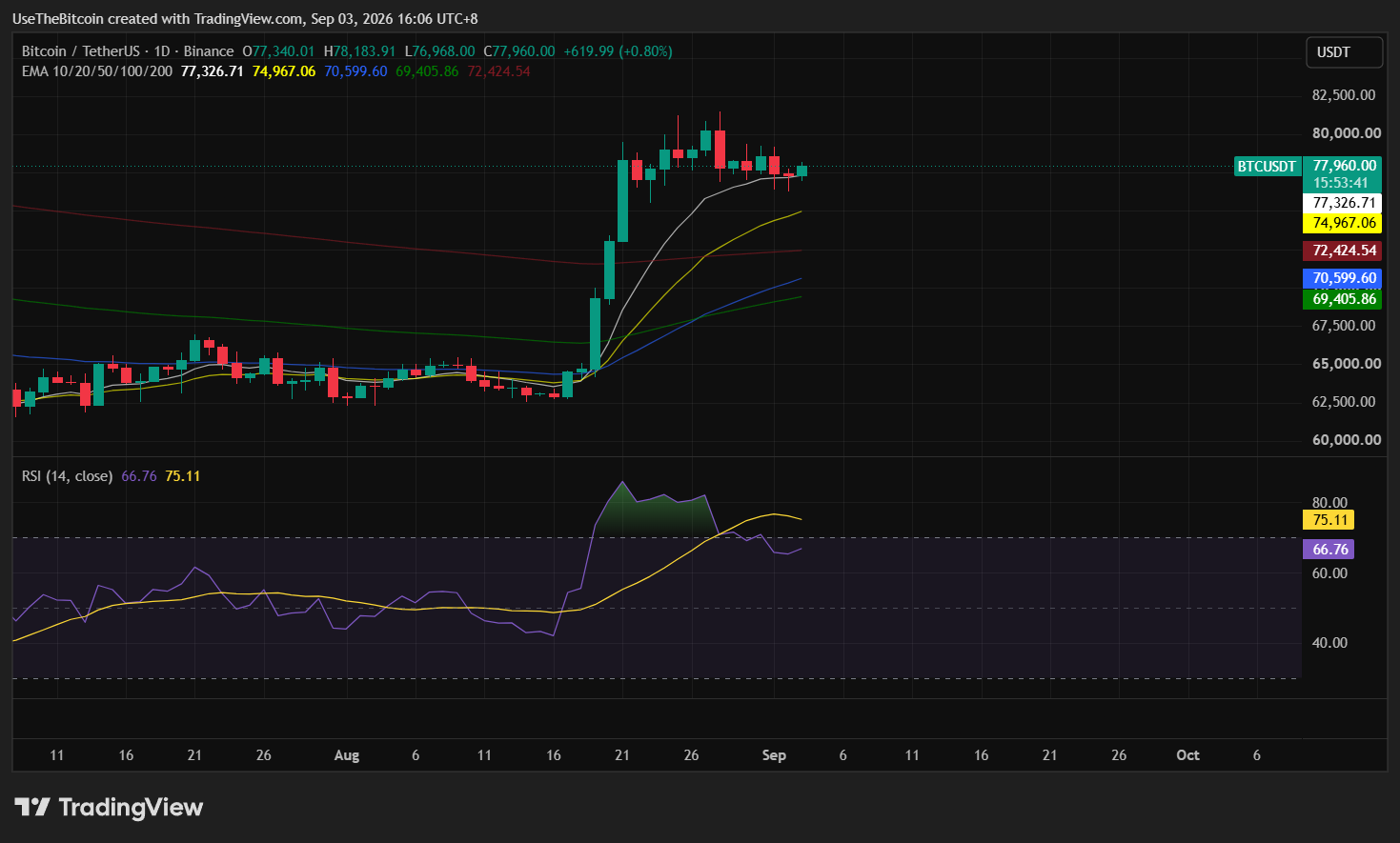
The first level to watch is at $78,340. A sustained move above this area could open the way toward $78,800-$79,000.
The more important resistance sits between $79,730 and $79,920. A clean breakout and successful retest of this zone would strengthen the bullish reversal case and bring $80,280 and $81,000 back into focus.
| Level | Role |
| $77,165 | Critical short-term support |
| $78,340 | First bullish confirmation |
| $78,800 – $79,000 | Transition resistance |
| $79,730 – $79,920 | Major reversal confirmation |
| $80,280 | Upside resistance |
| $81,000 | Upside resistance |
Table 1. Bitcoin Key Levels to Watch
$75K Becomes Important if Support Breaks
Below the current price, $75,000 remains one of the more important support areas on the 4-hour chart, just around the 100-EMA.
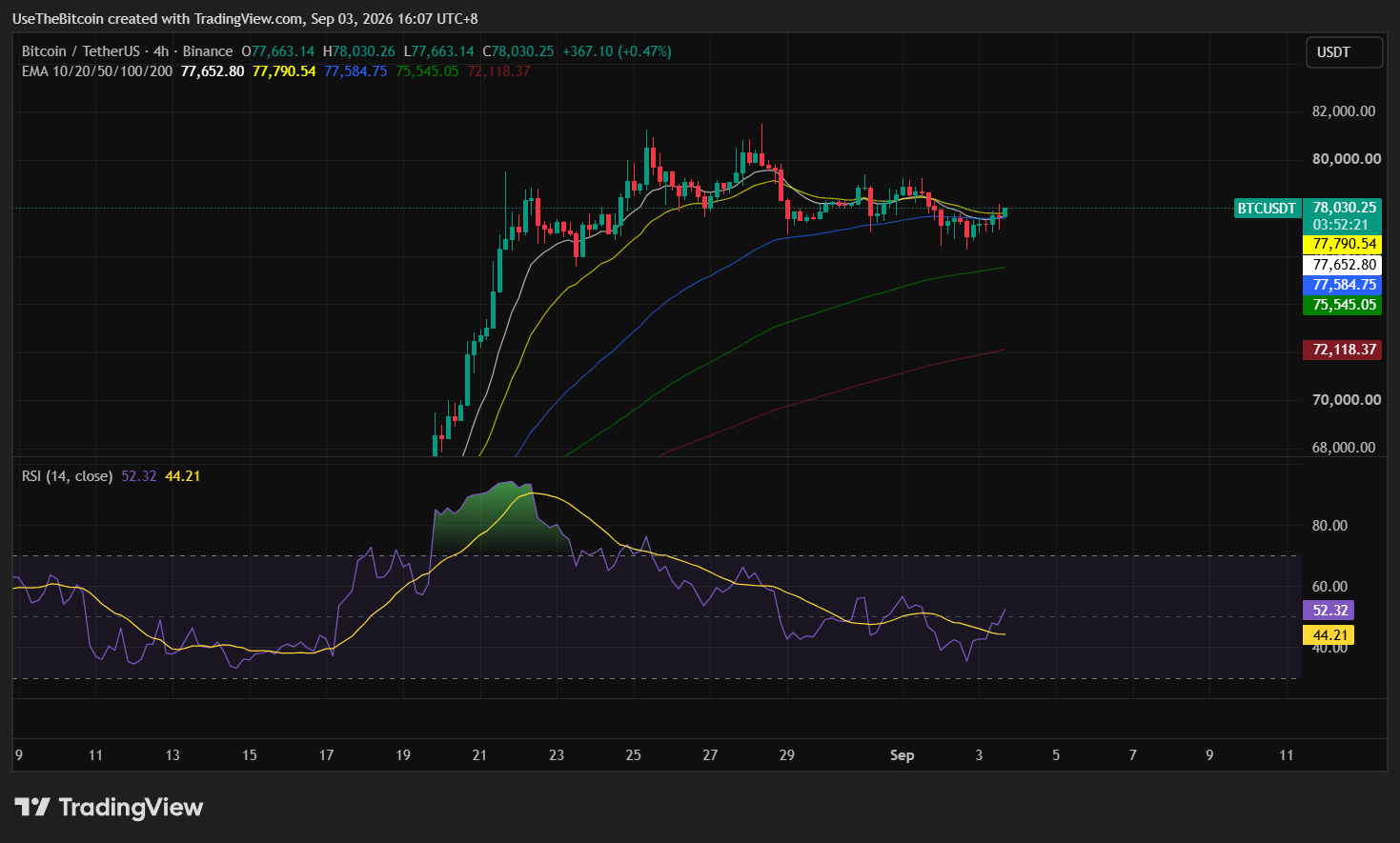
A confirmed break below that level could increase the risk of a deeper pullback, with the former breakout area around $68,000 becoming a possible lower support zone.
For now, the bullish setup depends on BTC holding the $77,000 area and breaking through resistance between $78,300 and $80,000.
Jobs Data Could Decide Bitcoin’s Next Move
The upcoming US jobs report is one of the biggest near-term catalysts because markets are increasingly pricing a Federal Reserve rate hike at the September meeting. For a deeper look at how changing Fed expectations are affecting crypto, see our breakdown of Fed September rate hike odds and Bitcoin pressure.
A stronger-than-expected jobs report could reinforce expectations for tighter monetary policy, keeping Treasury yields high and creating additional pressure on Bitcoin.
On the other hand, a weaker report could reduce rate-hike expectations and give BTC another opportunity to break through resistance.
The US jobs report is scheduled to be released on Friday, September 4, 2026, at 8:30 a.m. ET.
ETF Outflows Add Another Headwind
US spot Bitcoin ETFs recorded around $236 million in net outflows on September 1 after a strong August, according to SoSo Value data.
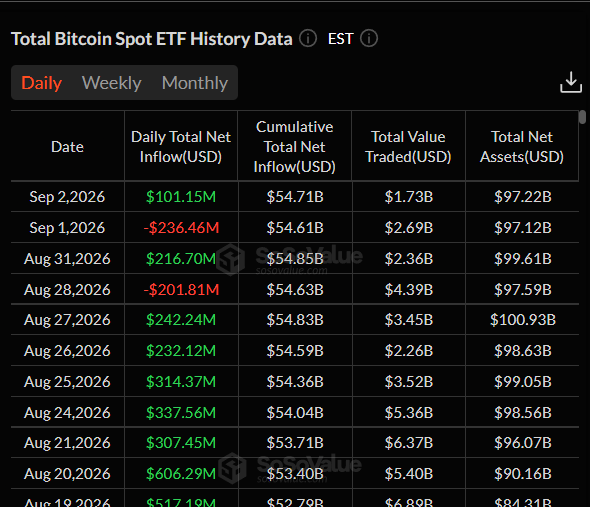
For context, August was much stronger, with spot Bitcoin ETFs recording roughly $3.5 billion in inflows.
If ETF demand returns while Bitcoin holds support, it could help buyers challenge the $80,000 area again, and continued outflows would make that recovery more difficult.
| Scenario | Price Trigger | What It Could Mean |
| Bullish Case | BTC holds $77,165 and reclaims $79,730–$79,920 | Reversal strengthens, opening $80,280 and $81,000 |
| Base Case | BTC stays between roughly $77,000 and $80,000 | Consolidation continues while traders wait for jobs data and the Fed |
| Bearish Case | BTC loses $77,165 and then $75,000 | Reversal fails, increasing the risk of a deeper correction toward lower support |
Table 2. Bitcoin’s Bullish, Base and Bearish Scenarios. These scenario levels are based on technical structures, not price guarantees.
Bottomline
Overall, Bitcoin is still trading inside a narrow decision zone. Holding above $77,165 keeps the short-term recovery attempt alive, but bulls need to reclaim above $78,000 before the structure turns more convincingly bullish.
A break below $77,000 would weaken the setup, while a loss of $75,000 would increase the risk of a deeper move toward lower support.
Frequently Asked Questions
Need a refresher? Here are some of the most common questions traders ask about Bitcoin’s price.
Why Does the Fed Affect Bitcoin Price?
Federal Reserve policy can affect Bitcoin through interest rates, bond yields, the US dollar, and overall risk appetite. Higher rates can make safer assets more attractive, while lower rates can support demand for risk assets such as Bitcoin.
Does a Strong Jobs Report Usually Hurt Bitcoin?
Not always. A strong jobs report can increase expectations for tighter monetary policy if inflation is still high, which may pressure Bitcoin. But the market reaction depends on how much of the data was already priced in.
Why Do Bitcoin ETF Flows Matter for Price?
Spot Bitcoin ETF inflows can increase buying demand from institutional and traditional-market investors. Outflows can have the opposite effect, especially when they happen alongside weak momentum or negative macro conditions.
Why Do Interest Rates Matter for Bitcoin?
Interest rates affect the cost of money and investor appetite for risk. When rates rise, cash and government bonds can become more attractive, reducing demand for assets like Bitcoin. When rate expectations fall, financial conditions can ease, and risk assets may benefit.
Can Bitcoin Trade Differently From Stocks During Fed Events?
Yes. Bitcoin often reacts to the same macro factors as stocks, but crypto markets trade 24/7 and can move faster around major economic releases. Leverage, liquidations, and crypto-specific flows can also make BTC react differently from traditional markets.