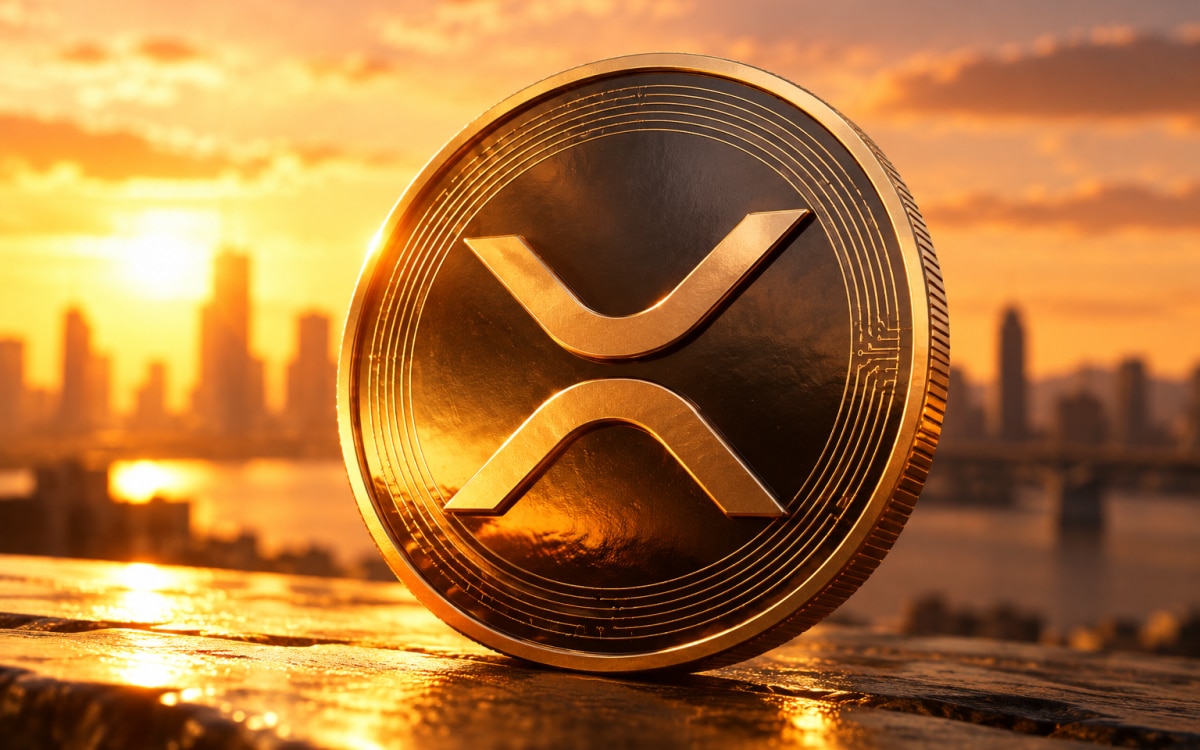
XRP trades between $1.06 and $1.08 as of mid-July 2026, down roughly 70% from its 2025 peak near $3.65. Whether XRP reaches $2, $5, or the more ambitious $15 targets circulating in Ripple communities by 2027 depends on a specific chain of catalysts, not just general crypto market sentiment.
What Analysts Are Predicting for XRP in 2027?
As of July 2026, analysts’ 2027 forecasts for XRP vary widely: Changelly, CoinCodex and DigitalCoinPrice project ranges between $0.40 and $1.92, while Standard Chartered projects about $7 by the end of 2027. A widely discussed bullish scenario puts $15 on the table, though analysts covering it see $5 to $8 as more realistic.
Non-custodial cryptocurrency exchange Changelly projects a 2027 range of $1.15 to $1.92, with quarterly averages climbing from around $1.31 in the first quarter to $1.46 by December.
Crypto market data and analytics platform CoinCodex is more bullish, projecting a range of $1.22 to $1.87, with an average near $1.76 by the end of the year.
Cryptocurrency price-tracking and forecasting website DigitalCoinPrice is the most conservative of the three, projecting a much narrower $0.40 to $1.17 range with a bearish first half before a recovery attempt later in the year.
On the institutional side, Standard Chartered has projected that XRP will reach approximately $7 by the end of 2027, rising to around $28 by 2030.
One widely discussed bullish scenario puts $15 on the table by 2027, though reaching that level would require XRP’s market capitalization to hit roughly $927 billion, about 60% of Bitcoin’s entire market cap today.
Most analysts covering that specific scenario consider a realistic 2027 range closer to $5 to $8, with $15 representing a genuine bullish stretch target rather than a base case.
The Catalysts That Matter Most for XRP
Three things need to happen for XRP to move meaningfully beyond its current range, and they build on one another rather than operate independently.
The first is the CLARITY Act, a US bill that would permanently classify XRP as a commodity under federal law. The Senate Banking Committee passed it 15-9 in a bipartisan vote in May 2026, sending it to the full Senate floor, where it needs 60 votes to pass.
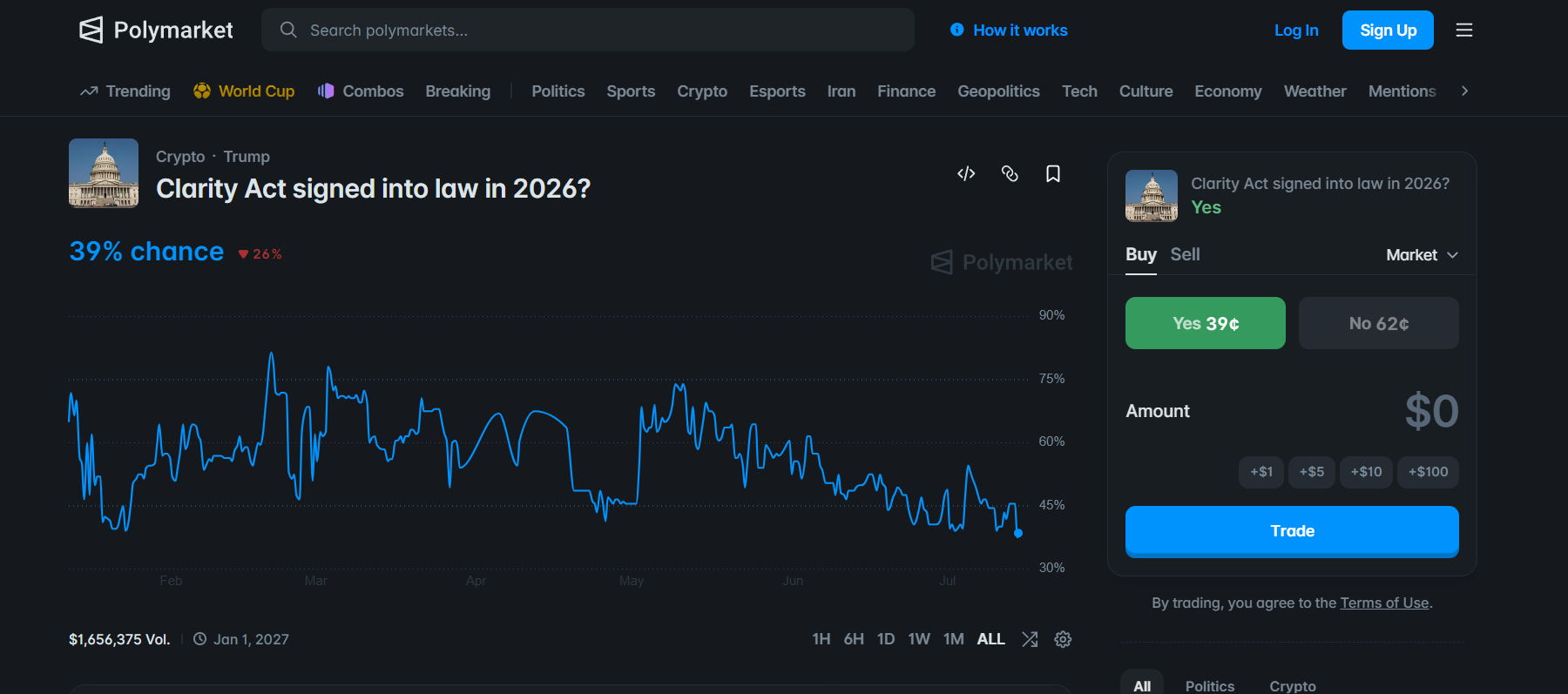
As of mid-July, the bill remains stuck in the Senate with roughly even odds and an August deadline. Polymarket had assigned it a around 39% probability of passing in 2026 as of July 14, 2026.
A March 2026 joint SEC-CFTC ruling already classified XRP as a commodity at the agency level, but that classification can be reversed by a future administration, while a law cannot.
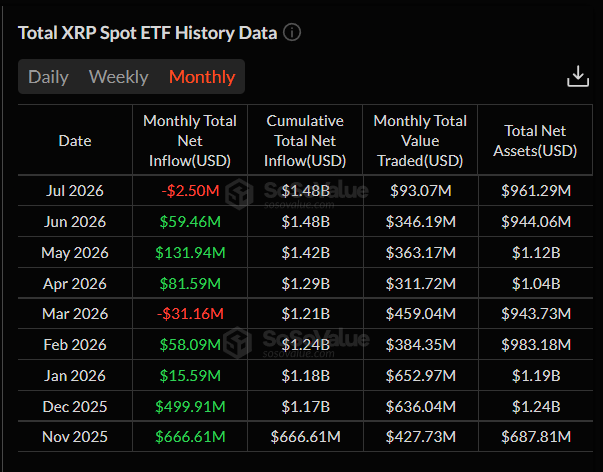
The second is institutional ETF demand. US spot XRP ETFs crossed $1.42 billion in cumulative net inflows by May 2026, their strongest month of the year, though roughly 84% of those flows still came from retail investors rather than large institutions, according to SoSoValue data.
If the CLARITY Act passes, Standard Chartered has projected an additional $4 billion to $8 billion in ETF inflows as institutional capital that has been waiting on the sidelines starts to move.
The third, and most uncertain, is whether banks begin settling payments in XRP itself rather than routing around it with other tools. On May 6, 2026, JPMorgan’s Kinexys platform, Mastercard, Ripple, and Ondo Finance completed a cross-border, cross-bank tokenized US Treasury settlement on the XRP Ledger, clearing in under five seconds and delivering funds to a Singapore bank account outside normal banking hours, a transaction that traditional payment rails typically take one to three days to complete.
Société Générale launched a euro stablecoin on the XRP Ledger, Aviva Investors signed a tokenization partnership with Ripple, and Deutsche Bank built Ripple’s technology into its cross-border payments infrastructure.
The catch is that, specifically in the JPMorgan Treasury settlement, the actual value transfer went through RLUSD, Ripple’s dollar-backed stablecoin, while XRP itself covered only minimal network fees, around $0.0002 per transaction.
Banks are increasingly using the XRP Ledger without needing to hold or transact in XRP itself, and closing that gap between ledger activity and token demand is exactly what higher price targets depend on.
Why Has XRP’s Price Stayed Flat?
XRP’s price stayed largely flat through the first half of 2026 because banks increasingly use the XRP Ledger without holding XRP: in JPMorgan’s May 2026 Treasury settlement, value moved in RLUSD and XRP covered only network fees. Ledger activity still grew: tokenized real-world assets on it crossed $3 billion in late April 2026, a 59% jump in 30 days.
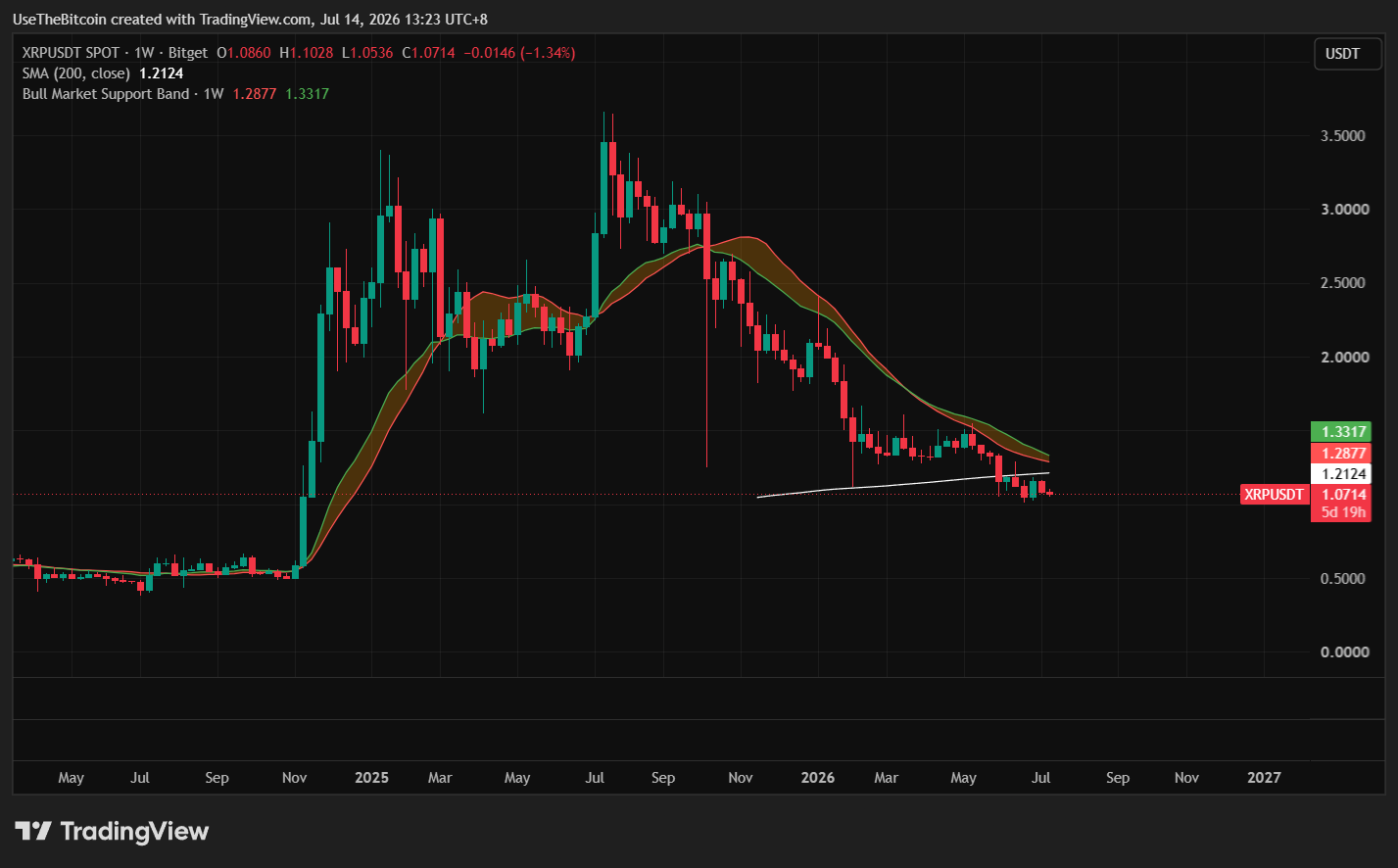
The number of wallets holding at least 10,000 XRP hit an all-time high of 332,230 around the same period, suggesting larger holders are quietly positioning even while the price remains low.
Whether that translates into a 2027 breakout depends on the same three catalysts resolving in XRP’s favor, not on ledger activity alone. For a broader look at Ripple’s ongoing legal and regulatory situation, our guide to Ripple’s SEC case and regulatory updates tracks the story’s development.
Historical Context of XRP’s Price
XRP’s all-time high of $3.65 was set in July 2025, and its all-time low of roughly $0.11 came in March 2020. The token’s most consequential turning point was legal rather than technical.
A March 2023 court ruling found that XRP itself is not a security, and in August 2025, the SEC agreed to drop its remaining appeals, formally ending a legal battle that had constrained institutional adoption for years.
XRP surged more than 23% to $3.38 within days of that news, then retreated to $1.87 by the end of 2025, and continued to decline through the first half of 2026.
That pattern, a strong reaction to regulatory clarity followed by a slower fade as attention shifts to the next catalyst, is a reasonable lens for evaluating how the market might react to CLARITY Act passage specifically.
Readers weighing XRP as a longer-term holding can find more context in our guide on whether XRP is a good investment.
This article is for informational purposes only and does not constitute financial advice. Crypto price predictions are based on analyst estimates and are not guarantees of future performance. Do your own research before making any investment decisions.
Frequently Asked Questions
Need a refresher? Here are the questions readers most often ask about XRP’s price outlook for 2027.
What is a realistic XRP price for 2027?
Most analyst forecasts cluster between $5 and $8 by 2027, with Standard Chartered specifically projecting around $7. More conservative platforms like DigitalCoinPrice project a narrower range under $1.20, while more bullish platforms like CoinCodex see upside toward $1.87 in their base case, before accounting for a CLARITY Act catalyst scenario.
Can XRP reach $15 by 2027?
Reaching $15 would require XRP’s market capitalization to hit approximately $927 billion, roughly 60% of Bitcoin’s current market cap. Most analysts consider this a genuine bullish stretch target rather than a base case, achievable only if the CLARITY Act passes, ETF inflows climb past $10 billion, and banks begin settling directly in XRP rather than using stablecoins to route around it.
What is the CLARITY Act and why does it matter for XRP’s price?
The CLARITY Act is a US bill that would permanently classify XRP as a commodity under federal law rather than leaving that status subject to reversal by a future administration or agency ruling. It passed the Senate Banking Committee in a bipartisan vote in May 2026 and remains pending a full Senate vote, with an August 2026 deadline referenced in current coverage.
Why has XRP’s price stayed flat despite Ripple’s institutional partnerships?
Much of Ripple’s recent institutional activity, including a JPMorgan Kinexys tokenized Treasury settlement in May 2026, has run through RLUSD, Ripple’s stablecoin, rather than XRP itself, with XRP covering only minimal network fees. Banks are increasingly using the XRP Ledger’s infrastructure without needing to hold or transact in the XRP token directly, which limits the price impact of these deals until that gap closes.
How does XRP’s 2027 outlook compare to Bitcoin’s?
Bitcoin’s path to a higher price depends mainly on existing catalysts, capped supply, and continued ETF demand, which are already in place, giving it a smaller but more likely payoff. XRP’s upside potential is higher on paper, with some forecasts implying returns of 4x to 6x current prices, but it depends on a longer chain of unresolved catalysts, making it a higher-risk, higher-reward comparison rather than a like-for-like bet.
More on XRP: XRP hub · XRP price today · How to buy XRP