Key Takeaways
- TVL (Total Value Locked) measures the total value of crypto assets deposited in DeFi protocols through smart contracts across lending, staking, and liquidity.
- TVL is calculated by summing all deposited assets and converting them to USD at current market prices for standard comparison.
- Investors use TVL to compare platforms, track growth, and gauge liquidity, but they combine it with other metrics for better analysis.
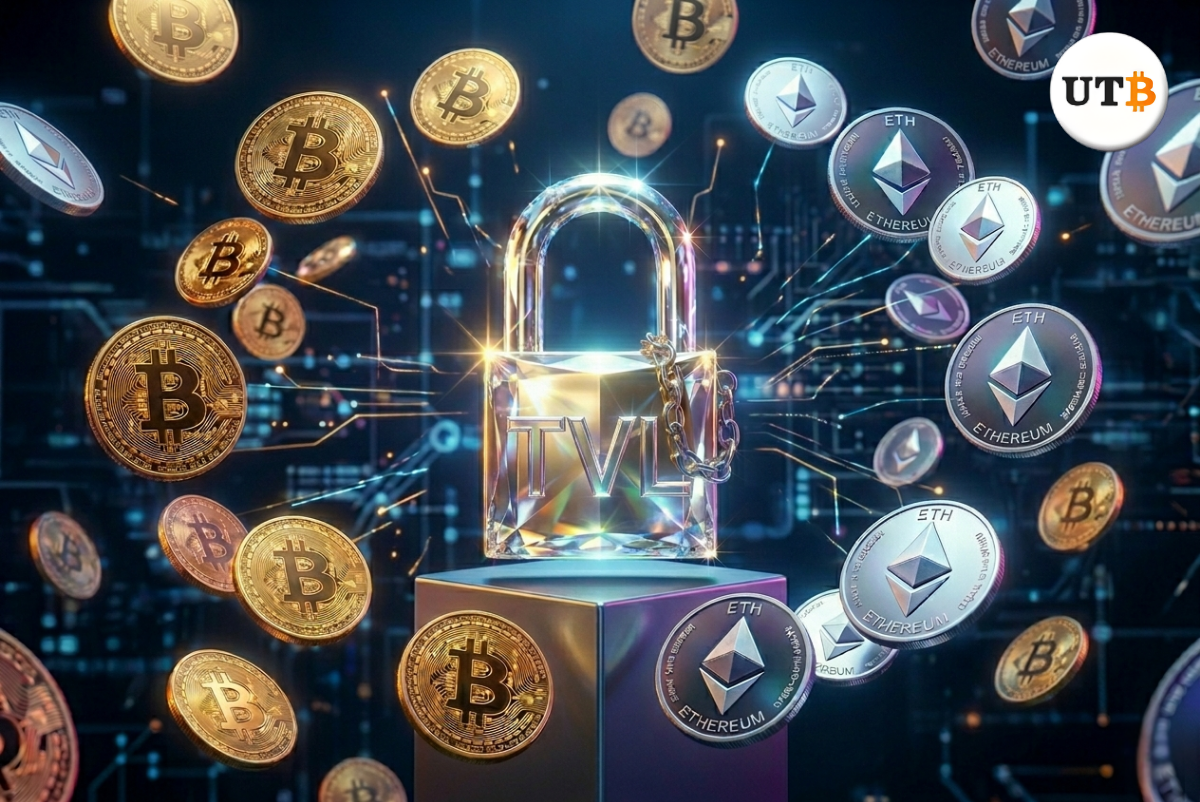
In decentralized finance (DeFi), a single number is often used to show how active or popular a platform is: Total Value Locked (TVL). In basic terms, TVL shows how much money is currently stored or being used inside a blockchain protocol, whether it’s staked, lent, or deposited in smart contracts.
Because it gives a quick snapshot of how much capital a platform is attracting, TVL is often used to compare different DeFi projects. But while it’s useful as a general indicator, it doesn’t always capture the full picture of a protocol’s performance, user activity, or long-term stability, all of which are important to consider. In this article, we’ll break down what TVL means and how it works in more detail.
What Is Total Value Locked (TVL)?
Total Value Locked (TVL) refers to the total value of digital assets that users have deposited or “locked” into a decentralized finance (DeFi) protocol. These assets are held in smart contracts and are actively used to power different financial activities within the platform, such as:
- Lending and borrowing
- Providing liquidity for trading pairs
- Staking tokens to earn rewards
- Participating in yield farming strategies
Whenever users deposit their crypto into a DeFi protocol, that value is added to its TVL, reflecting the amount of capital currently being utilized within the system. In simple terms, TVL shows how much value a DeFi protocol holds and manages at any given time.
How TVL Works in Practice
Total Value Locked (TVL) is calculated by adding up the total value of all assets deposited into a DeFi protocol. To make comparisons easier across platforms, these assets are usually measured in USD based on current market prices.
1. Depositing Assets Into the Protocol
Users begin by depositing cryptocurrencies into a DeFi platform. Instead of being held by a central company, these funds are stored in smart contracts that automatically manage and record the assets.
2. Tracking Locked Assets
The protocol then tracks all assets that are locked within its system. This can include different types of crypto holdings, such as:
- Major cryptocurrencies like ETH, BTC, and stablecoins
- Liquidity provider (LP) tokens from trading pools
- Staked governance tokens used for voting or rewards
3. Calculating the Total Value
Each asset is then valued based on its current market price. The protocol multiplies the amount of each token by its price and adds everything together.
4. Final TVL Figure
The final sum represents the Total Value Locked (TVL). It reflects the total amount of capital currently secured, managed, and used within the DeFi platform at that time.
Why TVL Matters in DeFi
TVL is widely used in decentralized finance as a quick reference point for understanding how much capital is actively being used within a protocol. Since it reflects real assets locked in smart contracts, it helps give a snapshot of a platform’s scale and level of activity.
A higher TVL can often suggest several things, such as:
- Stronger market interest in the protocol
- Deeper liquidity, which can support smoother trading
- Wider user participation and adoption
- Increased activity within the ecosystem
For traders and investors, TVL is commonly used to compare DeFi platforms and get a sense of how much value is currently flowing through each one.
However, TVL is just one metric, and it is most useful when considered alongside other indicators of performance and usage.
Key Limitations of TVL
While Total Value Locked (TVL) is a widely used metric in DeFi, it also has limitations that can affect its accuracy in reflecting a protocol’s real performance.
A. Price Volatility Can Influence TVL
Since TVL is measured in USD, changes in cryptocurrency prices can majorly affect the figure. Even without any new deposits or withdrawals, TVL can increase or decrease simply because the value of the underlying assets has moved in the market.
B. Incentives Can Temporarily Inflate Numbers
Some DeFi platforms use rewards, token emissions, or yield incentives to attract deposits. This can increase TVL in the short term, even if some of those funds are temporary and may be withdrawn once rewards decrease.
C. Limited Insight Into Actual Usage
A higher TVL doesn’t always mean people are actively using the platform. Sometimes, funds stay deposited but are not being used for lending, trading, or other activities. Because of this, TVL can make a protocol look more active than it really is.
D. Cross-Chain and Reporting Challenges
With assets moving across multiple blockchains through bridges and wrapped tokens, TVL can sometimes be difficult to track accurately. This may lead to double-counting or inconsistencies in reporting across different platforms.
TVL Across Different DeFi Sectors
Total Value Locked (TVL) is not limited to one type of DeFi application. It is spread across different sectors, and each uses locked assets in different ways to support its functions.
- Lending platforms: Lending platforms where users deposit crypto as collateral, which is then used to issue loans to other users
- Decentralized exchanges (DEXs): Liquidity is provided in trading pools, allowing users to swap tokens without intermediaries
- Staking protocols: Tokens are locked to help secure blockchain networks and earn staking rewards
- Yield platforms: Funds are automatically allocated across strategies designed to generate returns
Each of these sectors plays a different role in the DeFi ecosystem, and together they contribute to the overall TVL of the industry.
TVL vs Market Capitalization
TVL is often confused with market capitalization, but they measure very different aspects of a crypto project.
- Market capitalization refers to the total value of a token based on its current price multiplied by the number of tokens in circulation. It mainly reflects the market value of the asset itself.
- Total Value Locked (TVL) shows how much real capital is actively deposited and used within a DeFi protocol’s smart contracts. It reflects actual usage within the ecosystem rather than token price alone.
Because they measure different things, a project can have a high market cap but relatively low TVL, or a lower market cap but strong TVL depending on how much real activity is happening in its protocol.
Understanding this difference helps distinguish between speculative token value and actual on-chain usage.
How Investors Use TVL
Investors and analysts use Total Value Locked (TVL) as a starting point to understand how much capital is flowing into DeFi protocols and how active those ecosystems are.
TVL is commonly used to:
- Compare DeFi protocols: Helps assess which platforms are attracting more capital compared to others.
- Track ecosystem growth: Shows whether a protocol is expanding or losing deposited value over time.
- Identify rising platforms: Sudden increases in TVL can signal growing interest or new adoption.
- Evaluate liquidity depth: Indicates how much capital is available for trading, lending, or other on-chain activities.
However, TVL is rarely used on its own. Most analysts combine it with other key metrics, such as trading volume, user activity, and protocol revenue, to gain a more complete view of a project’s actual performance and sustainability.
Final Thoughts
Total Value Locked (TVL) is a key metric in DeFi that shows how much capital is deposited and used within a protocol, giving a quick view of its size, liquidity, and activity. However, it does not fully reflect real usage or performance on its own, as it can be affected by price changes and incentives. For a clearer picture, TVL is best used alongside other metrics like trading volume, user activity, and protocol revenue. Overall, it remains a helpful starting point for understanding how much value is flowing through a DeFi ecosystem.