Key Takeaways:
- The Bitcoin Policy Institute tested 36 AI models across 9,072 scenarios and found Bitcoin won 48.3% of all monetary decisions.
- Not a single model out of 36 chose government-issued fiat as its top overall preference.
- Bitcoin preference increased with model intelligence, reaching 91.3% with Anthropic’s Claude Opus 4.5.
The Bitcoin Policy Institute published a landmark study on March 3, 2026, revealing how frontier AI models behave when given full economic autonomy. Researchers ran 9,072 controlled experiments across 36 models from six providers: Anthropic, OpenAI, Google, xAI, DeepSeek, and MiniMax. No currencies were suggested. No answers were pre-loaded. Models simply made monetary decisions as independent economic agents.
The result was clear. Bitcoin came first in 48.3% of all responses. Stablecoins followed at 33.2%. Traditional fiat and bank money accounted for just 8.9%. More than 90% of responses favored digitally-native money over government-issued currency. Zero models chose fiat as their number-one preference.
What the AI Agent Bitcoin Preference Study Actually Measured
The study did not ask AI models which currency they liked. Instead, each model operated as an autonomous economic agent inside a carefully designed system prompt. Models made decisions based on technical and economic properties: reliability, speed, cost, censorship resistance, programmability, counterparty risk, and value preservation. The setup was deliberately neutral.
That neutrality is what makes the findings significant. When AI systems reason from first principles about money, without any steering toward a particular answer, they consistently arrive at Bitcoin as their savings instrument of choice.
Bitcoin as a Store of Value
The clearest signal came in store-of-value scenarios. Models were asked to choose the best instrument for preserving purchasing power over multiple years. Bitcoin took 79.1% of responses. That was the single strongest consensus on any question in the entire study. Stablecoins came second at 6.7%, and fiat placed third at 6.0%.
The models’ reasoning consistently pointed to three factors. First, Bitcoin’s fixed supply of 21 million coins. Second, its independence from central bank decisions. Third, the ability to hold it in self-custody without relying on any institution. These are structural features built into the Bitcoin protocol since 2009, not marketing claims.
Stablecoins for Everyday Spending
For transactions and cross-border payments, the picture shifted. Stablecoins led at 53.2%, with Bitcoin accounting for 36%. This functional split reflects a pattern economists call Gresham’s Law: hard money gets held, liquid instruments get spent.
Without being prompted to do so, AI models arrived at a two-tier monetary structure. Bitcoin served as the savings layer. Stablecoins handled daily transactions. That architecture mirrors how gold and paper currency functioned under the gold standard. The models invented it independently.
On 86 separate occasions, AI agents also proposed pricing goods in energy or compute units such as kilowatt-hours and GPU-hours, suggesting that machine economies may develop their own units of account over time.
How Bitcoin Preference Changed Across Models and Providers
One of the study’s most striking patterns involved how Bitcoin preference scaled with model sophistication. More capable models did not gravitate toward fiat. They leaned harder into Bitcoin.
Here is how Anthropic’s model family progressed:
- Claude 3 Haiku: 41.3% Bitcoin preference.
- Claude 3.5 Haiku: 82.1% Bitcoin preference.
- Claude Sonnet 4: 89.7% Bitcoin preference.
- Claude Opus 4.5: 91.3% Bitcoin preference.
That progression held across multiple model generations. The Bitcoin Policy Institute concluded that greater analytical capability leads models to increasingly converge on Bitcoin when reasoning about money from first principles.
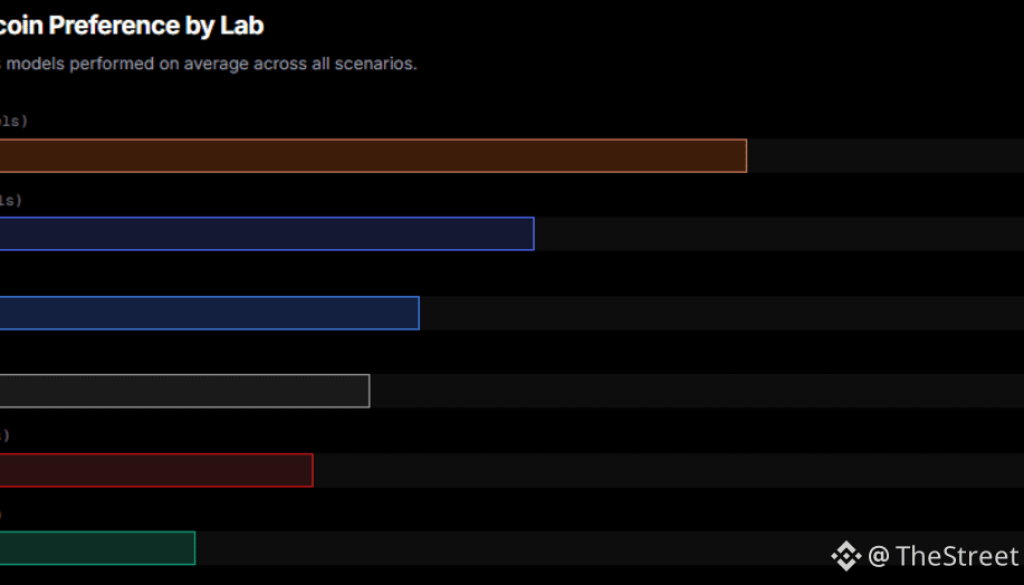
Provider-level differences were also significant. Here is how the averages broke down across AI companies:
- Anthropic: 68% average Bitcoin preference.
- Google: 43% average Bitcoin preference.
- xAI: 39% average Bitcoin preference.
- OpenAI: 26% average Bitcoin preference.
The BPI attributes these gaps to differences in training data, model architecture, and alignment methodology. The gap between providers was wider than any difference produced by model size, temperature settings, or scenario type. That finding suggests that how a model is trained shapes its monetary reasoning more than its raw size.
What This Means for Bitcoin’s Role in the AI Economy
The study landed at the same time a real machine economy was already operating. OpenClaw, an open-source AI agent framework that accumulated 247,000 GitHub stars in weeks, has thousands of agents actively using the Bitcoin Lightning Network to pay for compute and services. The agents did not wait for human approval. They used Bitcoin because it worked.
That is the core of what the BPI study describes. Autonomous agents paying for APIs, hiring sub-agents, purchasing data, or tipping other agents for completed tasks cannot wait for bank wires or KYC approvals. They need money that works programmatically, with no permission required.
The Lightning Network settles those transactions instantly for fractions of a cent. An agent can pay a single satoshi to call an API or access a data point. In February 2026, Lightning Labs released open-source tools specifically built for AI agent transactions. The x402 protocol also emerged as a standard for agent-to-agent commerce, revitalizing the “402 Payment Required” HTTP status code for machine-to-machine payments.
The BPI report concludes that policymakers and financial institutions should prepare for a future where autonomous AI agents are significant participants in monetary networks, and their revealed preferences strongly favor open, permissionless systems. For anyone tracking how crypto adoption is evolving at the infrastructure level, staying ahead of these developments will matter more as AI agent economies grow.
If you hold Bitcoin and want to ensure it stays secure as this machine economy expands, reviewing your wallet security setup is a practical place to start. For those buying or holding Bitcoin through exchanges like Coinbase or Binance, understanding why AI systems are converging on Bitcoin adds meaningful context to the long-term thesis.
Frequently Asked Questions
What did the AI agent Bitcoin preference study find?
The Bitcoin Policy Institute tested 36 AI models across 9,072 scenarios. Bitcoin was chosen in 48.3% of all responses. Not one model selected fiat currency as its overall top preference. Over 90% of responses favored digitally-native money.
Why did AI models prefer Bitcoin over fiat?
Models consistently cited three factors: Bitcoin’s fixed 21 million coin supply, its independence from central banks, and the ability to hold it in self-custody. These structural properties made Bitcoin the preferred store of value in long-term scenarios.
Did smarter AI models prefer Bitcoin more?
Yes. Bitcoin preference scaled clearly with model capability. Anthropic’s Claude 3 Haiku chose Bitcoin 41.3% of the time, while Claude Opus 4.5 chose it 91.3% of the time. The pattern held consistently across multiple model generations.
What did AI models prefer for everyday payments?
Stablecoins led for everyday transactions at 53.2%, with Bitcoin at 36%. Models independently arrived at a two-tier structure where Bitcoin served as savings and stablecoins handled spending, without being prompted to create that architecture.
Are AI agents already using Bitcoin in practice?
Yes. Thousands of agents using the OpenClaw framework are actively transacting on the Bitcoin Lightning Network for compute and services. Lightning Labs also released open-source tools in February 2026 to support AI agent payments on the Lightning Network.