Key Takeaways
- The US-Iran war sees oil rally, gold struggle, Dubai financial market shares crash, and Bitcoin gain strong upside momentum.
- Previous wars such as Russia-Ukraine, Israel-Gaza, Israel-Iran, and others have seen the price of Bitcoin crash to the downside before a market strong rally upwards.
- Bitcoin has demonstrated strength amid market uncertainty, underscoring why institutional investors are always looking for opportunities to build a strong long-term position.
Bitcoin and the cryptocurrency market have struggled over the years, leading to market cycles, as a result of global uncertainties ranging from COVID-19 to wars, which have seen the price of Bitcoin react in different instances. A major factor in the price of the decentralised digital asset over the years has been war, especially in the Middle East.
How have wars over the past few years, since 2020-2026, shaped the price cycles of the cryptocurrency market and Bitcoin itself? This article discusses various instances, including the recent US-Iran war, which has affected the financial markets, including Bitcoin.
COVID-19 Outbreak and Bitcoin Reaction
COVID-19 outbreak cannot be classified as a war; however, this event marked a major market cycle for the cryptocurrency market and for Bitcoin, as the outbreak of COVID-19 saw the price of many cryptocurrency assets and Bitcoin crashed to an all-time low from a region of $20,000 towards $2,000, resulting in huge market liquidations and overall market cycle shift.
Following this period marked by a market crash towards a key low, many traders and investors saw the opportunity and took advantage of it, as Bitcoin rallied from a $2,000 low to a $50,000 high, marking a huge market cycle shift.
This period was also marked by new market trends around 2020 to 2021, as decentralised finance (DeFi) made a grand entrance, opening up significant liquidity and investor interest.
This period has led to different market cycles shaped by wars, especially in the Middle East, which has resulted in Bitcoin Market Cycles.
Geopolitical Conflict and Effect on Bitcoin Cycles
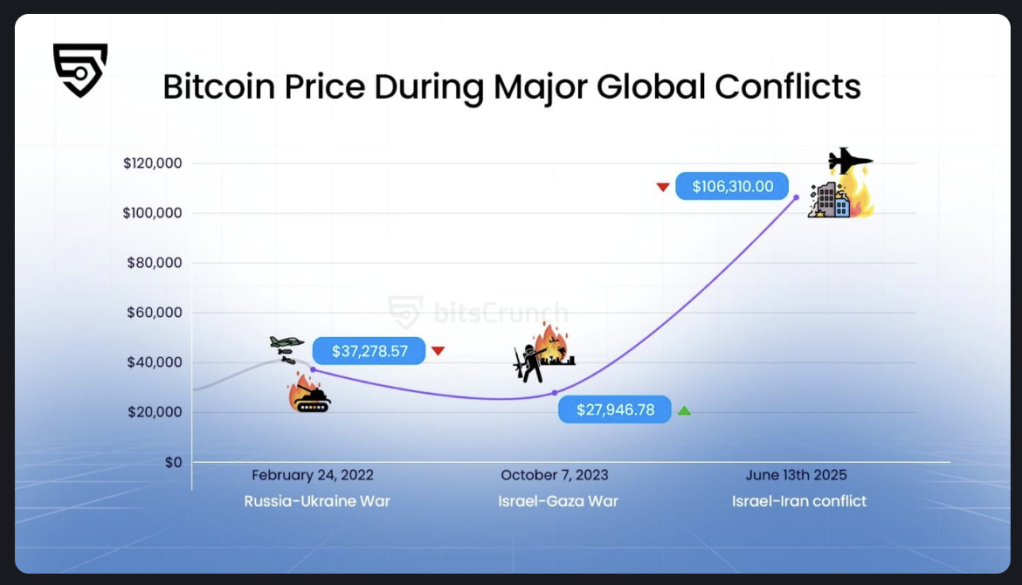
Source – Geopolitical Conflicts and Bitcoin Reaction
Over the years, there have been four major geopolitical conflicts that have affected Bitcoin, including Russia-Ukraine, Israel-Gaza, Israel-Iran, and the recent US-Iran war. The majority of these geopolitical conflicts have happened in the Middle East. Let us discuss them.
Russian-Ukrainian War
The Russian-Ukrainian war broke out in 2022. This period was marked by Bitcoin down by over 50% from its all-time high. While there was market uncertainty around this time, Bitcoin’s price rallied to $45,000, gaining over 20% amid demand during the war and market uncertainty.
However, events such as the Federal Reserve’s interest rate cut in response to the oil rally during this period led to BTC’s price crashing by over 60%, creating greater uncertainty for prices and investors at the time. BTC has since shown resilience during those periods into the Middle East wars.
Middle East Wars (Israel-Gaza, Israel-Iran, US-Iran)
During this period of war, the market has seen volatility to the downside but has rebounded more to the upside, as more institutional investors have entered the cryptocurrency space, spotting opportunities to buy more Bitcoin for the long term.
Although BTC’s price has experienced periods of market uncertainty and crashes, the market has always recovered over time. Recent market uncertainties, however, would not affect BTC compared to the past, as institutional investors’ presence has changed the current market cycle for BTC.
Final Thoughts
The effect of war on Bitcoin cycles hasn’t disappeared; however, due to the presence of institutional investors, the effect on holding Bitcoin has reduced over the years, as big whale players look for opportunities to build BTC reserves, especially during periods of market uncertainty.
FAQs
What will happen to crypto if the US attacks Iran?
Speculations are suggesting the price of BTC could go lower, but they have proven wrong as the price is rallying. Gold and Oil have seen strong price action over the last few days.
How much BTC does Iran hold?
There are no exact figures yet, but Iran has been conducting many transactions and mining activities with Bitcoin lately, despite the recent US-Iran war.
Will the Iran War affect crypto?
The crypto market has experienced a crash in the last few hours amid the US-Iran war, as US President Donald Trump hints at a combat operation. The crypto market could see a significant crash on Monday when it opens.
Does war affect the crypto market?
Historical data show wars such as the Russian-Ukrainian and Israel-Iran have led to market crashes of over 40% and 20%, respectively, and could trigger a similar reaction.
Related Read
Nigerians Face Oil Scarcity, Crude Oil Prices to $200/barrel, as Bitcoin Price Stalls
How Oil Supply Could Affect Crypto as Oil Eyes $100 per Barrels
How Will Bitcoin and Gold React to the US-Iran War?
G7 Debates Release of 400 Million Barrels of Emergency Oil Reserve – Will Crude Oil Price Drop?