Key Takeaways
- Crypto markets react faster than stock markets during global conflicts because of 24/7 trading, enabling investors to respond immediately to breaking news.
- Investor sentiment affects crypto prices sharply, with fear, speculation, and online chatter triggering fast buying or selling.
- Stocks respond more slowly because trading is limited to set hours and regulations prevent extreme volatility, giving investors time to adjust.
Global conflicts often shake financial markets, but the cryptocurrency market usually reacts much faster than traditional stocks. When news about military escalation, economic sanctions, or diplomatic negotiations breaks, crypto traders tend to respond within minutes. Because digital assets trade around the clock on global exchanges, price movements can happen almost instantly as investors rush to adjust their positions.
This rapid reaction was evident in March 2026 when Bitcoin climbed above $70,000 after geopolitical signals suggested tensions involving Iran could ease. Traders quickly responded to the news, pushing prices higher within a short period. The move highlighted how sensitive crypto markets can be to global political developments.
Digital asset markets operate nonstop, allowing investors around the world to react immediately to breaking events. When headlines related to conflict, sanctions, or diplomacy appear, traders often adjust their positions right away. This constant activity makes cryptocurrency prices one of the first financial indicators to reflect changes in global sentiment.
Traditional equities, however, usually respond more slowly. Stock markets follow fixed trading hours and close overnight and on weekends, limiting when investors can trade. Because of these restrictions, major geopolitical developments may already be reflected in crypto prices before stock markets reopen and begin adjusting to the same news.
Bitcoin Stands Out During War
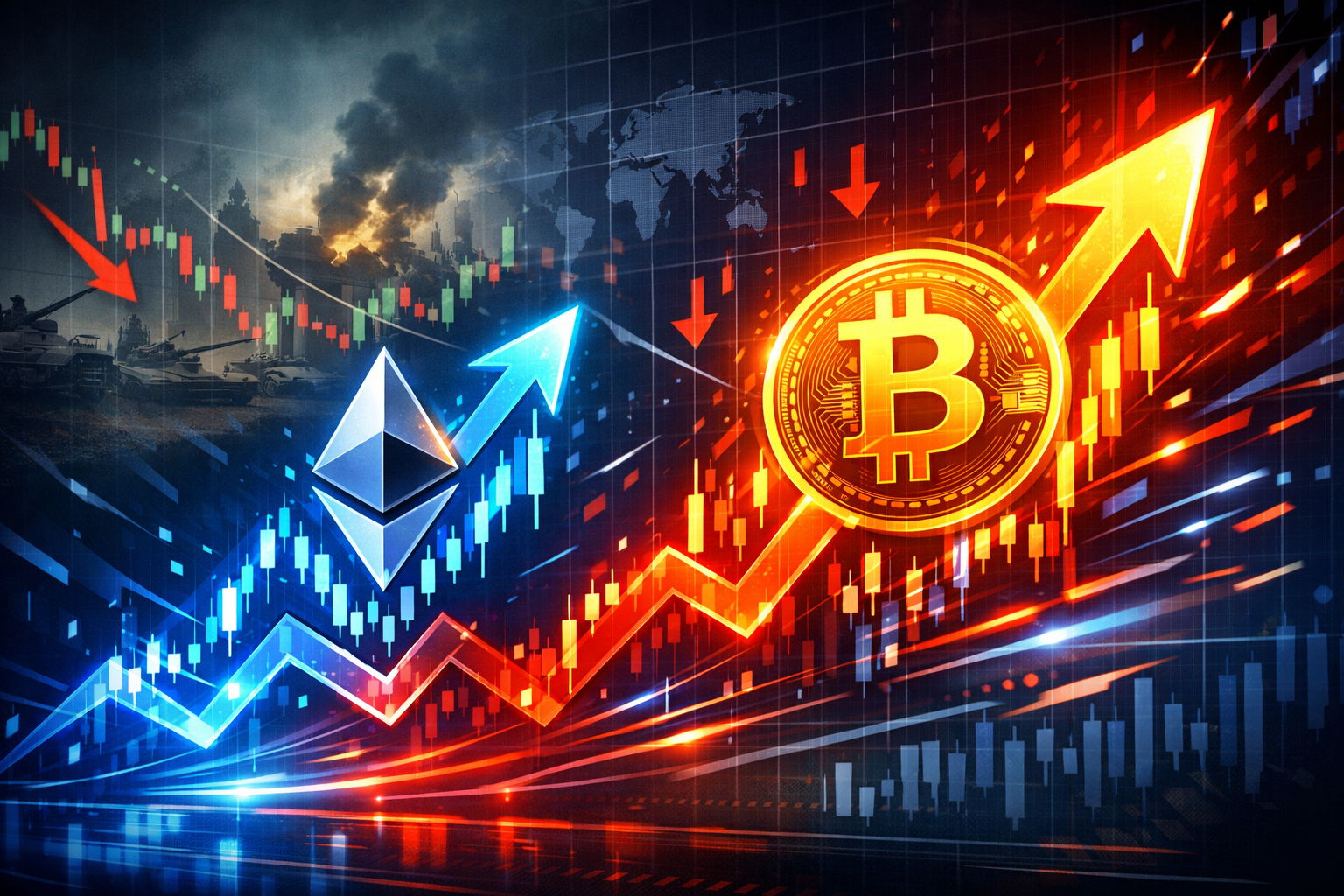
Bitcoin has stood out during the recent conflict, rising even as stocks, gold, and silver fell. Investors have continued buying the cryptocurrency, highlighting its appeal as a digital store of value and a hedge against risk. Unlike traditional assets, which often suffer sell-offs during times of fear, Bitcoin has shown resilience, reflecting growing confidence among traders who view it as a safe haven in volatile markets.
Analysts noted that if the conflict eases or ends, Bitcoin could rise sharply, possibly toward $100,000. This would happen as investors return to high-growth assets, showing that Bitcoin often moves on its own compared with stocks, gold, or other traditional markets during global crises.
Crypto vs. Stocks: Why Digital Markets React Faster to War
24/7 Trading Gives Crypto an Immediate Edge
One of the main reasons cryptocurrency markets react faster to global events is their continuous trading schedule. Unlike traditional financial markets, digital assets such as Bitcoin and Ethereum trade 24 hours a day, seven days a week across exchanges worldwide. This constant activity allows investors, traders, and institutions to respond immediately when major news breaks.
Traditional stock markets, on the other hand, operate within fixed trading hours during weekdays. Major exchanges like the New York Stock Exchange and Nasdaq close overnight and remain shut during weekends and holidays. If a significant geopolitical event occurs outside those hours, such as a sudden military escalation or new economic sanctions, stock investors often have to wait until the next trading session before they can react.
Because crypto markets never close, price discovery happens in real time. News spreads across global trading platforms, and market participants quickly adjust their positions, which can lead to rapid price swings. By the time stock markets reopen, cryptocurrency prices may have already reflected much of the market’s reaction to the same event.
Sentiment Drives Crypto Markets More Strongly
Investor sentiment plays a major role in cryptocurrency price movements. Digital asset markets are heavily influenced by short-term reactions to breaking headlines, online discussions, and shifting market narratives. Traders often monitor platforms such as X (Twitter) and Telegram for updates, and rapid information sharing can quickly trigger waves of buying or selling in assets like Bitcoin and Ethereum.
In traditional equities, investors usually focus more on company fundamentals. Stock prices are often influenced by factors such as corporate earnings, revenue growth, management decisions, and economic outlooks. Because investors tend to analyze financial data and long-term performance, equity markets may react more gradually to geopolitical developments compared with crypto markets.
During periods of conflict or geopolitical tension, emotions such as fear, uncertainty, and speculation can spread rapidly across crypto communities. As traders respond quickly to these shifts in sentiment, price swings in digital assets can become sharper and faster than those typically seen in stock markets.
Fewer Regulations and Market Safeguards
Traditional stock markets operate under strict regulations designed to reduce extreme volatility. Major exchanges such as the New York Stock Exchange and Nasdaq use mechanisms like circuit breakers and temporary trading halts that pause trading when prices move too sharply, giving investors time to process major news.
Unlike stock markets, crypto platforms have fewer built-in safety measures. Digital assets like Bitcoin trade continuously across global exchanges, allowing prices to move freely. While this allows the market to react faster to events such as war-related news, it also makes crypto more vulnerable to sudden and dramatic price swings.
Leverage and Liquidations Affect Price Trends
Crypto markets can react very quickly because many traders use leverage, which means borrowing money to take bigger positions. This can make gains bigger but also losses. When prices move suddenly, often after major news, these trades can be automatically closed, a process called liquidation. If enough liquidations happen at once, it can push prices sharply up or down in a short time. Some key points:
- Leverage makes gains and losses bigger.
- Sudden news can trigger many automatic trade closures.
- Multiple liquidations can create a chain reaction, moving prices fast.
Stocks, on the other hand, usually allow much less leverage and have rules to limit big losses. That means stock prices move more slowly and less dramatically. For example:
- Price changes are usually smaller.
- Market shocks rarely create chain reactions.
- Investors often have time to think before reacting.
This combination of high leverage and nonstop trading is why crypto often jumps or drops faster than traditional stocks during global events.
Why Crypto Moves First on War News
Cryptocurrencies react faster than traditional stocks during global conflicts due to 24/7 trading and strong investor sentiment, allowing digital assets like Bitcoin and Ethereum to see their prices shift within minutes of major news. This constant activity makes crypto highly responsive to global events, often reflecting market reactions long before traditional stocks, gold, or other assets adjust. This makes crypto exciting but also risky. Big swings can happen quickly, especially with borrowed funds and automatic trade closures. At the same time, Bitcoin has shown it can hold value even in uncertain times, making it a popular choice for investors looking for a safe option. When global events shake markets, crypto often leads the way before stocks or gold catch up.
Frequently Asked Questions
Why do cryptocurrencies react faster than stocks during global conflicts?
Crypto markets trade 24/7 worldwide, allowing investors to respond immediately to breaking news, while stock markets operate during limited hours.
How does investor sentiment affect crypto prices?
Fear, speculation, and online discussions can trigger rapid buying or selling, making crypto prices move sharply within minutes.
Why are stock markets slower to react to geopolitical events?
Stocks have fixed trading hours, strict regulations, and safeguards like circuit breakers, giving investors more time to respond.
Can Bitcoin act as a safe haven during conflicts?
Yes. Bitcoin has often held or increased value even when stocks, gold, and silver fell, making it attractive for risk-averse investors.
What makes crypto markets riskier during times of conflict?
High volatility, nonstop trading, and leveraged positions can cause sudden and dramatic price swings, increasing both risk and opportunity.