Key Takeaways
- Mastercard and Chainlink enable 3.5B cardholders to buy crypto directly on-chain, linking traditional payments with DeFi infrastructure.
- Chainlink connects off-chain card data to blockchain smart contracts, enabling secure and verified execution of on-chain transactions.
- Mastercard handles global card payments, while regulated partners convert fiat to crypto before final on-chain settlement.
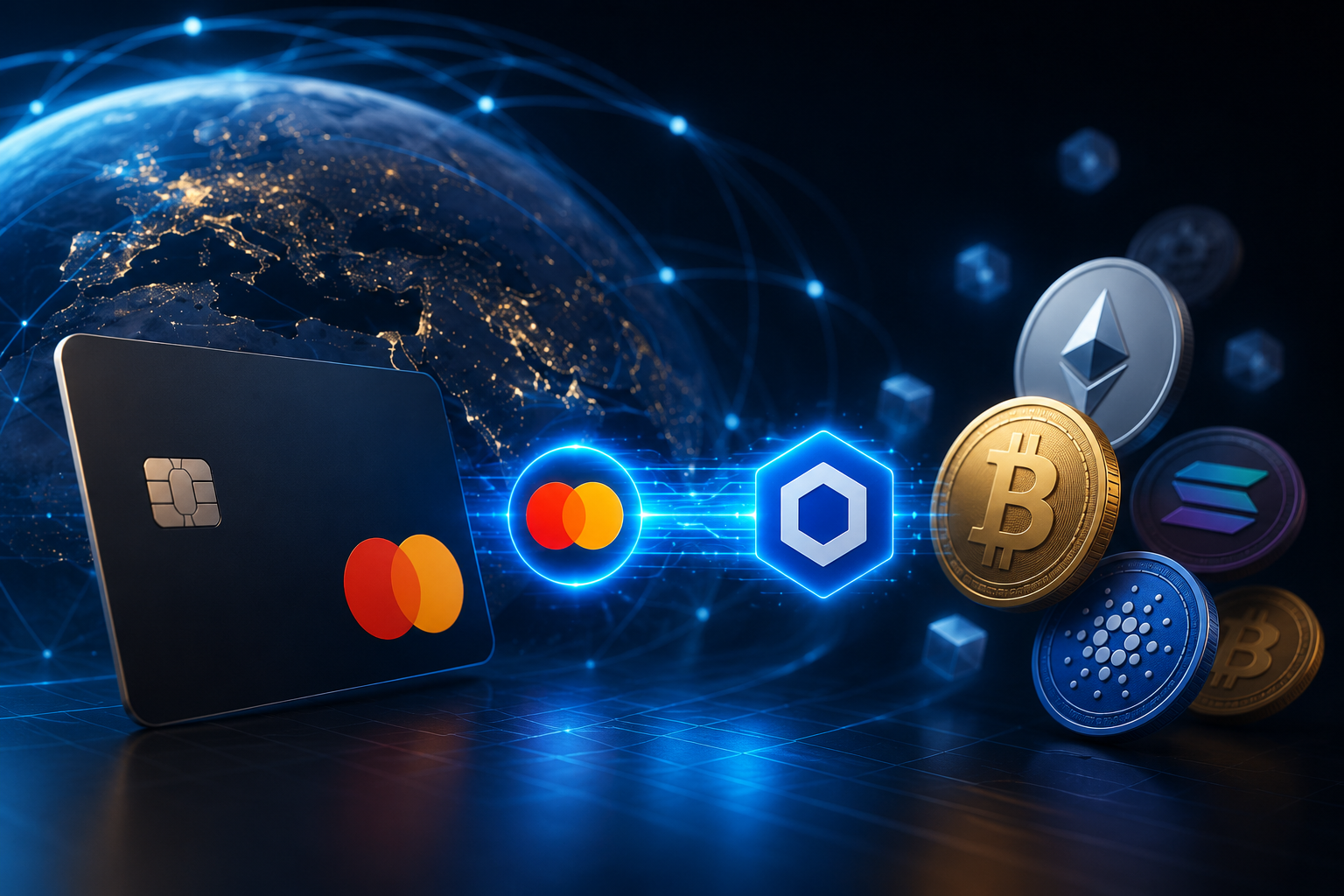
Mastercard and Chainlink have announced a major expansion of their partnership that aims to connect traditional payment systems with decentralized finance (DeFi), enabling around 3.5 billion Mastercard cardholders to buy digital assets directly on-chain. The move is being seen as one of the biggest steps yet toward linking global card payment infrastructure with blockchain-based markets.
The initiative removes many long-standing barriers to crypto adoption by enabling users to move from regular card payments to owning on-chain assets in a much smoother process. Instead of relying solely on centralized exchanges, users can now tap into decentralized markets directly while still using the card payment systems they already know.
What The Partnership Is About
The collaboration builds on Mastercard’s global payment network and Chainlink’s blockchain interoperability infrastructure to embed fiat-to-crypto conversion directly into on-chain environments, cutting out the middleman for hundreds of millions of users.
The goal is straightforward: make buying crypto as simple as any other card transaction. That means reducing the steps between a regular card payment and on-chain asset ownership, connecting card networks directly to decentralized exchanges, and opening DeFi markets to a mainstream audience that has largely been locked out by technical complexity.
How The Onchain Purchase System Works
Rather than routing transactions through a centralized exchange, the system creates a direct pipeline from card payments to on-chain settlement, with multiple infrastructure layers working together.
- A user starts a crypto purchase through a Mastercard-supported interface.
- Mastercard processes the card payment through its network.
- Regulated partners convert the fiat into crypto.
- Chainlink sends verified transaction data to blockchain smart contracts.
- A decentralized exchange carries out the token swap.
- The user receives crypto directly in their wallet.
The result is a process that feels familiar on the front end but is fully decentralized on the back end.
Key Infrastructure Behind the System
The system runs on a coordinated set of financial and blockchain providers, each handling a specific layer of the transaction.
A. Mastercard Payment Network
Mastercard provides the global card infrastructure that most users are already familiar with, covering payment authorization, fraud protection, and card issuance across billions of accounts.
B. Chainlink Interoperability Layer
Chainlink serves as the bridge between traditional payment data and blockchain smart contracts, ensuring transaction information is securely verified before anything is executed on-chain.
C. ZeroHash
Handles the conversion of fiat currency into crypto and manages regulated custody services in the middle of the transaction flow.
D. Shift4 Payments
Processes card transactions on the merchant side, routing payments into the broader system.
E. XSwap and Uniswap
Provide access to decentralized liquidity pools where the actual token swaps take place, completing the on-chain leg of each transaction.
Why 3.5 Billion Cardholders Matter
Most crypto growth so far has been driven by a small group of users willing to deal with exchanges, wallets, and technical setup. This partnership changes that in a big way.
By plugging into Mastercard’s existing network, the system reaches people who have never used a crypto exchange, making it much easier for first-time users to get started and bringing a far larger group of people into on-chain markets. More users also means more money flowing into DeFi, which makes the broader ecosystem stronger.
- Expands crypto access well beyond existing exchange users.
- Lowers the barrier for first-time buyers.
- Brings more liquidity into decentralized markets.
- Makes crypto purchases feel like a normal part of everyday payments.
The bigger picture is a transition in how crypto fits into the financial world, less a separate system people opt into, and more a built-in layer within the payment infrastructure billions already use every day.
Impact on DeFi and Traditional Finance
This partnership reflects a growing trend of traditional finance and decentralized finance moving closer together rather than operating in separate lanes.
For Traditional Finance
- Grows Mastercard’s role beyond payments into digital asset settlement.
- Pushes wider adoption of regulated on-chain infrastructure.
- Opens new revenue streams tied to blockchain transactions.
For DeFi
- Brings in more liquidity from everyday users.
- Connects card-based payments directly to decentralized exchanges.
- Makes DeFi easier to access for people new to crypto.
The end result is a system where traditional payment networks and decentralized protocols work side by side rather than against each other.
Final Thoughts
The Mastercard and Chainlink partnership is bigger than a single product update. It points to a real shift in how finance is being shaped, one where the gap between everyday payments and decentralized markets keeps getting smaller. For regular users, the biggest change is ease. Buying crypto no longer means learning a whole new system from scratch. For the crypto market, it means a wave of new users who were once put off by the complexity now have a simple, familiar way in. Whether this becomes the new normal for buying digital assets remains an open question, but the groundwork being laid here is difficult to overlook.
Frequently Asked Questions
What is the Mastercard and Chainlink partnership about?
The partnership connects Mastercard’s global payment network with Chainlink’s blockchain infrastructure, enabling direct on-chain crypto purchases via traditional card payments.
Can Mastercard cardholders really buy crypto on-chain now?
Yes. Around 3.5 billion Mastercard cardholders can access systems that allow crypto purchases that settle directly on-chain instead of through centralized exchanges.
How does buying crypto on-chain with a Mastercard work?
A card payment is processed by Mastercard, converted into crypto by regulated partners, verified by Chainlink, and then settled on-chain through decentralized exchanges.
Which companies support the transaction process?
The system involves Mastercard for payments, Chainlink for blockchain connectivity, ZeroHash for fiat-to-crypto conversion, Shift4 for payment processing, and decentralized platforms like Uniswap for swaps.