VVV, the token tied to privacy-focused AI platform Venice, climbed roughly 10% over 24 hours to trade near $13.30 to $13.35 on August 18, 2026, after Venice said its annualized revenue crossed $100 million.
The Revenue Milestone Behind the Move
Venice’s annualized revenue run rate climbed to $100 million from roughly $70 million about a month earlier, according to co-founder Erik Voorhees on social media platform X.
Earlier in the day, VVV had traded around $12.64, up about 7% at that point with trading volume up more than 140%, before continuing to climb toward its eventual 10% daily gain as the revenue news spread.
Venice AI was founded by Voorhees, who previously founded ShapeShift and has been a prominent figure in crypto for over a decade, and offers access to more than 200 AI models while deliberately not retaining any record of a user’s interaction once it’s processed, drawing more than 3 million monthly active users, with the platform processing millions of API calls daily.
This latest jump follows Venice’s $65 million Series A round in July 2026, which valued the company at $1 billion and included investors Dragonfly and Coinbase Ventures.
Venice was already profitable at the time of that raise, reporting north of $70 million in ARR, and used the new capital to acquire GPUs and expand data center capacity.
How VVV’s Burn Mechanics Tie Into Revenue
Venice isn’t purely an AI company; it’s built with VVV as a crypto-native token whose mechanics are directly tied to platform revenue.
Since late 2025, Venice has used a portion of its monthly revenue to buy VVV from the open market and permanently remove those tokens from circulation. A second burn mechanism introduced in July expanded that link further.
Under the newer program, $5 of every $100 spent on Venice AI credits gets allocated toward buying and burning VVV, layered on top of existing burns tied to Pro, Pro+, and Max subscription tiers.
DIEM’s Staged Supply Increases Add Another Layer
DIEM, a separate token connected directly to VVV staking, gives holders another reason to lock up supply.
Users mint DIEM by locking staked VVV, and each DIEM provides $1 worth of Venice AI credits per day.
Venice raised DIEM‘s target supply to 39,000 from 38,500 on August 17, the second of four staged increases.
The schedule raised the target to 38,500 on August 3, will raise it again to 39,500 on August 31, and reaches a final target of 40,000 on September 14.
Since minting DIEM requires locking VVV, each staged increase in the DIEM target effectively expands how much VVV can be productively locked up rather than sold.
VVV’s Own Token Issuance Is Shrinking Too
Supply issuance is changing on a separate track. Venice plans to cut annual VVV issuance from 3 million tokens to 2.5 million on September 1, then to 2 million on October 1.
VVV originally launched with annual issuance of roughly 14 million tokens, meaning the planned October rate would sit about 86% below that original level.
Combined with the two burn mechanisms and DIEM’s staged lockup increases, VVV’s supply-side setup has shifted meaningfully more restrictive over the past year.
What the Charts Show
VVV’s daily chart has improved after the token spent much of July and early August consolidating following its decline from June’s highs. At around $13.40, VVV now trades above all four key exponential moving averages, such as the 20-day, the 50-day, the 100-day near $12.14, and the 200-day exponential moving average.
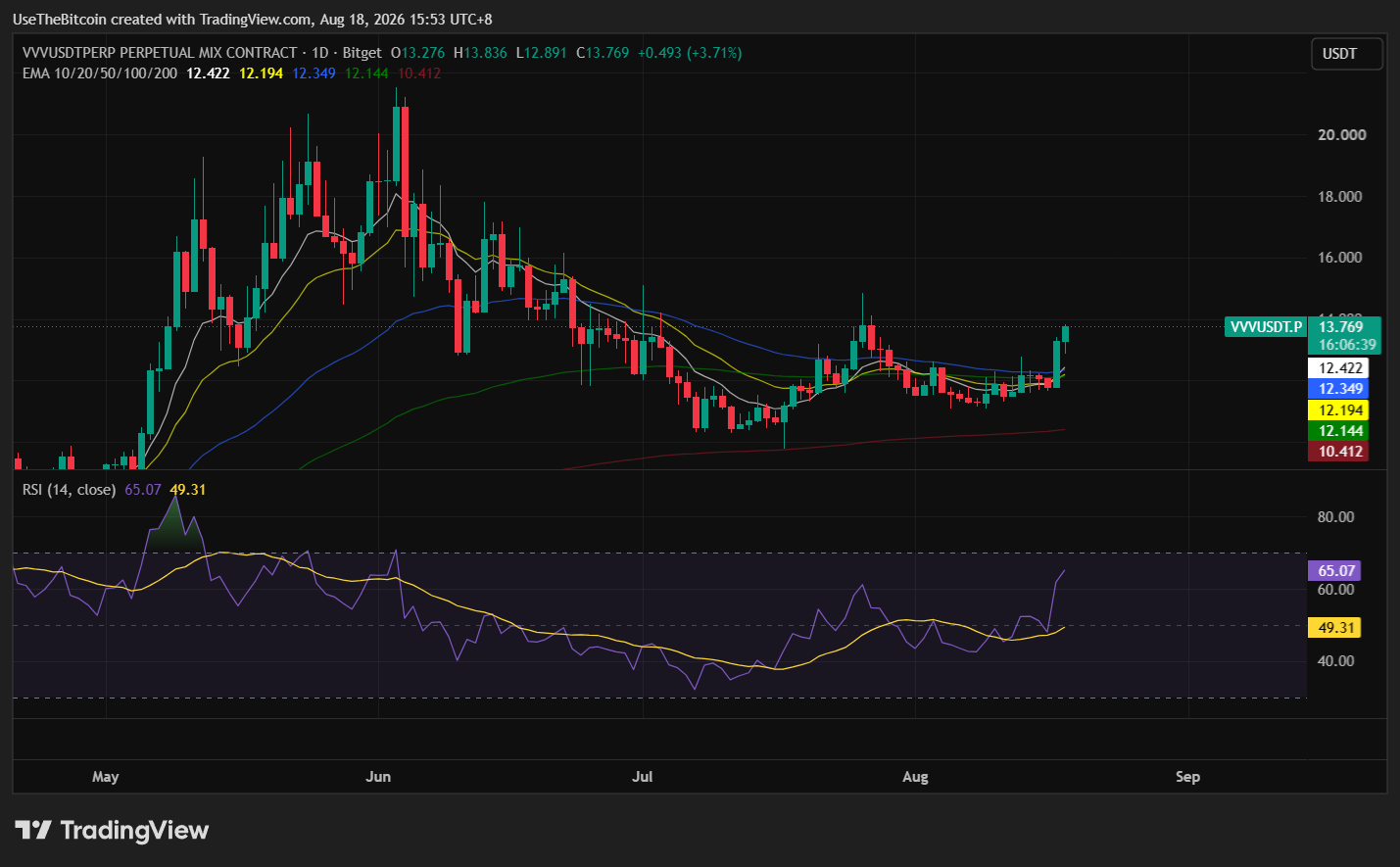
Clearing the 20-day and 50-day averages matters specifically because VVV had repeatedly traded at or below them during its recent consolidation. Holding above the $12.15 to $12.35 EMA cluster keeps the current breakout intact, while a drop back below it would weaken the setup.
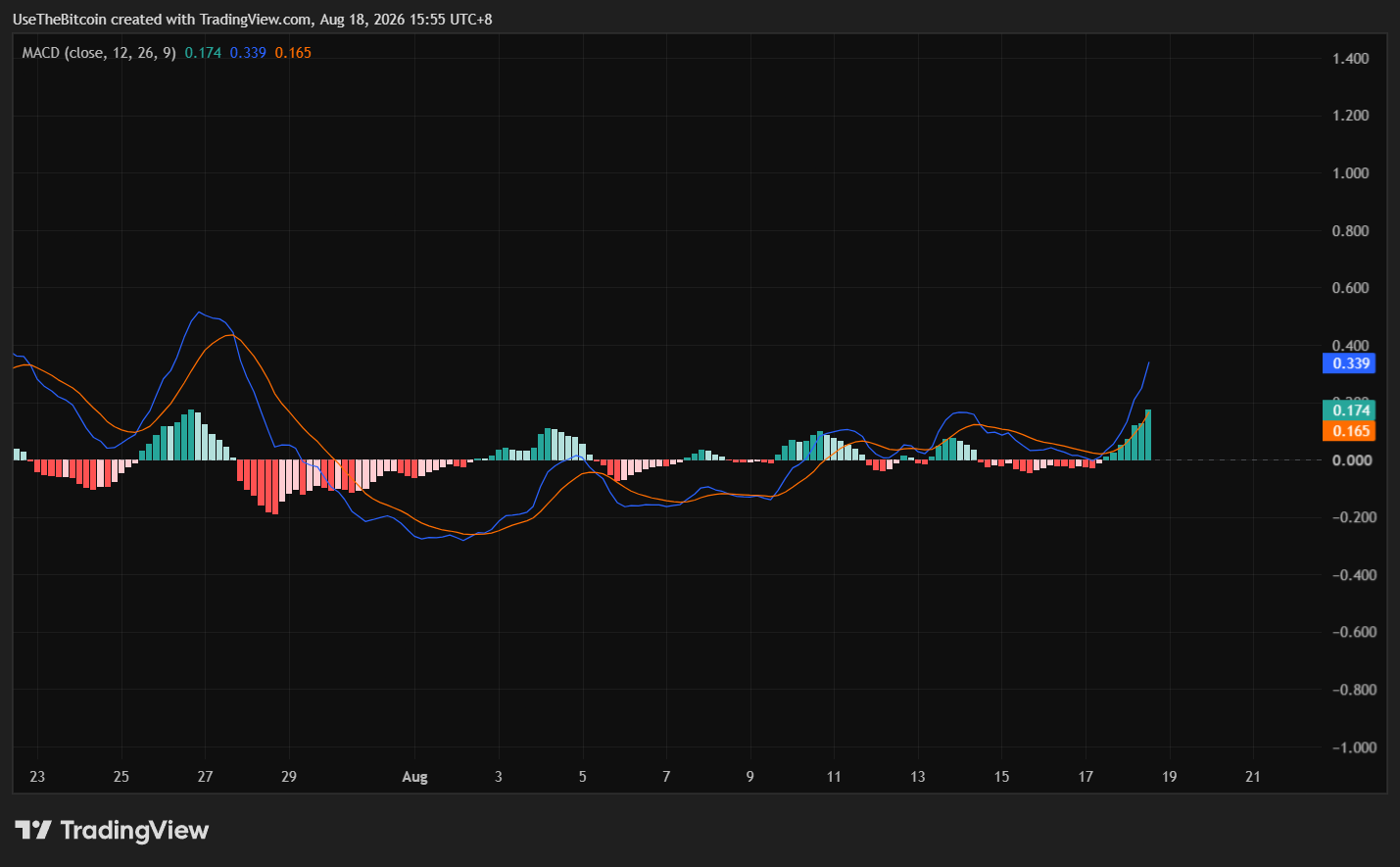
Moreover, the 4-hour MACD line has risen to about 0.339, above its signal line near 0.165, with the histogram expanding into positive territory at 0.173, a bullish crossover suggesting short-term momentum currently favors buyers.
| Level | Role | Notes |
| $10.40 | 200-day EMA | Downside level if the breakout fails entirely |
| $11.00-$11.30 | Secondary support | Exposed if $12.00-$12.20 breaks |
| $12.00-$12.20 | Former resistance, now support | High-volume reversal zone from July-August |
| $12.15-$12.35 | EMA cluster | Must hold to keep the breakout intact |
| $14.00-$14.50 | First upside test | Resistance from late July |
| $15.50-$16.00 | Second target | June trading range |
| $17.00-$18.00 | Further target | Also within the June trading range |
| $21.00 | June high | The most aggressive target, requires clearing several resistance zones first |
Bottom Line
VVV’s rally is being driven by a convergence of factors rather than sentiment alone, a real revenue milestone, two burn mechanisms that scale directly with that revenue, a staged DIEM supply schedule that encourages locking VVV, and a token issuance rate falling toward roughly 86% below its original launch level.
The bull case depends on the token holding above the $12.00 to $12.35 area while the 4-hour MACD stays positive.
Venice’s next scheduled tokenomics events land close together, the DIEM target rising to 39,500 on August 31 and annual VVV issuance dropping to 2.5 million tokens on September 1, both worth watching as the next test of whether this setup holds.
This article is for informational purposes only and does not constitute financial advice. Crypto price predictions are based on analyst estimates and are not guarantees of future performance. Do your own research before making any investment decisions.
Frequently Asked Questions
Need a refresher? Here are the questions traders are asking about VVV’s recent pump.
Why did VVV rally after Venice’s revenue announcement?
Venice’s revenue directly feeds two separate mechanisms that buy and permanently burn VVV from the open market, so a jump in annualized revenue from $70 million to $100 million in about a month translates into a real, scaling increase in recurring token purchases and supply reduction, not just a sentiment-driven move.
What is DIEM and how does it relate to VVV?
DIEM is a separate token users mint by locking staked VVV, with each DIEM worth $1 in daily Venice AI credits. Venice is raising DIEM’s target supply in four stages through September 14, and since minting DIEM requires locking VVV, each increase effectively encourages more VVV to stay locked rather than traded.
How much has VVV’s token issuance changed since launch?
Significantly. VVV launched with annual issuance of roughly 14 million tokens. Venice plans to cut that to 2.5 million on September 1 and 2 million on October 1, which would put the October rate about 86% below the original launch level.
What level does VVV need to hold to keep its current breakout intact?
The $12.15 to $12.35 EMA cluster is the key level cited across the technical analysis. Holding above that zone keeps the breakout intact, while a drop back below it would weaken the current setup and could expose deeper support levels near $11.00 to $11.30.
Is Venice AI profitable, or just growing revenue?
According to reporting on its July 2026 Series A round, Venice was already profitable before that raise, which valued the company at $1 billion. Reaching $100 million in annualized revenue while maintaining profitability is a distinct claim from revenue growth alone, and it’s part of what has drawn institutional investors like Dragonfly and Coinbase Ventures.