Key Takeaways
- Over 19.8 million BTC have already been mined, leaving roughly 1.2 million Bitcoin still to be issued.
- Bitcoin’s supply cap of 21 million coins is hard-coded into its protocol and cannot be changed.
- The last Bitcoin is projected to be mined around the year 2140 due to the halving schedule.
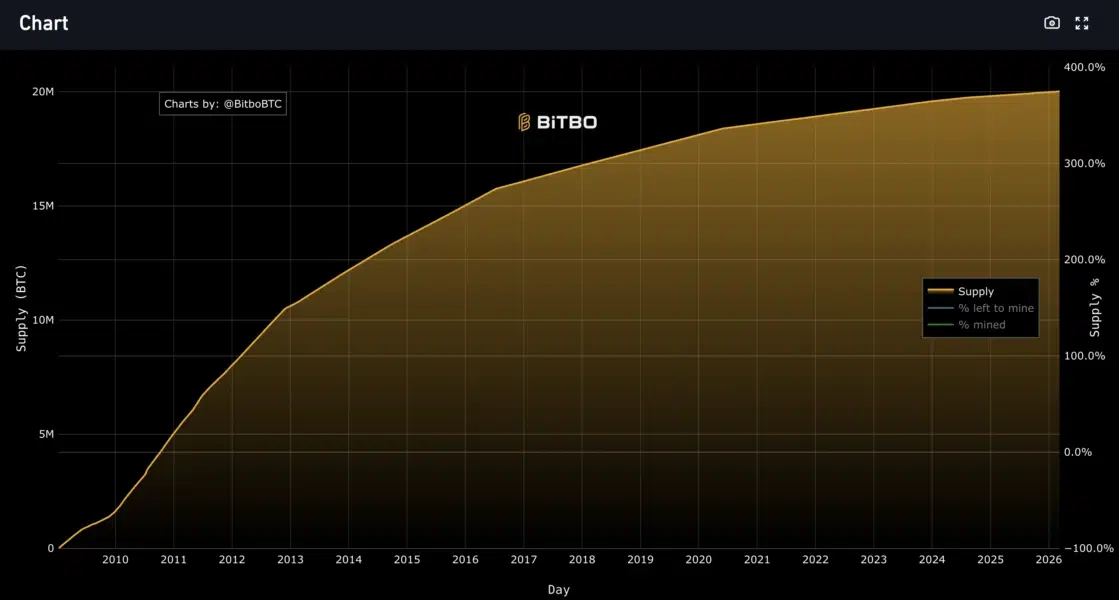
Bitcoin has a fixed supply, and that single feature sits at the core of its value. Out of 21 million total coins, more than 19.8 million are already in circulation. That leaves around 1.2 million Bitcoin left to mine. New supply slows every four years through the halving process, making the remaining coins increasingly harder to issue over time.
What Is Bitcoin’s Total Supply Cap?
Bitcoin’s maximum supply is 21 million coins. Satoshi Nakamoto set this limit, and it is written directly into Bitcoin’s code. No central authority can raise it, and no miner or developer can override it.
This cap is what makes Bitcoin fundamentally different from fiat currency. Governments can print more money whenever they choose. Bitcoin miners cannot produce more than the protocol allows, full stop.
Why Does the 21 Million Cap Exist?
The exact figure was a deliberate design choice by Satoshi. He combined a fixed issuance schedule with the halving mechanism to create a predictable, disinflationary supply curve. At the genesis block in January 2009, the block reward started at 50 BTC. Each halving cuts that reward in half, slowing the rate at which new coins enter circulation.
This schedule means Bitcoin grows scarcer over time. That scarcity is not driven by market demand alone. It comes from how the protocol itself works, by design.
How Many Bitcoin Have Been Mined So Far?
As of early 2026, approximately 19.85 million BTC have been mined. That figure accounts for around 94.5% of the full 21 million supply. The remaining coins will not arrive all at once. They will trickle out over more than a century, with each halving pushing the timeline further.
Here is a clear breakdown of where things stand right now:
- Total supply cap: 21,000,000 BTC
- Mined to date: ~19,850,000 BTC
- Left to mine: ~1,150,000 to 1,200,000 BTC
- Lost or inaccessible BTC: estimated 3 to 4 million coins
That last point deserves attention. A significant portion of already-mined Bitcoin is gone forever. Lost wallets, forgotten seed phrases, and dormant early addresses account for millions of coins that will never move again. The actual liquid supply is far tighter than the raw numbers suggest.
How Does the Halving Affect the Remaining Supply?
The halving is the mechanism that slows Bitcoin issuance over time. Every 210,000 blocks, roughly every four years, the reward miners earn for each block gets cut in half. This is not optional and cannot be skipped.
Here is how the reward schedule has progressed:
- 2009: 50 BTC per block
- 2012: 25 BTC per block
- 2016: 12.5 BTC per block
- 2020: 6.25 BTC per block
- 2024: 3.125 BTC per block
- 2028 (projected): 1.5625 BTC per block
Each halving pushes fewer new Bitcoin into the market. By the 2028 halving, miners will earn only 1.5625 BTC per block. This declining reward explains why the last Bitcoin will not be mined until around 2140, even though we are already past 94% of total supply. For context on who currently holds the most BTC and how supply concentration plays out, this UseTheBitcoin resource breaks it down well.
What Happens After All Bitcoin Are Mined?
Once the last Bitcoin gets mined, the block reward drops to zero. Miners will no longer receive new coins for validating transactions. At that point, they will rely entirely on transaction fees paid by users.
This raises a real question about long-term network security. Will transaction fees alone keep miners profitable enough to keep securing the blockchain? Some economists argue that growing Bitcoin adoption will push fee revenue high enough to sustain miners. Others remain less certain.
Platforms like Coinbase and Kraken already show how rising on-chain activity drives transaction volume. If that trend holds into the next century, fees may fill the gap left by the block reward. Still, predicting the economics of 2140 is not something anyone can do with real confidence.
Why Scarcity Shapes Bitcoin’s Value
Scarcity is not just a talking point in crypto circles. It is a structural part of how Bitcoin behaves as an asset. Gold is scarce because it exists in limited quantities in the earth’s crust. Bitcoin is scarce because its code enforces a hard ceiling with precision.
With only 1.2 million coins left to mine and millions more already lost, the effective circulating supply is tighter than most people assume. For anyone storing Bitcoin through a hardware wallet like Ledger or Trezor, that scarcity is a big part of the long-term thesis.
Binance offers real-time BTC data and trading access for those tracking supply dynamics closely. Fewer coins entering circulation means each new wave of demand hits a smaller available pool. That does not guarantee price increases, but it does create a structural pressure that traditional assets simply do not share. For a closer look at how Bitcoin’s supply concentration affects the broader market, check out this UseTheBitcoin guide.
Frequently Asked Questions
How much Bitcoin is left to mine in 2026?
Roughly 1.15 to 1.2 million Bitcoin remain to be mined as of 2026. Over 19.8 million BTC have already entered circulation, representing about 94.5% of the total 21 million supply.
Will Bitcoin’s supply cap ever change?
No. The 21 million cap is hard-coded into Bitcoin’s protocol. Changing it would require consensus from the majority of nodes and miners worldwide, and the community has consistently rejected any proposals to alter it.
When will the last Bitcoin be mined?
The last Bitcoin is projected to be mined around the year 2140. The halving schedule, which cuts the block reward in half every four years, extends the timeline well beyond what most people expect.
How many Bitcoin are lost forever?
Estimates suggest between 3 and 4 million Bitcoin are permanently lost. These come from forgotten wallets, misplaced seed phrases, and early addresses whose owners are no longer active.
What do miners earn after all Bitcoin are mined?
After the last Bitcoin is mined, miners will earn only transaction fees. The block reward drops to zero, and the entire compensation model shifts to fees paid by users sending Bitcoin on-chain.