Key Takeaways
- Layer-1 blockchains are the base of decentralized apps, defining speed, cost, security, and what developers can actually build on-chain.
- Some Layer-1 blockchains prioritize decentralization and security, often at the cost of higher fees and slower transaction speeds during periods of heavy demand.
- Others focus on high throughput and low latency, enabling fast, cheap transactions but sometimes at the expense of decentralization or validator scale.
Every decentralized application needs a foundation, a base blockchain that settles transactions, enforces code, and operates without borrowing security from anyone else. These are Layer-1 smart contract platforms, and the one a developer chooses determines everything: how fast their app responds, how much their users pay in fees, and what’s even possible to build.
The differences between them aren’t just technical footnotes. They represent genuinely competing visions for what the internet of value should look like, who controls it, how open it is, and how it scales to billions of users.
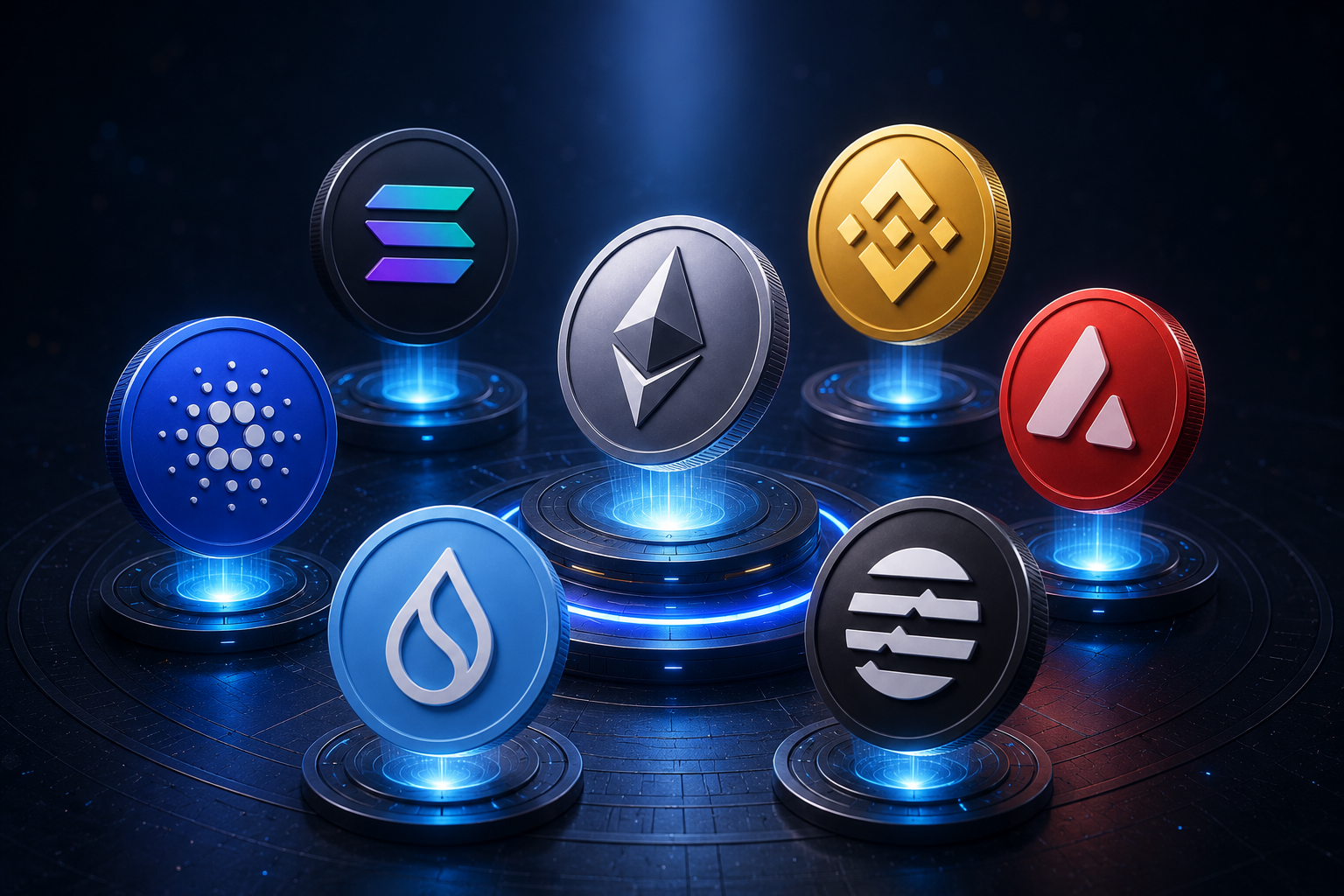
Here are seven Layer-1 blockchains that are actively defining those answers.
1. Ethereum
Ethereum is the most established Layer-1 smart contract platform and the foundation of decentralized applications. It introduced general-purpose smart contracts, a concept every platform since has either built on or built against, and today hosts the deepest DeFi liquidity, the largest NFT markets, and a growing share of tokenized real-world assets.
The main tradeoff is cost. Fees rise when the network gets busy, nudging users toward faster alternatives. Ethereum is addressing this through rollups, a scaling approach that keeps transactions secure while making them cheaper and faster. No other platform comes close in tooling maturity, developer depth, or institutional trust. It remains the benchmark everything else gets measured against.
2. Solana
Where Ethereum optimizes for security and decentralization, Solana optimizes for speed. It uses a combination of proof-of-stake and proof-of-history to process thousands of transactions per second at fractions of a cent, making it one of the few blockchains where high-frequency applications actually feel fast. That has made it a natural home for NFT trading, on-chain gaming, and DeFi activity that demands low latency.
Speed comes with architectural tradeoffs, though. Solana runs on a smaller, more powerful validator set, which keeps performance high but draws scrutiny over decentralization. Past network outages have tested user confidence, though reliability has improved considerably. For builders who need performance first, it remains one of the most capable platforms available.
3. BNB Chain

BNB Chain carved out its place by making Ethereum compatibility affordable. It mirrors the Ethereum Virtual Machine almost exactly, meaning developers can deploy existing applications with minimal changes, but at significantly lower fees and faster block times. That combination made it one of the earliest destinations for users priced out of Ethereum during peak congestion.
Its closest tie is to Binance, the world’s largest crypto exchange, which brings built-in liquidity, a massive user base, and deep ecosystem integration that few chains can replicate organically. The catch is a more centralized validator set, which has been a consistent point of criticism. For projects prioritizing reach and affordability, BNB Chain offers a well-worn path.
4. Avalanche
Avalanche takes a different approach to scaling by letting developers launch their own application-specific blockchains, called subnets, that share the network’s underlying security. Rather than forcing every application to compete for the same block space, it gives builders the option to run on dedicated infrastructure tuned to their needs.
Its consensus mechanism delivers near-instant transaction finality, which sets it apart from chains where confirmation times can stretch into minutes. Avalanche also supports Ethereum compatibility, easing the transition for developers already familiar with the ecosystem. That combination of speed, flexibility, and customization makes it a strong fit for projects that need more control over their environment.
5. Cardano
Cardano takes the long road by design. Built on peer-reviewed research and formal development methods, it prioritizes getting things right over shipping things fast. Every major upgrade goes through a structured process, which has made its timeline slower than competitors but its codebase unusually deliberate.
Its proof-of-stake system, one of the earliest and most studied in the space, is built for energy efficiency and long-term sustainability. Smart contracts on Cardano are designed with correctness as the primary goal, reducing the surface area for exploits. The ecosystem is still catching up in size and activity, but for developers who value rigor over hype, Cardano occupies a distinct space.
6. Sui

Sui was built around a simple observation: most blockchain bottlenecks come from processing transactions one at a time. Its object-based data model allows independent transactions to execute in parallel, which dramatically improves throughput without sacrificing responsiveness. The result is a chain that feels noticeably faster for end users, especially in interactive applications.
That design makes Sui particularly well-suited for gaming, digital collectibles, and real-time experiences where latency matters. As a newer entrant, its ecosystem is still maturing, but its architecture addresses scaling problems at the foundation rather than patching them later, which gives it a meaningful edge as demand for high-performance applications grows.
7. Aptos

Aptos shares DNA with Sui; both emerged from Meta’s discontinued Diem project, but pursue a distinct path. It uses the Move programming language, designed specifically to make smart contracts safer and harder to exploit, and pairs it with a parallel execution engine that processes transactions without the bottlenecks common in older architectures.
Where some chains scale by adding layers on top, Aptos focuses on making the base layer itself more efficient and reliable. Its emphasis on safety and upgradeability positions it toward developers building applications where failure is costly, including enterprise use cases and large-scale financial infrastructure. Still growing, but with a technically strong foundation to build from.
Final Thoughts
No single Layer-1 has solved everything, and that’s partly the point. Each blockchains represents a deliberate set of priorities: what to optimize for, what to accept, and who to build for. Ethereum bets on security and ecosystem depth. Solana on speed. BNB Chain on accessibility. Avalanche on flexibility. Cardano on rigor. Sui and Aptos on rethinking execution from the ground up. What makes this space worth watching isn’t any one winner but the competition itself. These platforms push each other to improve, and the results show. Fees are falling, finality is getting faster, and developer tooling keeps maturing. The infrastructure being built today is laying the groundwork for applications that don’t yet exist.
You Might Also Like: