Key Takeaways
- A crypto airdrop farmer lost their entire $112,700 Monad (MON) reward due to a series of uncorrected, failed blockchain transactions.
- The loss occurred because gas fees were deducted from the wallet for every failed attempt, quickly depleting the whole token reward.
- The incident highlights the critical need for users to perform small test transactions before executing large, scripted transfers, especially following reports of a potential vulnerability in the Monad claim portal.
How Unchecked Scripts Led to Total Loss
The world of crypto airdrops—where new projects distribute tokens to early users—can be lucrative, but a recent incident involving a Monad (MON) token farmer serves as a stark warning about automation risks. A crypto wallet, identified as 0x7f4, received a substantial reward of MON tokens valued at approximately $112,700. Unfortunately, the farmer, likely utilizing an automated script to consolidate or transfer the funds quickly, neglected a crucial safety step: monitoring the transaction status.
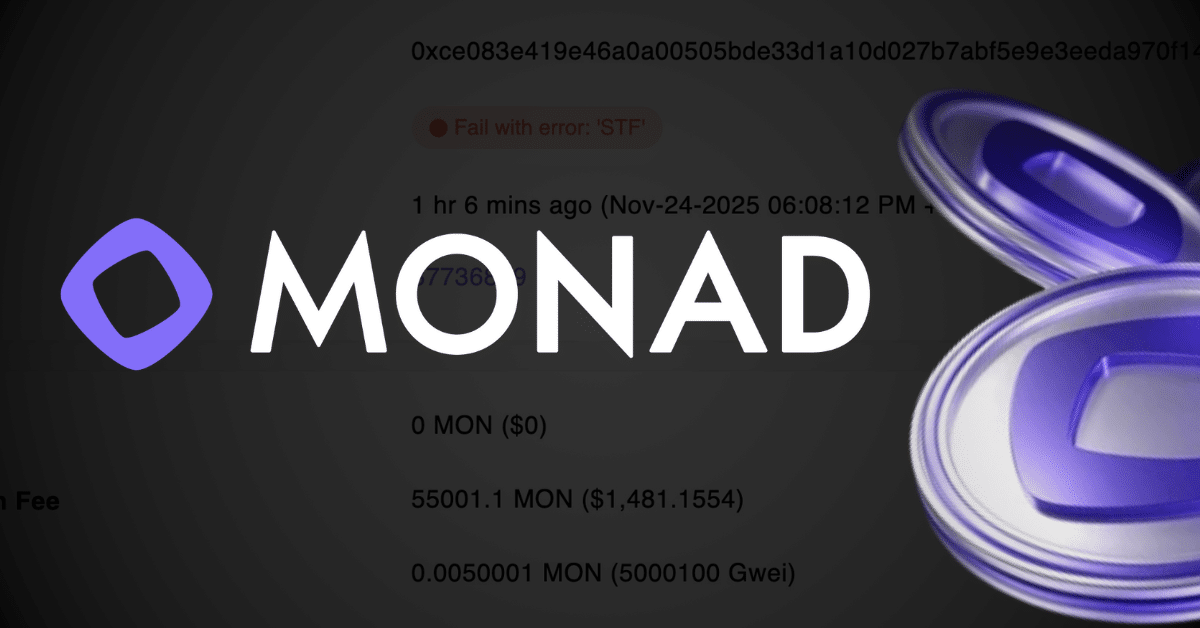
Blockchain data shows that the wallet initiated hundreds of transactions in a rapid sequence. Despite the transfers failing to execute, the underlying blockchain mechanism mandated that a gas fee was still deducted for each attempt. This common but often overlooked rule meant that with every failed transaction, a portion of the $112,000 MON reward was effectively “burned” as gas, leading to the complete depletion of the reward funds.
Crypto investor Joe showed the mishap on X, emphasizing the necessity of running small-scale test transactions before committing to large, scripted or bulk transfers. This safeguard is designed to verify the correct parameters, before risking significant capital.
Vulnerabilities in the Claim Process
The saga surrounding the failed trades was compounded by broader security concerns. Simultaneously, reports emerged from Monad airdrop recipients regarding missing token allocations. SlowMist, a prominent blockchain security firm, issued a warning about a potential vulnerability discovered within the Monad claim portal itself.
According to SlowMist founder Cos, the flaw allowed malicious actors to potentially “hijack” a user’s session on the claim page. This exploit could enable hackers to bind a legitimate user’s airdrop allocation to an attacker-controlled wallet address, redirecting the tokens without requiring the user’s explicit wallet confirmation. This kind of attack capitalizes on the pressure and speed associated with new token launches.
For any new crypto project, airdrop farmers are the recurring nightmare. These are the people using armies of wallets just to maximize rewards, and their immediate token dump can completely tank a project’s market stability. The security warning, coming right after a $112K loss, screams one thing: there are two huge threats. First, users are making mistakes, and second, the platform might have weak spots.
This is a repeat of history, just look at the Arbitrum ARB airdrop, where hunters managed to stack millions of dollars across just a few controlled wallets.
Why You Should Always Run Test Transactions
This whole fiasco is a massive, costly reminder of one simple truth: blockchain transactions cannot be undone. Whether someone messed up a script or a vulnerability was exploited, the message is loud and clear: you absolutely must be patient, vigilant, and always run test transactions. In the high-speed world of crypto transfers, skipping these basic steps is no longer an option if you want to keep your money safe.
Frequently Asked Questions
What is an airdrop farmer?
An airdrop farmer is an individual who interacts with a new crypto protocol using multiple wallets solely to maximize their eligibility for future token distribution rewards.
Why do failed blockchain transactions still consume gas fees?
Gas fees compensate validators for the computational resources used to process the transaction, even if the transaction ultimately fails due to insufficient funds, an incorrect contract call, or other errors.
What is the key safeguard to prevent this type of loss?
Always perform a “test transaction” by sending a minimal amount of funds first to confirm that the network, address, and execution parameters are all correct before initiating a large-scale transfer.