Key Takeaways:
- XRP and Solana are headed toward critical support levels if the Iran war worsens, with XRP at risk below $1.13 and SOL below $68.69
- Both tokens dropped roughly 10% during initial strikes before recovering partially to $1.37 and $84.39 respectively
- Escalating conflict could push XRP toward $0.85-$0.95 and Solana into the $40s range if panic selling intensifies
- Oil prices surging past $80-$100 per barrel would likely force continued crypto liquidations
XRP and Solana are headed toward potentially severe corrections if Middle East tensions escalate beyond current levels following the death of Iranian Supreme Leader Ayatollah Ali Khamenei. Both tokens crashed approximately 10% during initial U.S.-Israeli strikes on February 28, 2026, with XRP falling to $1.27 and Solana dropping to $77 before partial recovery.
Technical analysts identify $1.13 as XRP’s critical support and $68.69 as Solana’s make-or-break level. Breaking these floors during renewed conflict could trigger cascading liquidations pushing XRP toward $0.85 and Solana into the $40s. The crypto market faces additional pressure from oil prices surging past $80 per barrel as Strait of Hormuz disruption fears mount.
What Happened During the Initial Iran Strike Panic?
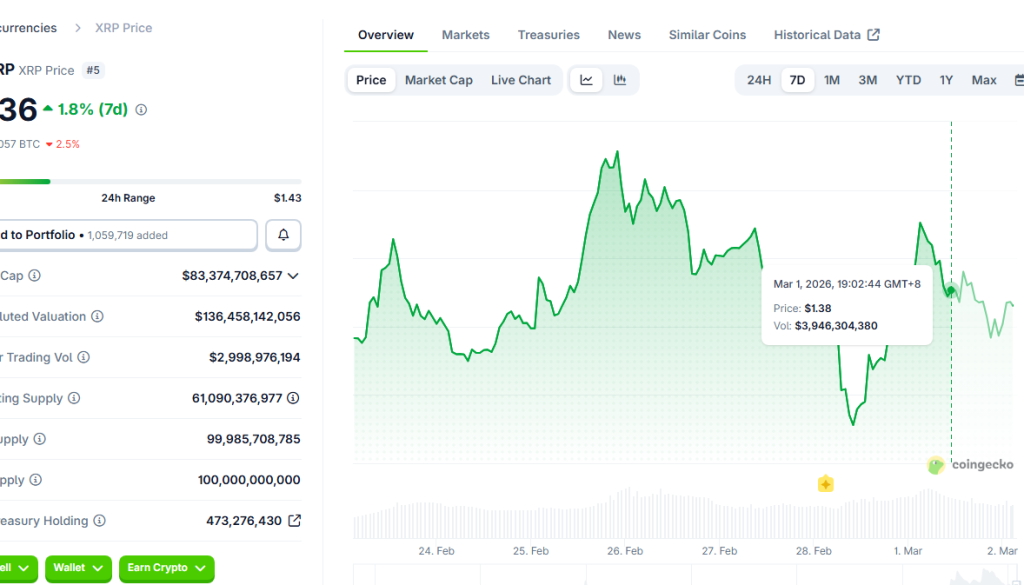
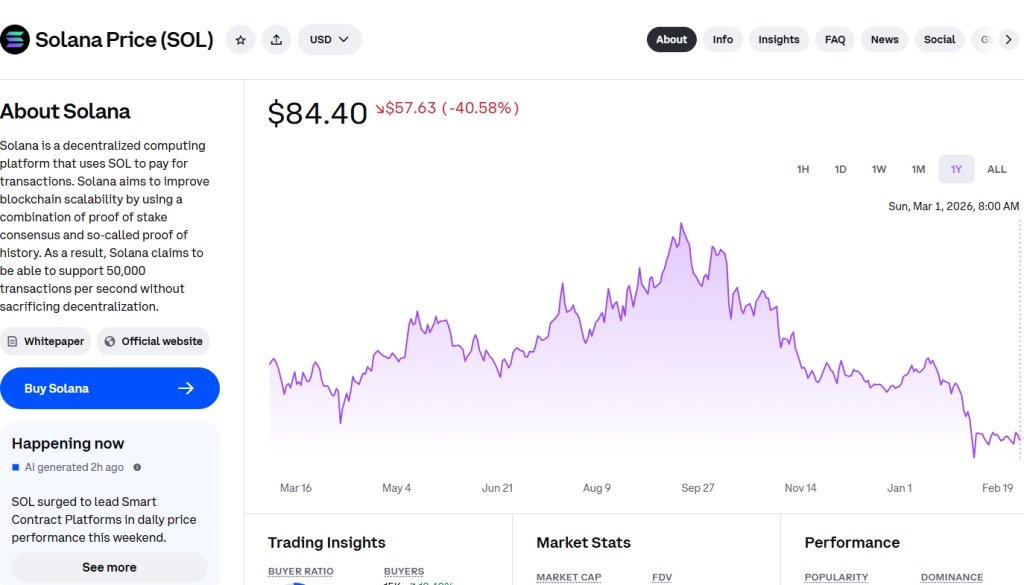
The coordinated U.S.-Israeli military strikes on Iran on February 28, 2026, set off immediate panic across crypto markets, and XRP and Solana had their sharpest single-day drops in months. XRP fell 8.75% from $1.39 to $1.27 within hours of the news breaking, while Solana crashed roughly 10% from $85 to approximately $77.
The selling pressure reflected crypto’s role as the only major market open during weekend strikes. Traditional equity and bond markets were closed, funneling all geopolitical risk-off sentiment into digital assets. Approximately 157,000 traders faced liquidations totaling $657 million as leveraged positions couldn’t withstand the rapid decline.
Both tokens recovered partially by March 1 after Iranian state media confirmed Khamenei’s death. XRP bounced to $1.37, up 5.6% from Saturday’s lows. Solana led the recovery with a 10.8% surge to $86.42. However, analysts warn these gains occurred on thin weekend liquidity without input from institutional investors who return Monday.
The weekly picture reveals continued weakness despite Sunday’s bounce. XRP remains down 2% over seven days, while Solana clings to a fragile 1.7% weekly gain. Both tokens trade well below their recent highs, with XRP off 45% from its $2.50 peak and Solana down 33% from January’s $127 level.
The Strait of Hormuz Factor
Oil market disruptions add indirect pressure threatening to reverse weekend crypto gains. Iran issued navigation warnings for the Strait of Hormuz, through which 20% of global oil exports flow. Major shipping companies suspended transits, leaving over 150 tankers anchored rather than risk passage through contested waters.
Brent crude prices jumped toward $80 per barrel with analysts projecting potential spikes to $100 or higher if closures persist. These energy price increases feed directly into inflation expectations that force central banks to maintain tighter monetary policy. Higher interest rates reduce liquidity available for speculative assets including XRP and Solana.
What Are the Critical Technical Levels to Watch?
XRP and Solana are headed toward make-or-break support levels that will determine whether current weakness evolves into full capitulation. For XRP, the $1.13 level represents the line between correction and crisis. Daily closes below this support would deteriorate the technical structure significantly and open doors to much deeper declines.
Chart analysts identify $0.85 to $0.95 as the escalation target if XRP breaks through $1.13 support. This range represents roughly 35% downside from current $1.37 levels. The decline would retrace most of XRP’s gains since mid-2025 when the token traded around $0.80 before its rally toward $2.50.
Solana faces an even more precarious technical setup. The $68.69 support floor sits just 20% below current $84 pricing. Breaking this level could trigger panic selling that pushes SOL into the upper $40s or low $50s. Such a decline would represent nearly 50% drawdown from current levels.
Resistance levels indicate where recovery might stall if tensions ease. XRP faces overhead resistance at $1.43 to $1.52, while Solana must reclaim $90 to $100 to confirm bullish momentum. Breaking above these levels would suggest traders believe the worst of the conflict has passed.
Volume and Liquidation Risks
Trading volume analysis reveals both tokens remain vulnerable to liquidation cascades. Open interest in Solana futures contracts remains elevated despite recent declines. Large concentrations of leveraged long positions sit between $80 and $90, creating potential for forced selling if prices drop further.
XRP shows similar vulnerability with significant leverage clustered around $1.30 to $1.40. Traders who bought during earlier rallies using margin now face underwater positions that could be forcibly closed if XRP retests $1.13. These liquidations create selling pressure independent of fundamental news or sentiment.
How Would Prolonged Conflict Affect These Tokens?
XRP and Solana are headed for extended bearish pressure if the Iran conflict evolves from weekend strikes into sustained regional war. A scenario where Iran successfully closes the Strait of Hormuz for weeks would crater crypto markets alongside traditional risk assets. Oil at $120 per barrel would trigger inflation shocks forcing Federal Reserve hawkishness.
The relationship between energy prices and crypto valuations works through several channels. Higher oil costs increase inflation expectations, pushing real yields higher. This makes yield-bearing bonds more attractive relative to non-yielding crypto assets. Additionally, energy price shocks typically correlate with economic growth concerns that reduce risk appetite broadly.
Institutional investors have already shown willingness to exit crypto during uncertainty. U.S. spot Bitcoin ETFs recorded net outflows during February as professional money managers reduced exposure. XRP and Solana, lacking direct ETF products, depend even more heavily on retail sentiment that tends toward panic during geopolitical crises.
The leadership vacuum in Tehran creates additional unpredictability. While some traders bet the transition period reduces immediate escalation risk, others fear hardline military factions could act independently without civilian government restraint. This uncertainty keeps traders defensive about rebuilding positions.
The Recovery Scenario
If tensions de-escalate quickly, XRP and Solana are headed for potential relief rallies as fear premium unwinds. However, the magnitude of any bounce likely remains limited by broader market conditions. Both tokens need to overcome substantial overhead resistance before confirming trend reversals.
Solana benefits from ongoing ecosystem development that continues despite market volatility. DeFi activity on Solana remains healthy with total value locked holding relatively stable. New project launches and developer activity provide fundamental support that could limit downside if broader conditions stabilize.
XRP faces different dynamics tied to its institutional adoption narrative. Progress on cross-border payment partnerships and regulatory clarity in the U.S. could provide bullish catalysts. However, these fundamental developments take months to materialize while geopolitical shocks impact prices immediately.
What Do Market Makers and Whales See?
Large holder behavior reveals that XRP and Solana are headed into a period where smart money exercises extreme caution. Whale wallet tracking shows significant distributions occurred days before the Iran strikes, suggesting some sophisticated players anticipated or had advance knowledge of escalation.
Polymarket prediction markets recorded over $1.2 million in profitable bets correctly timing the U.S. strikes and Khamenei’s death. This raises questions about information asymmetry where connected traders position ahead of major events. The same wallets that profited from war predictions are now the ones determining whether to buy the dip or extend short positions.
Market maker positioning in derivatives reveals defensive stances. Put option volume for both XRP and Solana has increased substantially relative to calls. Implied volatility remains elevated, indicating traders price high probability of large price swings in either direction. This volatility premium makes options expensive, reflecting genuine uncertainty about conflict trajectory.
On-chain data shows exchange inflows increasing for both tokens, suggesting holders are moving assets to platforms for potential selling. This represents the opposite of the “not your keys, not your coins” mentality that dominates during bull markets. When investors move crypto onto exchanges during crisis periods, it typically precedes additional selling.
How Long Could Bearish Pressure Last?
XRP and Solana are headed for potentially extended weakness lasting weeks or months depending on conflict duration. Historical analysis of crypto during geopolitical crises shows recovery timelines vary dramatically based on how quickly tensions resolve and whether economic damage proves contained or widespread.
The Russia-Ukraine invasion in early 2022 triggered crypto selloffs that extended for months as energy crisis and inflation concerns dominated. Bitcoin fell from $45,000 to $17,000 over nine months following the invasion. XRP and Solana experienced similar magnitude declines during that period.
In contrast, shorter-lived tensions like brief Israel-Hamas flare-ups in 2023 produced crypto dips lasting days or weeks before recovery. The current Iran situation sits somewhere between these extremes. Khamenei’s death represents a major leadership change with uncertain succession, but it could also enable faster conflict resolution if reformist elements gain power.
Oil market developments will likely determine crypto’s path more than military actions. If Strait of Hormuz reopens within days and oil prices retreat below $75, crypto could stabilize quickly. If closures extend beyond a week and oil surges past $100, expect crypto weakness to persist through March at minimum.
Frequently Asked Questions
What price levels indicate XRP and Solana are headed lower?
XRP and Solana are headed for deeper corrections if XRP breaks below $1.13 and Solana falls under $68.69. These support levels represent last lines of defense before potential cascading liquidations push XRP toward $0.85-$0.95 and Solana into the $40s range.
How does oil price affect crypto tokens like XRP and Solana?
Rising oil prices feed inflation expectations that force central banks to maintain higher interest rates. Tighter monetary policy reduces liquidity available for speculative assets. Oil at $100+ per barrel typically correlates with broader risk-off sentiment that pressures all cryptocurrencies.
Can XRP and Solana recover if the war ends quickly?
Yes, XRP and Solana are headed for potential relief rallies if tensions de-escalate rapidly. However, recovery magnitude likely remains limited by overhead resistance at $1.43-$1.52 for XRP and $90-$100 for Solana. Both tokens need to reclaim these levels to confirm trend reversals.
Which token faces more downside risk from conflict escalation?
Solana faces steeper potential declines due to proximity to its $68.69 support level. Breaking this floor could trigger 40-50% drops. XRP’s $1.13 support sits further below current prices, providing more cushion, though the token still risks 35% declines if that level fails.
Should investors buy XRP and Solana during this dip?
Investment decisions depend on risk tolerance and time horizon. Short-term traders face high volatility and liquidation risks if conflict worsens. Long-term holders might view current prices as opportunities, but should wait for clear support confirmation before deploying significant capital during active geopolitical crises.