Key Takeaways
- Key chronological Bitcoin events span from the initial 2008 whitepaper launch to the 2026 market correction.
- Pseudonymous creator Satoshi Nakamoto published the peer-to-peer cash system whitepaper during a global banking collapse.
- Early milestones included the iconic first physical pizza transaction and hitting a psychological one-thousand-dollar milestone.
- Institutional adoption and regulatory exchange-traded fund approvals sparked major Bitcoin news cycles across global financial media.
- This macro Bitcoin history timeline highlights the peak of 126,000 dollars before capital rotated toward gold and other assets.
Bitcoin is getting closer to 20 years, and at UseTheBitcoin, we thought this could be a unique opportunity to look back at the ultimate Bitcoin history timeline. This guide covers the evolution of the first cryptocurrency from its cypherpunk origins into a globally recognized asset.
We will go through the major Bitcoin news and historical shifts that defined each era, including key price milestones, institutional adoption, and regulatory breakthroughs. From the mining of the genesis block to the defining Bitcoin events of 2026. In this chronological roadmap, you will find essential context to understand Bitcoin’s volatile past and unstoppable future.
Oct 31, 2008: Whitepaper Published
To grasp the magnitude of Bitcoin history, one must return to its Genesis moment: the publication of the Bitcoin whitepaper. For decades prior, brilliant cryptographers and cypherpunks had tirelessly sought to engineer an alternative electronic currency. A currency that could operate freely without reliance on trusted third parties.
That elusive dream finally became a reality on October 31, 2008, when the pseudonymous creator Satoshi Nakamoto published “Bitcoin: A Peer-to-Peer Electronic Cash System” to a niche cryptography mailing list.
The whitepaper came out right when the global banking system was crashing, and it fixed a major problem that had ruined all earlier attempts: double-spending. Satoshi Nakamoto didn’t build this out of nowhere. Instead, they put together ideas that other smart people had already created.
In fact, the whitepaper directly credits earlier work like Wei Dai’s b-money, Adam Back’s Hashcash, and the timestamping research by Stuart Haber and W. Scott Stornetta. By combining these pieces, Satoshi Nakamoto started a financial revolution.
Jan 3, 2009: Genesis Block Mined
The Genesis Block is where Bitcoin officially started operating as a living network. No longer just a theoretical project or a draft of a whitepaper, it became a functioning reality that shocked the cryptographic community. For the first time in human history, a fully operational digital currency successfully solved the double-spending problem without relying on a central authority.
Satoshi Nakamoto hardcoded a permanent message directly into the first block:
“The Times 03/Jan/2009 Chancellor on brink of second bailout for banks.”
This wasn’t just a simple message. It was a direct reaction to the subprime financial crisis that unfolded in 2008. The headline served as a critique of the traditional banking system, which relied (and still relies today) on massive government bailouts.
By launching the network right then, Satoshi introduced a new decentralized philosophy. Bitcoin was designed to be independent, scarce, and owned by the people. This offered a transparent alternative to the failing systems of Wall Street and international financial markets.
May 22, 2010: Bitcoin Pizza Day (Laszlo Hanyecz)
Almost a year passed after the Genesis block was mined, and Bitcoin still didn’t have a massive, liquid market. Instead, it was traded between cryptography enthusiasts. The very first recorded exchange rate didn’t appear until October 2009, when a site called New Liberty Standard valued Bitcoin at a fraction of a cent based on the electricity cost to mine it.
Outside of small peer-to-peer trades on internet forums, early coins had very little utility and no mainstream place to be spent.
However, this changed the day Laszlo Hanyecz, an early Bitcoin developer, decided to buy pizza using BTC. On May 22, 2010, Laszlo posted a request on a Bitcoin forum offering 10,000 Bitcoins to anyone who would order him two large pizzas. A few days later, another user took him up on the offer, bought the pizzas using a credit card, and received the coins in return.
Today, this event is widely celebrated by the crypto community as Bitcoin Pizza Day. It marks the very first time Bitcoin was used to purchase a physical good in the real world. While 10,000 Bitcoins were only worth about $41 back then, that transaction changed everything.
It proved to the world that Bitcoin had actual purchasing power, laying the foundation for the global digital economy we see today
Nov 28, 2013: Bitcoin Hits $1,000 For the First Time on Mt. Gox
Between 2010 and 2013, the cryptocurrency market solidified, and Bitcoin started to be actively traded online. The largest platform became Mt. Gox, a cryptocurrency exchange located in Japan that allowed early Bitcoin supporters to buy and sell BTC. This is the predecessor to the modern trading platforms.
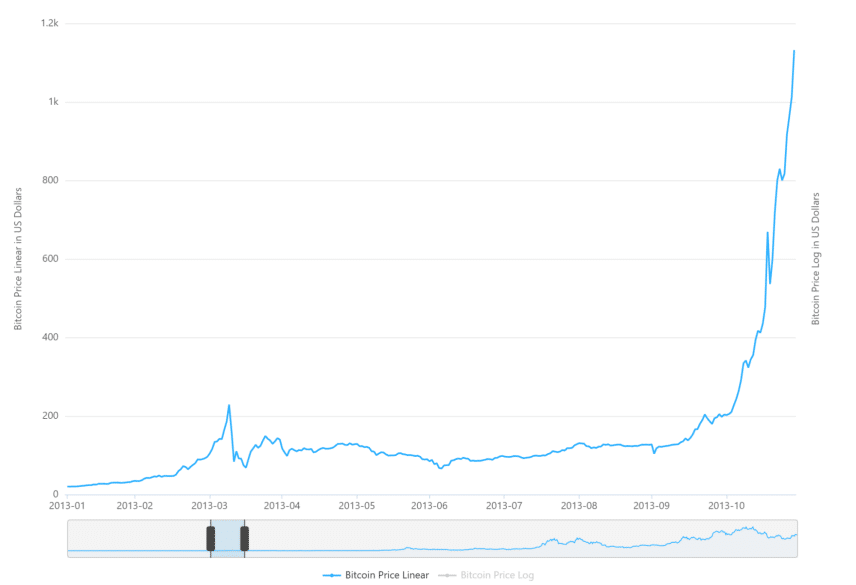
Mt. Gox quickly became the center of the crypto trading community, handling over 70% of all global Bitcoin transactions. The exchange turned into a marketplace where the price began to move extremely fast. Early adopters watched as the price of BTC skyrocketed from just a few dollars to double digits, then triple digits, and finally surged past $1,000 on November 28, 2013.
Hitting the $1,000 milestone was a massive psychological victory for the crypto community. This completely changed how the public viewed the project. It wasn’t an internet experiment anymore, it became an asset class with serious economic importance that caught the attention of mainstream media and traditional investors.
The market went into a frenzy, proving for the first time that Bitcoin had the potential to create life-changing wealth and compete on a global financial stage.
Feb 2014: Mt. Gox Collapses
Despite the surprising performance of Bitcoin, Mt. Gox collapsed in February 2014. This black swan event was one of the most destructive and damaging situations that affected the cryptocurrency market. But what happened to Mt. Gox when it seemed that everything was moving perfectly?
Behind the scenes, the exchange was a mess. Hackers had been quietly stealing Bitcoin from Mt. Gox’s wallets for years, exploiting major security flaws in the system. By the time management realized what was happening, the exchange had lost roughly 850,000 BTC. For this reason, Mt. Gox halted all withdrawals, shut down its website, and filed for bankruptcy protection.
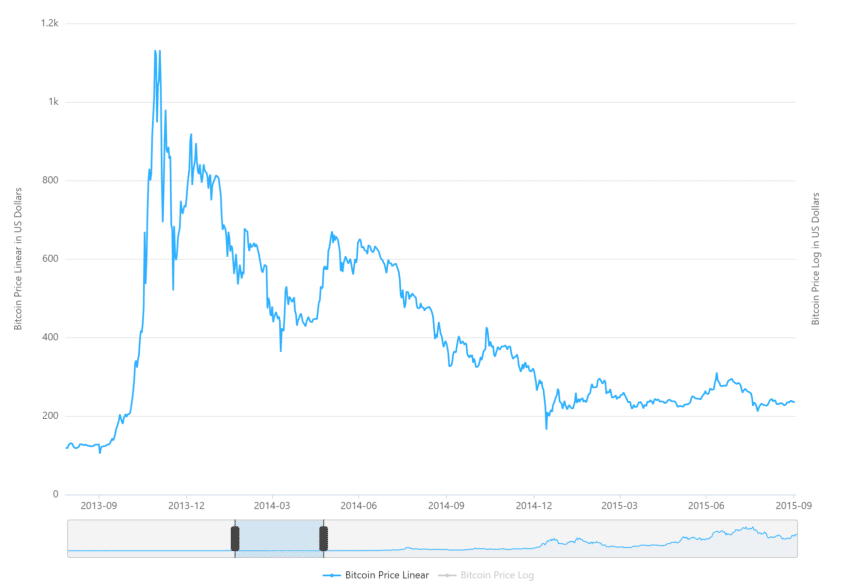
This was a devastating situation for the industry. People lost their life savings overnight, and the price of Bitcoin crashed by more than 50% in the following weeks. Mainstream critics declared that Bitcoin was officially dead, and the entire industry entered a multi-year bear market.
This lesson taught the crypto community a golden rule that is still repeated today: if you don’t hold your own private keys, you don’t own your coins.
Jul 14, 2017: UseTheBitcoin is Reborn
Back in the 2011-2013 era, UseTheBitcoin.com was a website that was completely against Bitcoin. The original owner spent their time publishing articles arguing that Bitcoin was useless, complaining about high transfer fees, and listing every problem they could find.
Everything changed when an anonymous crypto fan from Europe bought the domain name. Instead of keeping the old negative articles, they rebuilt the entire platform into a website completely focused on supporting Bitcoin and helping people adopt it.
Why this matters: when a website that used to trash Bitcoin completely flips and starts writing guides on how to build a Bitcoin wallet, you know a major shift is happening. It shows just how much the public perspective has changed and that mainstream adoption is finally arriving.
Aug 2017: SegWit & Bitcoin Cash Split
The Bitcoin history timeline encountered multiple threats over the years. One of the biggest threats was (and continues to be today) the community division. There had been multiple opinions on Bitcoin scalability and how its path should continue. The community was divided into those that wanted to keep small Bitcoin blocks (the network we have today) and those that wanted blocks to grow in size (Bitcoin Cash / BCH).
As there was no consensus on whether to escalate the network through bigger blocks or through Segregated Witness (SegWit), there was a chain split. Bitcoin Cash separated from the main Bitcoin network. Bitcoin holders received the same amount of BCH that they were holding in their portfolios.
The SegWit upgrade changed how transactions were structured. By separating the signature data from the base transaction information, SegWit freed up space inside each block without changing the network’s hard limits. This implementation helped reduce data weight, allowing more transactions to fit into every single block.
Nov 28, 2017: Bitcoin Surpasses $10.000 on Multiple Exchanges
On November 28, 2017, Bitcoin surpassed $10,000 on multiple exchanges. Four years after hitting $1,000 on Mt. Gox, Bitcoin was already trading 900% higher than its previous all-time high. Nobody knew how high Bitcoin could go, especially considering that multiple price records were broken in the previous trading sessions.
This surge became one of the biggest Bitcoin events of the decade, bringing the cryptocurrency straight into the mainstream spotlight. It dominated major Bitcoin news outlets everywhere, and suddenly, everyday people who had never cared about digital currencies were rushing to open exchange accounts. This incredible momentum created a wave of excitement that pushed the entire crypto market into unchartered territory.
Dec 17, 2017: BTC Hits ~$20k, CME Futures Launch
The final price record for this bull market was on December 17, 2017, when Bitcoin hit $20,000. This legendary peak happened on the exact same day that the Chicago Mercantile Exchange (CME) launched its cash-settled Bitcoin futures contract. For many investors, this was the ultimate sign of validation, showing that traditional finance on Wall Street was finally ready to take the digital asset seriously.
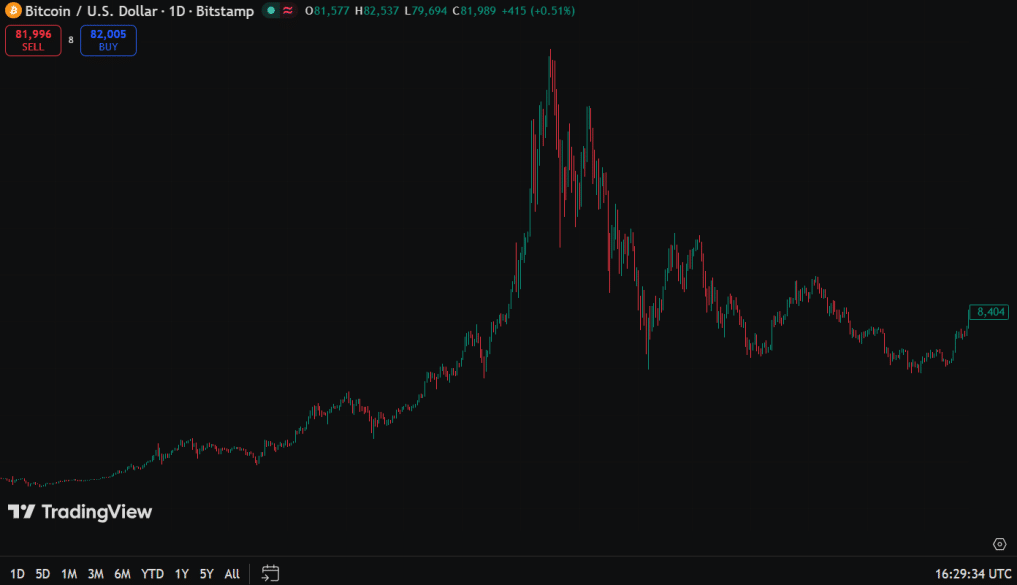
However, the launch also marked a major turning point for the market. The introduction of futures allowed institutional traders to easily short the asset, betting that the price would go down. Almost immediately after reaching this historic high, the massive retail buying pressure ran out of steam, and a multi-year bear market began.
Aug 2020: MicroStrategy adopts BTC as Treasury Asset
MicroStrategy was already a key player in the cryptocurrency market, and August 2020 became a permanent marker on the Bitcoin history timeline. The company announced that it was adding Bitcoin to its corporate balance sheet as its main treasury reserve asset, swapping traditional cash for hard digital money.
This decision turned into one of the most unexpected Bitcoin events in corporate finance. Instead of treating the asset as a quick trade, a publicly traded firm proved that Bitcoin could serve as a balance-sheet shield against fiat debasement.
The move swept across major Bitcoin news outlets globally, signaling to other public companies that holding sovereign reserves on-chain was possible. Nowadays, Strategy holds 848,250 BTC.
Sep 2021: El Salvador Makes BTC Legal Tender
As Bitcoin attracted headlines around the globe during its bull run, El Salvador made history by adopting Bitcoin as official legal tender alongside the US dollar in September 2021. The law required local businesses to accept Bitcoin for goods and services whenever technologically capable.
This move drew a wave of crypto travelers and digital nomads eager to test a real-world circular economy. High-profile advocates like Max Keiser even relocated to the country to live out a full, Bitcoin-focused lifestyle.
For the broader economic landscape, this was one of the most radical shifts ever recorded. It forced traditional financial institutions and central banks worldwide to stop viewing the asset as a pure novelty and start treating it as a functioning state-level monetary alternative.
After almost four years with Bitcoin as legal tender, the country decided to remove it as a mandatory requirement for businesses in early 2025 to unlock a $1.4 billion IMF loan program. The government stopped using taxpayer money to buy more BTC, made tax payments US-dollar only, and stepped away from the official Chivo wallet.
Nov 9, 2021: Bitcoin Skyrockets to $69,000
Hitting $69,000 became one of the defining Bitcoin events along the entire Bitcoin history timeline. The largest digital currency surged by roughly 2,000% from its 2018 bear market low, finally breaking past its previous ceiling and setting a massive new record.
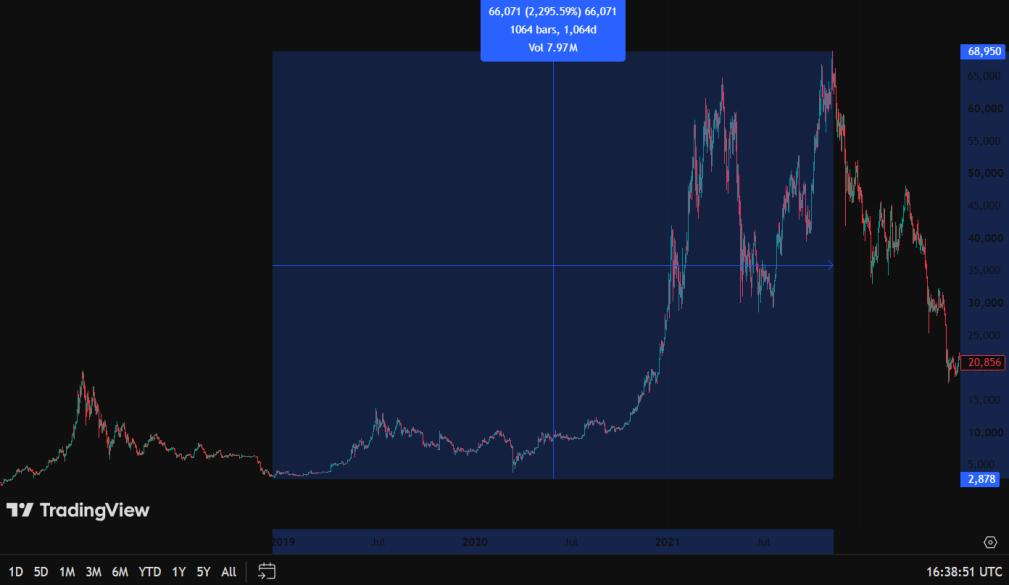
This milestone marked a major shift in how capital moved, dominating major Bitcoin news cycles everywhere as regular buyers and big companies piled in. Yet, the price action also exposed extreme volatility in the market, proving that rapid price increases tend to end in painful corrections.
Even with the pullback, the psychological finish line changed. Reaching $69,000 meant Bitcoin was suddenly very close to reaching $100,000, what many analysts have called in previous cycles as a price target for the largest cryptocurrency.
Nov 2022: FTX Collapse
Among the major Bitcoin news in recent years was the collapse of the cryptocurrency trading platform FTX. Founded in 2019 by Sam Bankman-Fried, the platform offered a wide range of services, including crypto trading, derivatives and futures, leveraged tokens and more. Additionally, one of the main aspects of this platform was the FTT token, issued by FTX, which allowed users to get discounts on transaction fees and use it as collateral for larger trades.
Bankman-Fried was also the founder of the hedge fund Alameda Research. This company focused on buying luxury real estate, funding risky investments, and investing in multiple celebrity ad campaigns. For several years, Alameda borrowed large amounts of money from FTX customer accounts. All of those funds were then used to sustain those speculative investments at Alameda.
Following a financial leak in November 2022, it was discovered that Alameda was heavily backed by FTT. Large amounts of FTT were minted just to back risky investments at Alameda. For this reason, Binance, also considered one of the largest exchanges in the crypto industry, announced through its CEO at the time, Changpeng Zhao, that it was liquidating its FTT position.
With a deficit of $8 billion from the funds loaned to Alameda, the company froze user funds. Later, on November 11, FTX filed for bankruptcy, making it one of the largest Bitcoin events in history. Bitcoin fell below $15,500 for a short period of time.
Jan 10, 2024: US Spot Bitcoin ETF Approval
For several years, the U.S. Securities and Exchange Commission (SEC) rejected and delayed applications for Bitcoin Spot ETFs. However, on January 10, 2024, 11 asset management firms received approval to offer Bitcoin spot exchange-traded funds.
Thanks to this approval, the whole cryptocurrency market gained greater legitimacy. It was now possible for larger and institutional investors to get exposure to Bitcoin through a standardized and traditional financial instrument.
This is the list of the top 7 Bitcoin Spot ETF issuers as of today.
| Rank | Asset Management Firm | ETF Fund Name | Ticker Symbol |
| 1 | BlackRock | iShares Bitcoin Trust | IBIT |
| 2 | Fidelity Investments | Fidelity Wise Origin Bitcoin Fund | FBTC |
| 3 | Grayscale Investments | Grayscale Bitcoin Trust | GBTC |
| 4 | ARK Invest & 21Shares | ARK 21Shares Bitcoin ETF | ARKB |
| 5 | Bitwise Asset Management | Bitwise Bitcoin ETF Trust | BITB |
| 6 | VanEck | VanEck Bitcoin Trust | HODL |
| 7 | Franklin Templeton | Franklin Bitcoin ETF | EZBC |
April 2024: 4th Halving
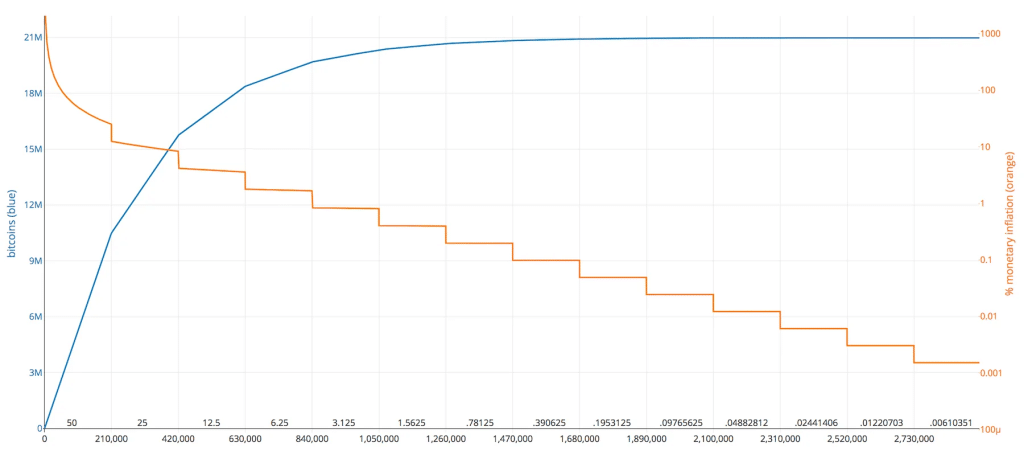
In the Bitcoin history timeline, halving events hold a central place. On April 20, 2024, the Bitcoin blockchain experienced its fourth halving, reducing the block reward from 6.25 BTC to 3.125 BTC per block.
Before the April 2024 halving event, the daily issuance of Bitcoin was roughly 900 BTC. Once the halving took place, the daily supply creation dropped to 450 BTC per day, which means that Bitcoin’s annualized inflation rate went down to approximately 0.82%.
The fourth halving event preceded one of the largest bull runs in the crypto industry. Bitcoin surged from below $30,000 in April 2024 to above $125,000 the following year.
Finally, a new halving event is expected in April 2028, reducing the block reward from 3.125 BTC per block to 1.5625 BTC. Halving events are among Bitcoin’s key features, allowing inflation to fall over the years and keeping its supply under 21 million BTC.
Dec 4-5, 2024: Bitcoin Crosses $100.000+
The path for Bitcoin to reach $100,000 was not easy, and it was full of challenges along the way. The largest cryptocurrency in the market hit $100,000 for the first time between December 4 and 5, 2024. This price action was part of a bull trend that started in late 2022 or early 2023.
This growth in Bitcoin’s price can be explained by the expansion of the digital currency among larger investors and institutions. Bitcoin ETFs and various other investment vehicles helped traditional capital enter a market that had been focused mostly on retail investors in previous bull markets.
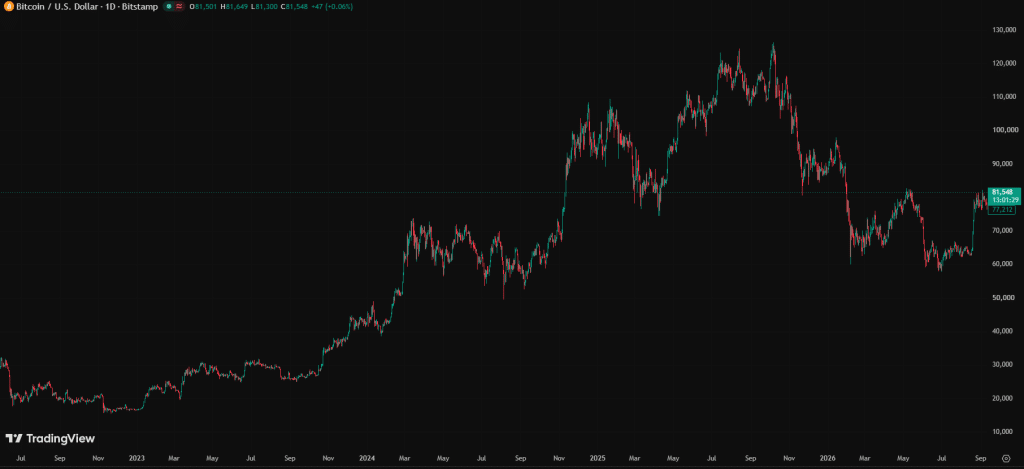
October 6, 2025: Bitcoin Reaches its Ultimate All-Time High of $126.000
Bitcoin didn’t stop at $100.000 and continued growing throughout 2025. On October 6, 2025, BTC reached an all-time high of $126.000. Reaching this ultimate price peak pushed Bitcoin’s market capitalization to almost $2.5 trillion, becoming the 7th most valuable asset on earth.
With this major Bitcoin news, analysts who were calling Bitcoin a fraud had to re-evaluate their predictions and positions. The virtual currency was able to show strong resilience over the years to FUD from different sectors and prominent financial figures.
2026: Market Correction
Finally, following the historic peak of over $126.000 in October 2025, Bitcoin entered a new market correction in 2026 that lasts until today. The price began a steady downward trend as investors moved funds from BTC towards less risky assets such as gold.
The relationship with gold is important because the precious metal reached an ATH a few months later, in January 2026. Investors moving and rotating from BTC to other assets could have had an impact on gold’s bull market.
After multiple years of a massive bull trend, Bitcoin entered a new accumulation period. Investors who didn’t have the opportunity to purchase Bitcoin between 2024 and early 2025 are now able to enter the market as bullish pressures eased.
More on Bitcoin: Bitcoin hub · Bitcoin price today · Bitcoin price prediction · How to buy Bitcoin safely