Key Takeaways
- Certain tokenized shares can be traded at all times via compatible exchanges or decentralized systems.
- Ondo enables continuous trading while providing fast minting and redeeming service for certain assets.
- xStocks have an option of trading stocks at all times in addition to minting and redeeming operations 5 days a week.
Both conventional stock markets and stock exchanges have fixed hours of their operation, but with the blockchain, assets can be traded any time of day or night.
Thus, getting the possibility to invest in tokenized stocks is appealing to those investors who are interested in the equity market but are unable to trade during the hours of traditional marketplaces. So can tokenized stocks be traded any time of day?
In fact, it is possible to buy and sell tokenized stocks at any time, but it does not mean that all tokenized stocks are available around the clock. It depends on the marketplace, the asset, and the operation involved.
Types of Token Activities
There are three different types of activities:
1. Trading – This refers to the act of selling or buying tokens on a centralized exchange, decentralized exchange, or supporting platform.
2. Transfers – The act of transferring tokens between compatible wallets and blockchain addresses.
3. Minting and redemption of tokens – This refers to the creation of new tokens against assets, or redemption of tokens for their underlying value in assets.
In other words, tokens may be transferable over weekends while the issuer may not be active in processing any new purchases or redemptions. While there are platforms that may support all three activities, they do not apply to all tokens.
What Platforms Support 24/7 Trading of Tokenized Stocks?
There are several service providers who provide trading operations beyond regular trading hours, however some of them have a limited number of tokens and limited services.
Ondo Stocks
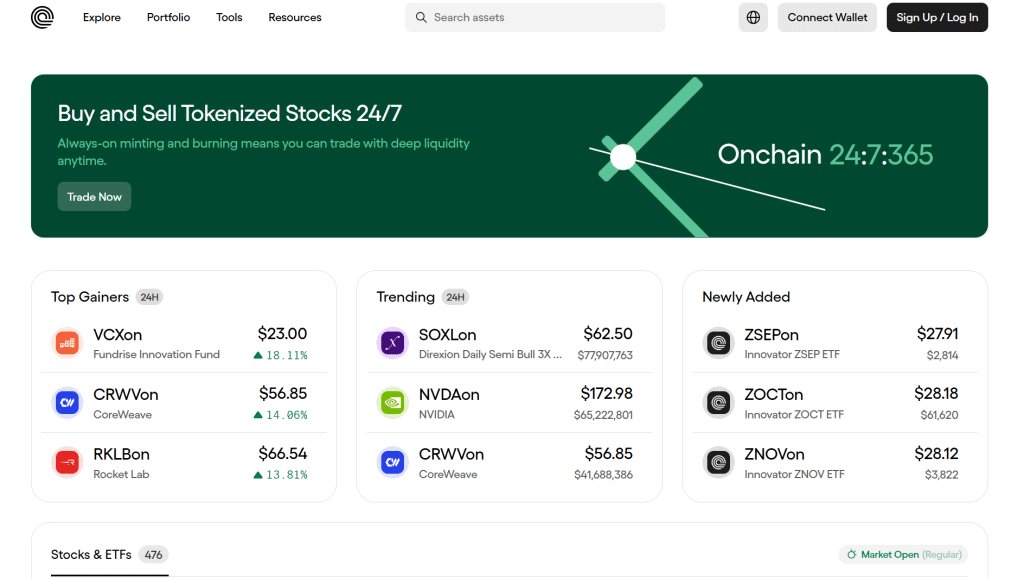
Ondo offers an opportunity for all qualified investors from outside the United States to buy tokenized stocks using approved exchanges, wallets, DeFi platforms during any hour of day or night though its tokens can still be used within Ethereum, BNB Chain, and Solana networks.
Moreover, Ondo has recently introduced peer-to-peer trading to the system in June 2026. Six assets can be bought or sold on 24/7 basis:
1) NVIDIA (NVDAon)
2) SPDR S&P 500 ETF (SPYon)
3) Circle (CRCLon)
4) Tesla (TSLAon)
5) Invesco QQQ ETF (QQQon)
6) Alphabet (GOOGLon)
In addition to the aforementioned projects, Ondo uses 24/5 minting and redemption protocols across their portfolio of products. However, they may hinder the trading process if previous notification is given for doing maintenance work etc.
Neither Ondo’s products nor services are available to any US-based customers or it’s citizens. Moreover, there may be additional regulations imposed in other regions.
xStocks
xStocks provides tokenized versions of stocks and ETFs that are listed on the stock exchange. Trading between investors is different from the issuance or redemption of tokens.
As indicated in xStocks partner documentation, secondary market trading can be performed 24/7 while issuance and redemption usually follow a 24/5 schedule that coincides with the hours of traditional markets.
An xStock rate in the secondary market depends on the demand and supply at a given marketplace. As a result, it can differ from the last known market rate of the underlying stock, especially when traditional markets are closed.
xStocks are neither offered in the United States or available for U.S. persons. Investors should also check supported platforms and regional restrictions.
Dinari dShares
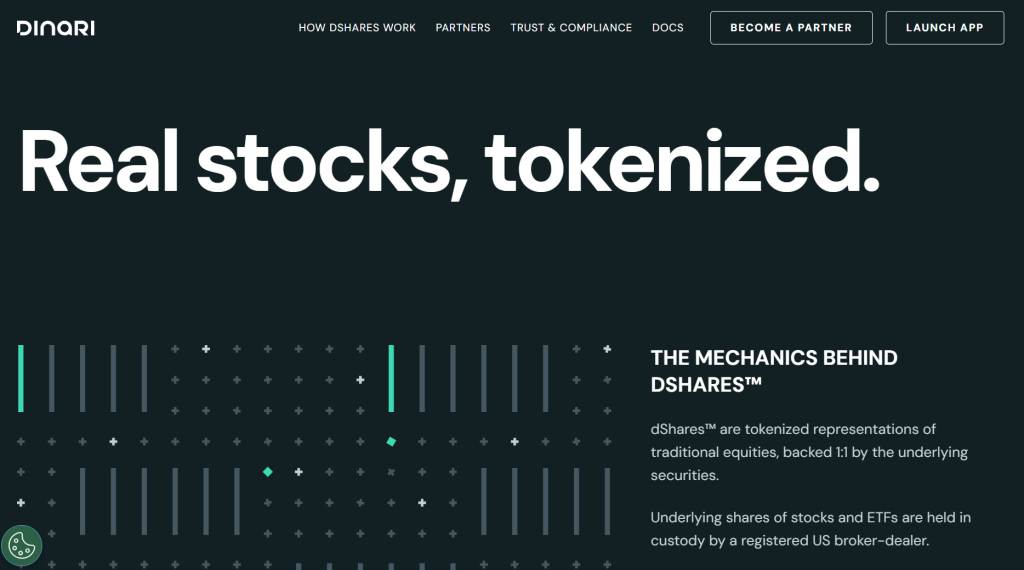
Dinari is providing a number of tokenized U.S. stocks and ETFs, called dShares. Due to the partnership with liquidity provider Flow Traders, certain dShares are tradable 24/7, i.e. through weekends and holidays.
When the US market is open, Dinari can utilize the liquidity from traditional exchanges and other trading platforms, while after hours, its network uses on-chain liquidity for trading.
However, not all dShares and not every trading session have the same conditions. According to Dinari, in its trading documentation, the weekend session has different conditions.
Only limit orders can be submitted in this session and orders can be only partially executed or not executed at all due to liquidity concerns.
Trading Without Limits and Conventional Stock Market Hours
In the traditional U.S. stock exchanges, trading hours are fixed. Trading sessions at the NYSE and Nasdaq start at 9:30 a.m. and last till 4:00 p.m. Eastern Time. The market may be subject to days when there are no operations because of market holidays.
Other brokerages may provide pre-market or after hours trading; however, the trading process will differ in terms of the market environment it offers.
The key aspect that stands out is trading time that is offered. The availability of trading via the means of tokens outside trading sessions means that buyers and sellers will lack the required level of liquidity to facilitate normal pricing.
What Is the Effect of Token Trading After Market Hours?
The token trading idea sounds very attractive but has its downsides.
Low Liquidity
One of the downsides of token trading is insufficient liquidity. The absence of trades made on weekends, holidays, or night means that there is a limited number of orders executed at the specified price.
Wider Bid-Ask Spreads
The difference between the prices is that between the highest offer to buy tokens and the lowest offer to sell tokens. Given that there is not much trade activity, the gap will be considerable.
Price Difference
The price for tokenized stock may change while the stock market is closed. The price reacts to news and inquiries regarding the relevant trading service. Therefore, the difference in price showcase between tokenized price and the most recent stock price is wide and then as soon as trading starts this gap disappears.
Delay in Order Execution
Having the trading platform accessible does not imply that the order will be executed right away. The order will be executed if and only if the minimum quantity of sellers or buyers are available at an acceptable price level.
Different exchanges restrict the types of orders allowed during non-active trading hours. For example, Dinari allows the use of limit orders for trading during weekends but this does not guarantee that the orders will be filled at all or that they will be filled completely.
How to Perform Transactions With Tokenized Stocks During Non-Active Trading Hours?
The steps needed for this depend on the trading platform being used and token in question, but in general, the following steps have to be followed:
- Choose the right trading platform. Make sure that the trading platform you choose operates during weekends, holidays, or even at night.
- Check if the asset can be traded. Tokenized stocks do not always allow trading every hour of every day.
- Connect an account or wallet to the chosen platform. Keeping in mind the requirements and the blockchain used by the trading platform.
- Confirm the liquidity and pricing. Ensure that your price is listed and that the price matches your intended stock volume.
- Choose your order type. If you desire a specific maximum or minimum price, your order must be a limit order. Make sure to confirm the order details, and the price will match according to the volume of stocks you would like to purchase.
Risks of Trading Tokenized Stocks 24/7
Here are the risks that you should consider
Market Volatility
The only limitation of 24/7 trading is that on weekends, there is minimal trading done, and therefore, there are huge fluctuations in the prices.
Liquidity Risk
Since there may be not enough buyers or sellers to complete the order, it may mean that the orders will only partially fill the order for the desired price of the transaction.
Price Deviations
In theory, it’s important to note that tokenized stocks are supposed to follow the prices of the traditional stocks, but for the reason of being dependent on various factors, like supply and demand, volume, and certain market situation, they often fail at that.
Platform and Blockchain Risks
There are risks for investors that stem from the disconnection of the trading platform, errors in smart contracts, wallet security, and potential mistakes during the blockchain transfers.
Frequently Asked Questions
Below are the answers to the most common questions about tokenized stocks.
Is it possible to trade tokenized stocks over the weekends?
Yes, it all depends on the provider and type of token used.
Is it possible to trade after the stock market has closed?
Yes, but it is important to keep in mind that the price may also differ during market hours even when the liquidity is low.
Are there any trading platforms that operate 24/7?
No, most of the trading platforms do not operate 24/7 and allow their users to trade only with a limited number of tokens.
Are tokenized stocks as liquid as the traditional stocks?
No, tokenized stocks cannot be as liquid due to the fact that there is no price fluctuation on weekends and holidays.
More crypto guides: Guides hub · What is cryptocurrency · What is a seed phrase · 7 crypto scams to avoid