Imagine lending crypto, swapping tokens, or providing liquidity on a decentralized exchange without ever handing your funds to a bank or broker. That is the point of a DeFi wallet. It is a tool that lets you hold your own assets while still plugging directly into decentralized finance.
Decentralized finance is reshaping how people access and use financial services, offering an alternative to traditional systems that rely on banks and intermediaries.
Using blockchain technology, users can manage their assets, make transactions, and access financial tools in a more open and permissionless environment.
As this ecosystem grows, the right tools become essential, and a DeFi wallet is one of the most important, serving as the main gateway for storing digital assets and connecting with decentralized applications across different blockchain networks.
What Is a DeFi Wallet?
A DeFi wallet is a type of crypto wallet that lets users interact directly with DeFi applications. It is non-custodial, meaning users control their own private keys and retain full ownership of their digital assets.
With a DeFi wallet, users can store, send, and receive cryptocurrencies and access decentralized applications (dApps) for activities such as trading, lending, borrowing, and staking, all without relying on a central authority.
Key Features of a DeFi Wallet
A DeFi wallet gives users full control and straightforward access to digital assets and blockchain services, allowing them to manage funds and use decentralized applications without relying on third parties.
Non-Custodial Control
Users hold their own private keys, so only they can access their funds, and they are responsible for keeping those keys protected.
Direct Blockchain Interaction
Transactions go straight to the blockchain without a bank or middleman, making them transparent and verifiable.
dApp Connectivity
Users can connect their wallet to decentralized applications to trade, lend, borrow, or stake directly.
Multi-Asset Support
Most wallets support a range of cryptocurrencies and tokens, letting users manage them all in one place.
Cross-Platform Access
DeFi wallets are available as mobile apps and browser extensions, making them usable across different devices.
How a DeFi Wallet Works
A DeFi wallet uses cryptographic keys to connect users to blockchain networks, letting them manage assets, approve transactions, and interact with decentralized applications.
Wallet Creation
When a user creates a DeFi wallet, it automatically generates two important components. A public address functions like an account number that can be shared with others to receive cryptocurrencies.
A private key is a code that proves ownership of the wallet and is used to sign and approve transactions; it must never be shared with anyone.
The wallet also provides a recovery phrase, also called a seed phrase, a set of words that can restore access to the wallet if a device is lost, damaged, or replaced.
Protecting this phrase is critical, since anyone who obtains it can take full control of the wallet.
Storing Assets
Cryptocurrencies are not physically stored inside a DeFi wallet. Instead, they exist on the blockchain, while the wallet functions as an interface for accessing and managing those assets.
It uses cryptographic keys to verify ownership and display balances, transaction history, and supported tokens.
Through this setup, users can monitor and manage their holdings across different blockchain networks in one place.
The wallet does not hold funds itself, but provides a reliable way to interact with assets recorded and maintained on the blockchain.
Sending and Receiving Funds
To receive funds, a user simply shares their public address, which functions like an account number on the blockchain.
Others can use that address to send cryptocurrencies directly, and it can be shared openly without putting existing funds at risk.
To send funds, a user creates a transaction and approves it by signing with their private key.
This step confirms wallet ownership and authorizes the transfer without revealing the private key.
Once approved, the transaction is sent to the blockchain network, where it is verified and recorded.
Connecting to DeFi Platforms
DeFi wallets let users connect directly to decentralized platforms through built-in integrations.
Once connected, the wallet authorizes interactions with smart contracts, letting users perform financial activities without intermediaries; the user signs every action, and the blockchain records it.
Users can swap tokens by exchanging one cryptocurrency for another directly through decentralized exchanges, lend or borrow assets by supplying funds to earn interest or borrowing against collateral through lending protocols, provide liquidity by contributing assets to pools that support decentralized exchange trading in exchange for a share of fees, and stake tokens by locking them in a protocol to support network operations in exchange for rewards.
All of these actions run through smart contracts, which automatically process transactions based on predefined rules.
Transaction Signing
Every action in DeFi requires user approval through transaction signing. When a user initiates a transaction, the wallet prompts them to review the details and confirm the action, using the private key to create a digital signature that verifies ownership without exposing anything sensitive.
This process requires explicit consent for every transaction, preventing unauthorized access or transfers, since no action can complete without the user’s own signature.
Once signed, the transaction is sent to the blockchain network for validation and recording.
Types of DeFi Wallets
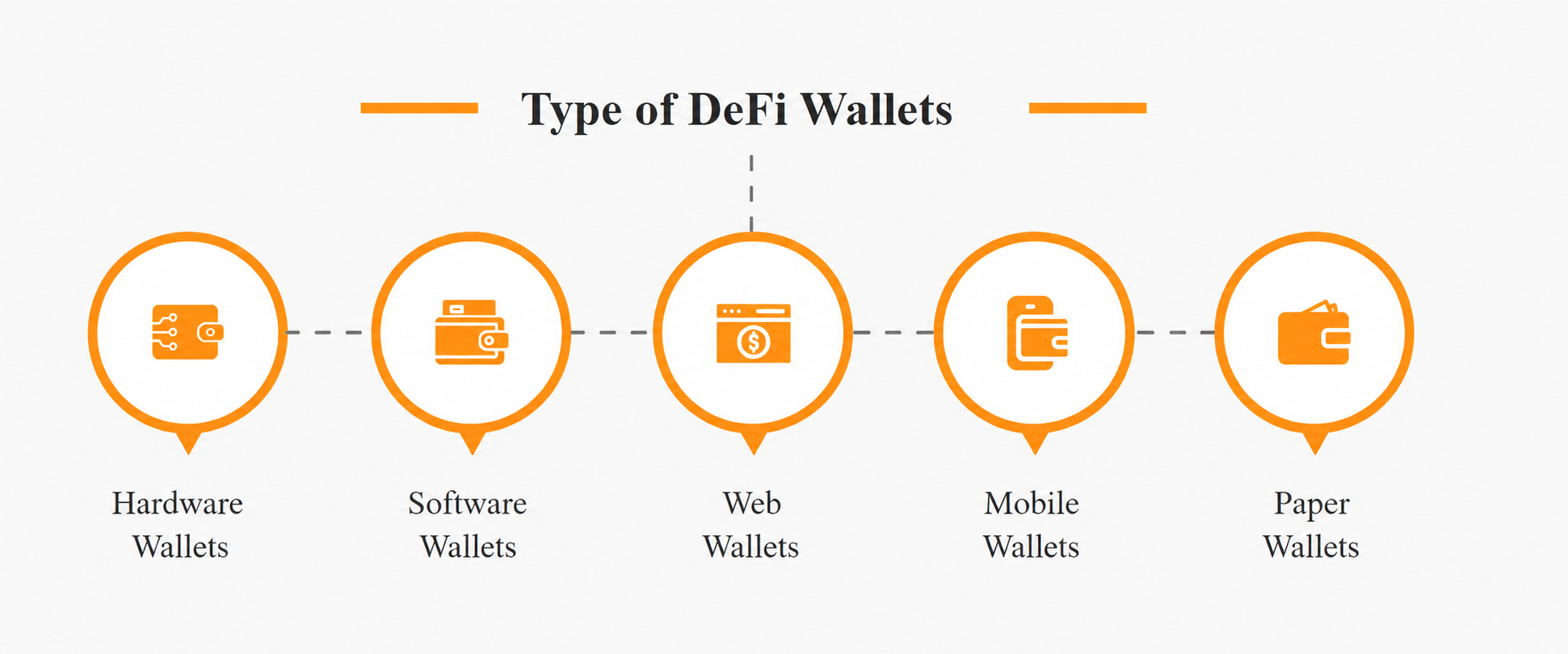
DeFi wallets come in different forms, each balancing convenience and protection differently, and the right choice depends on how someone plans to access DeFi platforms and manage assets.
Browser extension wallets run directly in a web browser and let users quickly connect to decentralized applications, approve transactions, and interact with services without leaving the browser window.
Mobile wallets are smartphone applications that let users store, send, and manage cryptocurrencies on the go, often including built-in features for connecting to dApps, scanning QR codes, and tracking portfolio activity in real time.
Hardware wallets are physical devices that store private keys offline, reducing exposure to online threats, and are typically used when protecting larger holdings matters most, since transactions must be physically confirmed on the device itself before being signed and broadcast to the blockchain. Our guide to the best hardware wallets covers specific options worth considering.
Advantages of Using a DeFi Wallet
These benefits are what draw most users to a DeFi wallet in the first place.
Full Control of Assets
Users hold their own private keys, giving them complete ownership of their funds without relying on banks or centralized exchanges.
Permissionless Access
DeFi wallets let users reach decentralized applications and services without requiring approval or identity verification in many cases, depending on the platform.
Transparency
All transactions are recorded on public blockchains, making them verifiable and traceable by anyone and helping build trust in the system overall.
Global Accessibility
DeFi platforms can be reached from anywhere with an internet connection, letting users worldwide participate in financial activities without geographic restrictions.
Risks and Limitations
These are the trade-offs worth understanding before relying on a DeFi wallet day to day.
User Responsibility
Users must store their private keys and recovery phrases securely. If they are lost or exposed, no third party can restore access to the wallet and its funds.
Smart Contract Risk
DeFi platforms run on smart contracts, automated pieces of code that can be exploited if they contain bugs, vulnerabilities, or poor design choices, potentially leading to a loss of funds.
Scams and Phishing
Users may encounter fraudulent websites or malicious links designed to trick them into connecting their wallets or approving unauthorized transactions. Real caution matters when interacting with unfamiliar platforms. Our crypto scams to avoid guide and wallet security mistakes guide both cover this in more depth.
Transaction Fees
Blockchain networks charge fees, often called gas fees, for processing operations. These fees fluctuate depending on network demand and can climb noticeably during periods of heavy activity.
Frequently Asked Questions
Need a refresher? Here are the questions readers often ask about DeFi wallets.
Is a DeFi wallet the same thing as a regular crypto wallet?
Not always. Every DeFi wallet is a crypto wallet, but not every crypto wallet is built for DeFi specifically. What sets a DeFi wallet apart is its ability to connect directly to decentralized applications through smart contracts, something not every basic crypto wallet supports out of the box.
What happens if I lose my recovery phrase?
If you lose a recovery phrase and the device holding the wallet is also lost, damaged, or replaced, you typically cannot restore access to that wallet and its funds. No company or support team can recover it, since a DeFi wallet has no central authority holding a backup on a user’s behalf.
Can someone steal my funds just by knowing my public address?
No. A public address only allows someone to send funds to a wallet, not withdraw from it. Only the private key, which should never be shared, can authorize an outgoing transaction.
Do I need a hardware wallet to use DeFi safely?
Not necessarily, but it adds a meaningful layer of protection for larger holdings, since a hardware wallet keeps private keys offline and requires physical confirmation before signing any transaction. Many users pair a hardware wallet with a browser extension for everyday DeFi activity.
Why do gas fees change so much between transactions?
Gas fees reflect demand for space on a given blockchain at any moment. During periods of high network activity, more users compete for the same limited block space, which pushes fees higher until demand eases.