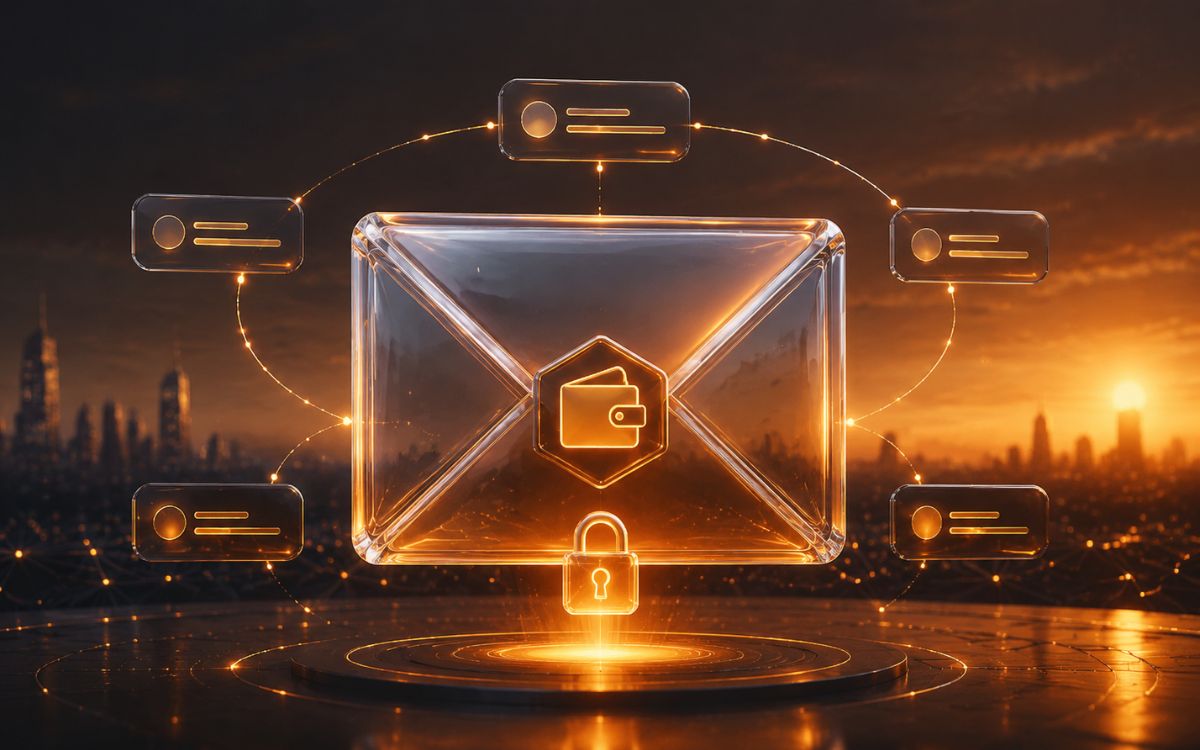
A Web3 email platform lets you send and receive messages using your wallet address, an ENS domain, or a similar on-chain identity instead of a traditional email address tied to a centralized provider.
Messages route through encrypted, wallet-authenticated channels rather than a single company’s mail servers, which cuts down on the spam and data harvesting that come standard with Gmail or Outlook.
Five platforms currently stand out for combining active development with a fully wallet-native sign-up process, meaning your crypto wallet, not a username and password, is what proves who you are.
How Does Web3 Email Work?
Web3 email works by using your crypto wallet as your login: you connect a self-custodial wallet, and the platform verifies you own the address through a cryptographic signature instead of a password. Messages are typically encrypted end to end and often stored on decentralized infrastructure such as IPFS, and some platforms accept ENS domains as addresses.
Think of your crypto wallet as a passport. Traditional email asks you to create a new identity, a username and password, for every service you sign up for. Web3 email instead lets that one passport work everywhere.
When you connect MetaMask, Phantom, or another self-custodial wallet to a Web3 email platform, the platform verifies you own that address through a cryptographic signature rather than a password, the same private-key ownership that already secures your on-chain assets.
From there, messages are typically encrypted end to end and often stored on decentralized infrastructure such as IPFS instead of a single company’s servers. Some platforms also let you use a human-readable identity, like an ENS domain (yourname.eth) or a Solana Name Service handle, as your address instead of a long string of characters.
That solves a real problem: dApps and projects have no reliable way to reach wallet holders directly, since a wallet address alone cannot receive a message.
Why This Matters If You Hold a Wallet
If you have ever connected a wallet to a new dApp and started receiving spam within days, you already know why this space exists. Traditional email requires you to hand over an address to every protocol, exchange, and NFT project you interact with, and once that address leaks into a marketing list, there’s no taking it back.
Web3 email flips that model. Instead of broadcasting your inbox to anyone who asks, you decide which wallets and dApps are allowed to reach you, and you can revoke that access at any time.
For anyone managing multiple protocols through our resources hub, a wallet-based inbox is one of the more practical upgrades available right now, since it consolidates transaction alerts, governance notices, and project updates into one place without a new sign-up for each one.
The 5 Best Web3 Email Platforms in 2026
Each of these platforms was checked directly against its live site and current documentation this month, with the following standouts based on active development, user base, and how fully wallet-native the sign-up process is.
1. EtherMail
EtherMail is the most active platform on this list, with more than two million verified accounts and a blog that has published new posts every few weeks through June 2026. Its core feature, Email-as-a-Wallet, lets you turn a wallet address into a working inbox, receive blockchain-synced transaction and NFT updates, and send tokens directly through PayMail without leaving the inbox.
In March 2026, EtherMail launched moltmail.io, a companion product that gives AI agents their own email addresses and wallets so they can operate independently of a human user’s inbox.
That launch signals EtherMail is expanding beyond consumer inboxes into infrastructure for autonomous agents, a fast-growing niche as AI agents increasingly need their own way to transact and communicate online.
2. LedgerMail
LedgerMail runs on the XDC Network rather than Ethereum, and it takes a stricter approach to decentralization than most competitors on this list.
It operates as a closed-loop system, meaning messages can only be sent and received within the LedgerMail network itself, rather than bridging to standard SMTP or IMAP servers the way some hybrid services do.
Sign-up works through decentralized identity providers including Unstoppable Domains, ENS, and XDC Domains, and the company has partnered with IPFS, Filecoin, and Arweave for message storage. LedgerMail is based in Dubai and also offers an Android app, which fills a gap for users who want a mobile-first option.
3. Outposts

Outposts takes a different angle from the other platforms on this list. Instead of replacing your inbox with a wallet-based mailbox, it delivers an actual email newsletter twice a week, built around whichever wallet address you connect. Signing in only requires a signature to prove ownership, and Outposts uses that wallet’s on-chain activity, including token holdings, NFTs, and guild.xyz memberships, to decide which communities and updates belong in your digest.
Each sign-up mints a free access NFT on Polygon, with Outposts covering the gas fee, and you can manually follow or unfollow specific communities to fine-tune what shows up. For anyone who wants project updates delivered as a real email rather than logging into a separate wallet-based inbox, Outposts fills that gap.
4. Signic
Signic is a newer entrant built around the idea that your wallet should be your only login. It supports Ethereum, Solana, and Polygon addresses, and it lets you use an ENS or SNS domain as your email identity instead of a raw wallet string.
There’s no password to create or remember, since ownership is verified through your wallet signature each time you log in.
Signic also includes basic DAO governance tools, which is a feature aimed squarely at the kind of user who is already active across multiple protocols and wants notifications and voting reminders to land somewhere other than Discord. The service is currently free to use.
5. iExec Web3Mail
iExec Web3Mail takes a different approach from the other four platforms, since it is built as a developer protocol rather than a consumer inbox.
Through iExec’s confidential computing infrastructure, a project can send you an email tied to your wallet address without ever seeing or storing your actual email address. You grant permission for specific apps to contact you, and you can revoke that access at any time.
This is the option to know about if you are a developer building a dApp that needs to notify users, or if you simply want to understand the infrastructure running quietly behind some of the other platforms on this list. It ships as an npm package and stays under active development, with a changelog update as recently as this year.
Common Mistakes to Avoid With Web3 Email
A few habits separate a smooth switch to wallet-based email from a frustrating one. Keep these in mind before you connect a wallet to any of the platforms above.
Treating It as a Full Replacement for Your Primary Email
The biggest mistake is treating any of these platforms as a replacement for your primary email address without a backup plan. Web3 projects are still young companies, and a wallet-based inbox with no export option can mean lost messages if a provider ever changes direction or folds.
Assuming Decentralized Means Anonymous
A second mistake is assuming decentralized means anonymous. Several of these platforms, including EtherMail and Outposts, still collect wallet activity data to power their reward systems, so read the privacy policy before assuming your on-chain identity is fully private.
Granting More Wallet Permissions Than Necessary
Finally, avoid connecting your primary wallet to an unfamiliar web3 email service without checking exactly what it’s asking for. A legitimate sign-up request only asks for a signature to verify you own the address, not approval for a transaction or broader spending access. If a connection prompt asks for anything beyond that signature, disconnect and treat it as a red flag rather than a formality to click through.
Frequently Asked Questions
Still deciding whether Web3 email is worth setting up? These are the questions that come up most often.
Is Web3 email the same as a regular encrypted email service like ProtonMail?
No. Encrypted email services like ProtonMail still require a traditional username and password and route mail through their own centralized servers. Web3 email platforms authenticate you through a wallet signature and, in most cases, store messages across decentralized infrastructure such as IPFS rather than a single company’s servers.
Can I use Web3 email on my phone?
Yes, though support varies by platform. LedgerMail offers a dedicated Android app and Outposts arrives as a standard email newsletter you can read on any device, while EtherMail and Signic are accessible through a mobile browser connected to your wallet.
What happens to my messages if a Web3 email platform shuts down?
It depends entirely on the platform’s architecture and business model. Some services offer a message export tool and advance notice if they ever wind down operations, while others may not. Before relying on any platform for important communication, check its documentation for whether it supports exporting your data.
Do I need to hold a specific cryptocurrency to use these platforms?
No. Most Web3 email platforms are free to use and only require connecting a supported wallet, such as MetaMask or Phantom. Some, like EtherMail, offer optional token rewards for engaging with promotional content, but holding a token isn’t required to send or receive messages.
Is Web3 email safe from phishing?
It reduces some phishing risk since your address isn’t sitting in a data-broker’s spam list, but it doesn’t eliminate the risk entirely. Always verify that a wallet connection request is asking only for a signature to prove identity, not a transaction approval, before linking any Web3 email service to your wallet.
If you’re weighing whether to move any communication over to a wallet-based inbox, start with the platform that matches how you already spend most of your time on-chain. Someone in and out of a wallet-connected dApp several times a day will get more use out of EtherMail’s embedded messaging than someone who mainly wants a quieter, closed-loop alternative like LedgerMail or a simple digest like Outposts.