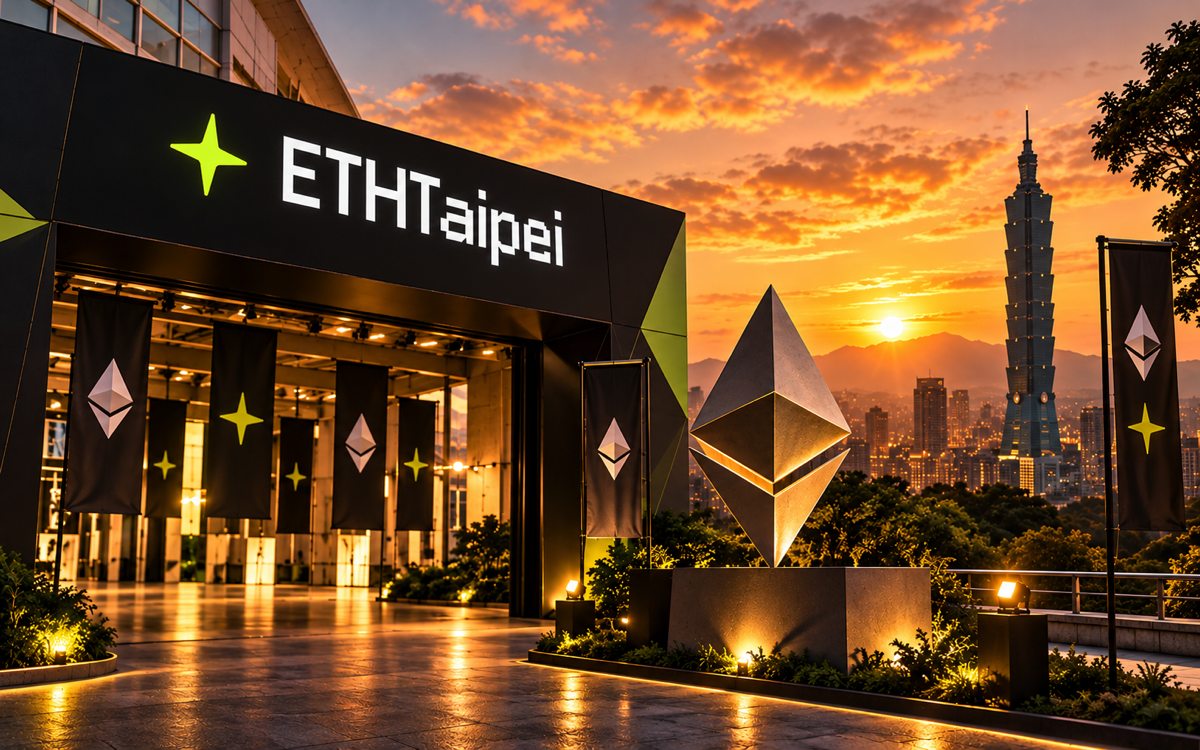
ETHTaipei 2026 opened its two-day conference in Taiwan with Cryptonative Day, bringing Ethereum developers and researchers together for discussions spanning protocol infrastructure, security, privacy, DeFi and prediction markets.
The September 13 program featured Ethereum co-founder Vitalik Buterin alongside contributors from the Ethereum Foundation, Uniswap, ChainSafe, CertiK, Polymarket, Vyper, imToken Labs and other Ethereum-focused teams.
Cryptonative Day is the developer-focused half of ETHTaipei’s new two-day format. The conference shifts to Institution Day on September 14, when the program turns toward banks, custody, real-world assets and other institutional applications.
What Vitalik Buterin’s Sessions Covered
The official ETHTaipei agenda scheduled Buterin for two sessions on the Genesis Stage, including a 40-minute morning appearance beginning at 10:20 and another 30-minute session at 1:00 p.m. The agenda did not publish titles for either session, listing both as “Topic to be announced,” and organizers noted that schedule times remained tentative.
ETHTaipei shared a look at Buterin’s appearance as Cryptonative Day got underway, showing the Ethereum co-founder addressing attendees during the opening day:
Buterin was joined by Ethereum Foundation engineer Alex Kuzmin, whose session focused on post-quantum migration at Ethereum’s zero-knowledge application layer. The program reflects ETHTaipei’s broader focus on the infrastructure underneath Ethereum rather than concentrating only on token markets or consumer crypto products.
Why Security and Privacy Took Center Stage
Several Cryptonative Day sessions focused directly on vulnerabilities, scam prevention and protocol security. Alex Murashkin of Common Defense AI presented “Trust No Message,” covering scam detection and defense as artificial intelligence makes impersonation and fraudulent communication more sophisticated.
CertiK’s Hao Chen discussed methods for proving DeFi systems safe beyond simply discovering individual bugs, while Alice of OneSavie Labs examined how large language model tools perform when identifying smart-contract vulnerabilities.
| Area | Selected Cryptonative Day Discussion |
| Ethereum protocol | Two sessions with Vitalik Buterin |
| Post-quantum security | Ethereum’s ZK application-layer migration |
| DeFi security | Formal approaches to proving protocols safe |
| AI and security | Scam detection and smart-contract vulnerability identification |
| Privacy | Stealth addresses and zero-knowledge identity verification |
| DeFi infrastructure | UniswapX market making and auditable Vyper vaults |
| Network infrastructure | Practical challenges of block propagation |
| Cross-chain systems | Verifiable cross-chain intents |
Table 1. Selected technical areas covered during ETHTaipei 2026 Cryptonative Day.
Privacy also appeared throughout the program. Fluidkey co-founder Antonio Seveso addressed stealth addresses and their remaining limitations, while a two-hour workshop explored privacy-preserving citizenship verification and national identity systems using zero-knowledge proofs.
How DeFi and Prediction Market Sessions Went Beyond Trading
The DeFi portion of the agenda focused heavily on the infrastructure and mechanisms operating underneath decentralized applications, several of which appear on a running list of Ethereum DeFi projects shaping the market in 2026. Uniswap protocol engineer Alan Wu presented “Life of a Fill: How Market Makers Work on UniswapX,” examining how orders move through the protocol’s market-making system.
A Vyper workshop focused on building secure, modular and auditable DeFi vaults, while imToken Labs developer Alfred Lu discussed verifiable cross-chain intents.
Prediction markets also appeared across several sessions, an area with growing crossover into crypto covered in a roundup of top Bitcoin prediction markets. Polymarket protocol engineer Aditya discussed rebuilding Polymarket’s protocol from conditional tokens upward, while SigMarket core developer Eric Lee covered automated market maker design for decentralized prediction markets.
Other sessions examined prediction markets for participatory budgeting and the broader concept of information finance.
How Cryptonative Day Sets Up Institution Day
ETHTaipei 2026 is being held September 13 and 14 at POPOP Taipei in the city’s Nangang district. Organizers describe the event as a meeting point between Taiwan’s developer community and the broader Ethereum ecosystem, with protocol labs, Layer 2 teams, wallet developers, zero-knowledge researchers and application builders represented.
This year’s format separates those technical discussions from a second day aimed more directly at traditional finance. The official ETHTaipei program describes September 14’s Institution Day as a dedicated program for banks and financial institutions, with discussions around custody, real-world assets and institutional-grade blockchain applications.
That separation gives the conference two different tracks: one examining how Ethereum’s underlying technology is being developed, and another looking at how parts of that infrastructure could be used by financial institutions.
What Institution Day Will Bring on Day Two
ETHTaipei moves into Institution Day on September 14, shifting the focus from developer infrastructure toward the interaction between Ethereum and established financial institutions. The announced speaker lineup includes representatives from Cathay Financial Holdings, Taiwan Financial Services Roundtable, BitGo, Zodia, KPMG, PwC, Deloitte, EY, XREX and the Ethereum Foundation.
The second-day discussions cover areas including digital asset custody, real-world assets, stablecoins, security, compliance and institutional adoption.
What this means for you: Cryptonative Day shows where Ethereum developers are concentrating technical work beyond token prices, particularly security, privacy, zero-knowledge systems, DeFi infrastructure and cross-chain interoperability. ETHTaipei’s move into Institution Day shifts the discussion toward whether those technologies can translate into infrastructure that banks and other financial institutions can use.