Key Takeaways
- Flash loans offer users the opportunity to borrow cryptocurrency without any collateral and repay it with interest in the same transaction on the blockchain.
- Multiple applications of flash loans include arbitrage opportunities, collateral swaps, self-liquidation, and debt consolidation.
- Flash loan fees, gas costs, trading costs, and slippage can take away any potential profit from the transaction.
- Flash loan attacks are based on vulnerabilities of contracts, price oracles, or accounting of protocols. The loan itself is not the weakness.
Flash loans give the chance to crypto investors to borrow any amount of assets and return them immediately. Flash loans are meant for use in decentralized finance (DeFi); thanks to them, traders can make profitable arbitrage operations.
Flash loans provide opportunities for traders to secure money when it is needed, but the trade has to be well-planned beforehand, as there are mistakes that may lead to huge losses.
Apart from being used for making profits, flash loans may promote DeFi hacking schemes. Whenever there is a weakness in a protocol’s pricing system or smart contracts, an attacker is able to borrow funds to hack the system.
What Are Flash Loans? A Quick Explanation
Flash loans are a unique category of cryptocurrency loans that are borrowed and paid back in just one transaction on the blockchain. They are different from the usual loans because a borrower does not need any collateral to receive the funds.
Flash loans are used widely in DeFi for arbitrage, collateral swapping, debt refinancing, and liquidation. With flash loans, people can easily obtain huge amounts of liquidity for a short period of time, although certain conditions and risks must be met.
How a Flash Loan Works, Step by Step
Flash loans work through smart contracts. The money is borrowed, used, and paid back in one transaction. The operation is automatic and cannot result in an unpaid loan after the transaction.
Here is how a typical flash loan works:
- Loan Request – A user or smart contract makes a request for a particular amount of cryptocurrency from a lending protocol.
- Receiving Funds – The lending protocol sends the assets required for borrowing to the borrower’s smart contract.
- Performing Transaction – The borrower utilizes these funds for a transaction, collateral swapping, repaying a debt, or any other approved activity.
- Repaying the Loan – The amount borrowed and the amount charged as fees are sent back from the smart contract back to the lending protocol.
- Finalize or rollback – The loan is either finalized, or the transaction is rolled back.
Flash Loan Process Diagram
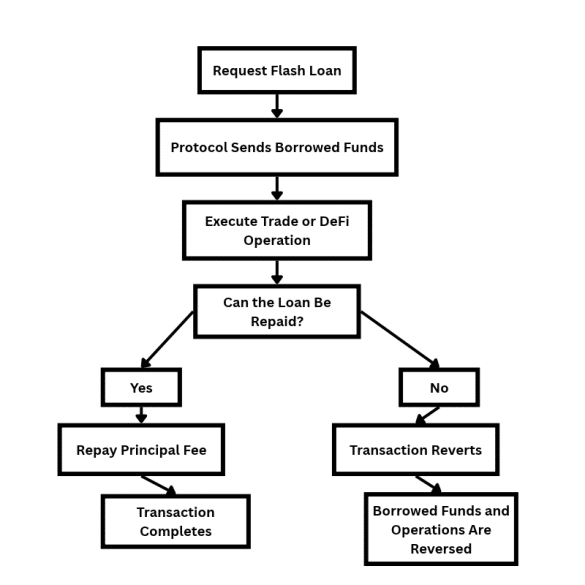
The diagram illustrates how the process works. The specific actions involved will depend on the lending protocol and the operation that is being executed.
For instance, in the Aave protocol, they contact the borrower’s smart contract after sending the money. The contract performs the expected operations. The contract must repay the borrowed sum with the fee within the specified timeframe. In case the amount isn’t enough for the repayment, the transaction happens to be reverted.
However, the fact that the transaction is reverted does not mean that the borrower enjoys a free transaction. The transaction gas price may still account for a considerable amount of losses.
Where to Get Flash Loans: Platforms and Costs
Some DeFi protocols allow users to use flash loans or similar features. They charge various fees and support different assets and networks.
The following table provides a list of a few of these providers along with their fee structures for users.
| Protocol | Feature | Fee | Notes |
| Aave V3 | Flash loans through flashLoan() and flashLoanSimple() | 0.05% at deployment | May change through governance; waivers for approved borrowers |
| Balancer V2 | Borrow from Vault liquidity | Depends on protocol settings | Check current on-chain fees |
| Balancer V3 | Vault flash loans | 0% | Depends on network and liquidity |
| Morpho | Flash loans via supported markets | 0% | Asset and network availability vary |
| Uniswap V2 | Flash swaps via pools | 0.30% pool fee | Flash swap, not a standard flash loan |
The rates are subject to change in the future. Please refer to the existing documents of the protocol being used and the current settings of the contracts in order to check transaction quotes before borrowing.
What the Fees Mean
Flash loan fee refers to the cost charged for temporary borrowing of the asset. It should not be confused with the gas fee that is required for the transaction.
- Borrowed amount: 100,000 USDC
- Flash loan fee: 50 USDC
- Total repayment: 100,050 USDC
In this example, the gas and any trading charges are not included in the example calculation.
A strategy must create enough profit to pay for the loan and any transfer costs. A transaction that is potentially profitable can end up being a losing one when fees are included.
Common Uses of Flash Loans
Flash loans are a useful tool when the user needs liquidity for only a short period of time. They allow traders and users of DeFi protocols to perform operations with the amount of coins needed without having the proper amount of funds beforehand.
Arbitrage
Arbitrage is when someone buys something at a low rate on one exchange and sells it at a higher rate on the other. A flash loan is what allows them to execute both trades at once. For instance, a trader borrows 100,000 USDC, buys a token for 100 USDC from Exchange A, and then sells it on Exchange B for 102 USDC.
In the end, the trader only has to pay back the borrowed amount together with the fee from the transaction. The rest will be profit. However, this does not guarantee a profit. If the trader cannot afford to repay the loan, the whole transaction will be reverted.
Collateral Swaps
With a collateral swap, users can swap their collateral in a lending protocol without having to withdraw the collateral and then deposit it again as a separate transaction. For instance, the collateral swap feature of Aave enables the user to perform the swap from ETH to a different asset through the use of flash loans and swap adapters.
With this method, the user repays the older loan or modifies the initial position and swaps the existing collateral all in one process. Thus, the users can carry out the collateral swap while maintaining their loan.
Self-Liquidation and Debt Refinancing
Flash loans allow users to control their positions in lending by self-liquidating or refinancing their debts. In self-liquidation, users obtain a loan in order to repay their previous debt, withdraw their collateral, and use part of the collateral to repay the flash loan.
Although this option helps avoid third-party liquidation, numerous fees, gas prices, and trading costs can diminish the advantage of the method.
For debt refinancing, a flash loan lets users switch from one borrowed asset to another (e.g., from USDC to USDT), so they don’t need to manually close and reopen their positions.
Several services can perform these transactions, including DeFi Saver. In this case, users still need to be aware of collateral requirements, interest rates, and liquidation risks.
Flash Loan Attacks: How Do They Happen
Flash loans are not bad. They are financial instruments that can be used for proper trading activities and lending operations. In simple words, fraudsters can borrow large amounts of money without collateral and take advantage of vulnerabilities in DeFi projects.
A flash loan attack usually consists of one or more of these elements:
- A smart contract that poses security risks
- Manipulation of a price feed
- A lending platform that permits overvaluation of collateral
- Error in reserve and accounting processes
- Weak validation in transactions
Price Oracle Manipulation
A price oracle gives data on asset prices, which is used by smart contracts to determine their values. If a protocol is dependent on price data from low-liquidity decentralized exchanges, an attacker can carry out large transactions to manipulate the price of a token.
The attacker will exploit the wrong price and get loans against undervalued collateral. Such attacks affect protocols that depend on unreliable price data. Better-designed oracles, carrying out liquidity checks, and guarding against sudden price shifts will reduce risk.
Notable Examples
Flash loans are one of the important components in several exploit cases of decentralized finance. Flash loans helped attackers exploit weaknesses in trading processes, lending systems, or smart contracts.
| Protocol | Date | Reported impact | What happened |
| bZx | February 2020 | Nearly $350,000 | One of the examples was an incident in which the bZx margin trading system was misused with the help of flash loans and price manipulation techniques involving several decentralized finance platforms. |
| Mango Markets | October 2022 | Nearly $116 million | The attacker was able to inflate the token price of MNGO and used its increased price to raise funds against it. |
| Euler Finance | March 2023 | Nearly $197 million | The attacker engaged in the utilization of flash loans in order to take advantage of the lending practices that had a flaw in the donateToReserves() function. |
Can Beginners Use Flash Loans? Code vs No-Code Tools
Flash loans tend to target experienced individuals in their use because they usually require a grasp of DeFi operations and smart contracts.
A beginner might be able to use certain flash loan services through a ready-made interface. However, creating a flash loan strategy from scratch will require someone with a basic understanding of programming.
Code-Based Flash Loans
Skilled programmers may make use of smart contracts to borrow funds from different protocols such as Aave V3, carry out the transactions, and return the amount taken as a loan with fees at once.
It is important for the contracts to include the correct callback functions and deal with possible transaction failures. In addition, the developers must have the necessary knowledge of smart contracts and test their coding skills before spending real money on transactions.
No-Code Flash Loan Tools
Certain DeFi tools make use of flash loans to deliver services to their users via user-friendly interfaces.
- DeFi Saver: Supports methods that use flash loans for a range of price management operations, including changing collateral or debt and refinancing.
- Aave: Offers flash-loan capabilities for swapping collateral or repaying debt using collateral.
- Instadapp: Provides various management tools in DeFi, possibly capable of working with flash loans.
While these tools can minimize the need for writing a smart contract, they definitely fail to eliminate the risks involved. Before signing, it is important for users to check the transaction preview, token approvals, network, fees, and the end position.
Users need to determine whether the service is applicable to their asset and lending market. A no-code interface is more convenient than writing a contract but does not render flash loans risk-free or acceptable for all beginners.
Frequently Asked Questions
Here are the most commonly asked questions about flash loans
Are flash loans free?
No. Quite a few protocols impose fees on borrowing flash loans, while others have a policy of zero-fee borrowing for particular protocols. Using a blockchain incurs gas fees and may impose trading fees too.
Do flash loans need collateral?
Since the borrowed amount should be repaid in a single transaction, flash loans usually do not need collateral in advance. If the repayment does not succeed, the whole transaction fails.
There are certain functions of the protocol that allow you to get a loan in certain situations, but that is not a flash loan transaction, as it has to be repaid right away.
Can everyone borrow a flash loan?
Not everyone can borrow a loan without experiencing the hassle. Usually, one should have a smart contract that will request a loan, as well as execute a repayment. Some DeFi applications allow the use of flash loans through their interface, so the user does not have to write the contract.
More crypto guides: Guides hub · What is cryptocurrency · What is a seed phrase · 7 crypto scams to avoid