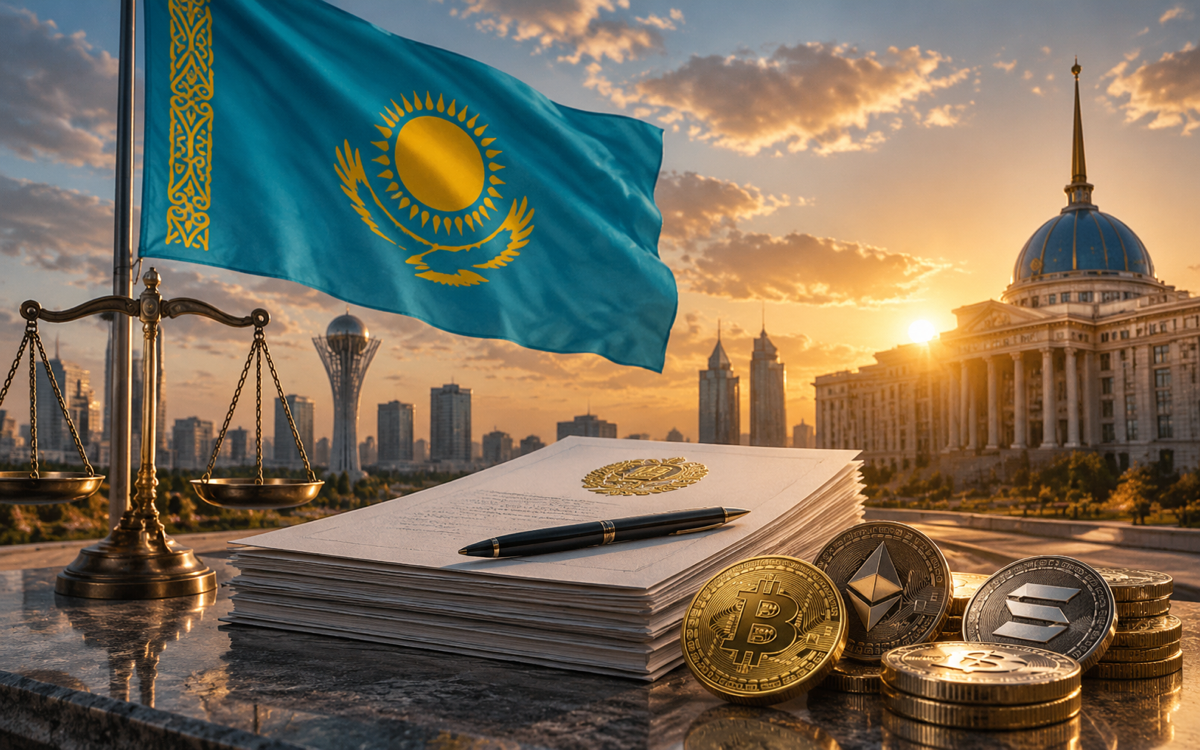
Kazakhstan’s government approved a 65-measure joint action plan across 10 policy areas on September 15, 2026, introducing coordinated steps across regulation, infrastructure, cryptocurrency mining, taxation, and blockchain adoption.
According to Kazakhstan’s Prime Minister’s Office, the roadmap follows discussions between government agencies and industry participants. Prime Minister Olzhas Bektenov said agencies should ensure timely implementation, emphasizing personal responsibility for each head to achieve specific results.
The government has not publicly released a complete breakdown of all 65 measures, though officials have detailed several specific initiatives already underway.
From Mining Hub to a Broader Digital-Asset Economy
Kazakhstan became one of the world’s most visible cryptocurrency mining destinations after China’s 2021 crackdown pushed operators to relocate, a shift explained in more detail in a guide to what Bitcoin mining involves. The country later introduced licensing and energy rules under its 2023 Law on Digital Assets.
| Kazakhstan Digital Asset Development | Details |
| Previous focus | Cryptocurrency mining expansion |
| Mining growth period | Became a major Bitcoin mining destination after 2021 |
| Current direction | Broader digital-asset infrastructure and regulation |
| New roadmap | 65 government measures across 10 areas |
Table 1. Kazakhstan’s transition from crypto mining hub to broader digital-asset ecosystem.
The Ministry of Artificial Intelligence and Digital Development, with the Energy Ministry, developed a mechanism using associated petroleum gas for mining, with autonomous power plants at oil fields generating the electricity, according to Vice Minister Gizzat Baitursynov.
What the 65 Measures Include
The plan is expected to help bring capital into Kazakhstan’s transparent financial system, expand digital assets for payments and financing, and strengthen investor protections.
| Focus Area | Planned Direction |
| Regulation | Development of clearer digital-asset rules |
| Infrastructure | Support for digital-asset market systems |
| Mining | Oversight and development of crypto-mining activities |
| Taxation | Improvement of digital-asset tax approaches |
| Innovation | Expansion of blockchain-related financial technology |
Table 2. Main areas covered by Kazakhstan’s digital-asset development plan.
Bektenov also instructed authorities to expand real-world asset tokenization. According to The Astana Times, National Bank Governor Timur Suleimenov said Kazakhstan plans to tokenize up to $60 million in real estate and logistics projects by year-end, including $50 million for the Iconic Tower complex and $10 million for the Birlik logistics center, issued through the Kazakhstan Stock Exchange’s digital infrastructure.
A National Crypto Reserve Already Underway
Kazakhstan’s national strategic crypto reserve, established last year, has reached $700 million, with roughly $200 million already invested, according to Xinhua, citing National Bank Deputy Governor Binur Zhalenov. It draws partly from digital assets seized by authorities or repatriated from abroad, alongside profits from state-managed mining.
The roadmap also calls for expanding the digital tenge, stepping up cybersecurity, and exploring digital instruments for international settlements, with officials emphasizing homegrown products and specialist training over imported infrastructure.
Kazakhstan Expands Focus Toward Regulated Digital Assets
The plan reflects a broader global trend of countries building structured digital-asset frameworks rather than treating crypto as purely speculative. Kazakhstan has also developed the Astana International Financial Centre as a regulatory hub, including a crypto-card pilot letting consumers make non-cash payments using funds held in AIFC-licensed exchange wallets.
However, the impact of the 65-measure roadmap will depend on how individual initiatives are implemented, which agencies oversee them, and whether businesses adopt the resulting infrastructure.
What Comes Next for Implementation
The next stage involves government agencies and industry participants implementing the measures outlined in the roadmap. The government has not disclosed a complete timeline for all 65 initiatives, though the tokenization pilot and mining mechanism are already moving forward.
Future updates will clarify how Kazakhstan plans to regulate digital-asset businesses, support blockchain infrastructure, and balance industry growth with oversight requirements.
What this means for you: Kazakhstan’s 65-measure digital-asset roadmap shows how countries are moving beyond individual crypto rules toward broader industry frameworks. The impact will depend on whether the measures create clearer conditions for digital-asset companies, blockchain developers, and investors while maintaining regulatory oversight.
This article is for informational purposes only and does not constitute financial advice. Digital-asset regulations vary by jurisdiction and may change as governments introduce new policies. Cryptocurrency markets involve regulatory, technical, and market risks.